Arabesque | An Art of Connections, A Poetics of the Swerve
L. Martina Young
Author’s Note: “Arabesque | an art of connections, a poetics of the swerve,” is just the tip of the iceberg: The Arabesque Project, with its themes of ‘unity’ and the ‘interdependency of life’ is going global as a “world-making” event. Garnering attention at the national and international community level, the work is poised for collaborative live reading by community residents— women, men, teens, elders, artists, dancers, actors, and civic leaders— including music artists who will riff off the original compositions by Reno Philharmonic bassist, Julie Machado. For more information please visit https://www.apoeticbody.com
Abstract
Exploring the concept of the ‘arabesque’ through its origins in Persian aesthetics, somatic ways of knowing, Merleau-Ponty’s phenomenology, and David Bohm’s physics, this essay offers a timely response to poet and Humanities scholar Joan Retallack’s provocation, “How can one frame a poetics of the swerve, a constructive preoccupation with what are unpredictable forms of change?” Weaving together these diverse fields with elements of poetry and memoir, the essay delves into the wisdom and beauty of ‘unity.’ This exploration frames a ‘poetics of the swerve,’ addressing the unpredictable nature of change and its relevance to our contemporary socio-cultural landscape, positing ‘unity’ as a critical ethos for the 21st century.
Keywords: Cross-cultural Unity; Neurobiological Interdependency; Persian Ethics and Aesthetics; Dance; Spirituality
This work is supported, in part, by the Nevada Arts Council, a state agency, which receives support from the National Endowment for the Arts, a federal agency, and the state of Nevada.
***
The ground’s generosity takes in our compost and grows beauty. Try to be more like the ground.Jalāl al-Dīn Rūmī (2003)
It is arbitrary to separate the intellectual aspects of movement [from] its emotional [and] aesthetic aspects. [All] of them have to be seen as a single whole.David Bohm (2004)
My most charming friends,
And am watching the palm tree
As, like a dancer, she curves
And swerves and sways above her hips—
One does too, if one watches long.
Like a dancer who, as it would seem to me,
Has stood too long, dangerously long
Always, always only on one little leg.
She has forgotten, it would seem to me,
The other leg. …
It is gone!
Forever gone!
The other leg! …
Where may it be staying and mourning, forsaken?
The lonely leg?
Thus Spoke Zarathustra, Friedrich Wilhelm Nietzsche (1972)
What is the subject of our thought? Experience! Nothing else! And if we lose the ground of experience then we get into all kinds of theories.Hannah Arendt (2018)
Step forward. Feel your foot planted firmly on the ground. Feel how it conspires with the Earth to support your weight. In this moment you are in an in-between place, your back foot stable by a single toe, like a kiss pausing on Earth’s surface until alas, it leaves for higher ground. Your back leg rises, arcing upward as in a salutation; it levitates toward the warmth of another source. On a vertical curve through horizontal space, the airborne leg lilts the air like a caress, a wing’d reverie. The more you succumb to the giving ground beneath you—your inner arch curved like the dome atop the Taj Mahal through which the line of gravity surges both downward and upward—the more you find yourself in the lift and the loft of the arabesque. Air entreats your arms to follow the arc of the leg. Bird-like and alert to the moment, the arc of ascent, you are poised at the center, the still point, where above and below meet. And as if Zephyr’s gentle kiss desires to linger a little longer, you swoon your loveliest in the loft of the arabesque. It is an ancient skill. Eternal and temporal. A sublime beauty. A divine harmony.
For whereas speaking distracts, silence and work collect the thoughts and strengthen the spirit.St. John of the Cross (The Apocrypha, 2001)
In the Beginning
I had no words. In the beginning the world’s cacophonies assaulted my ears, eyes, skin. Sounds and images ablaze’d. The world out there crashed into an interior world trying to make sense of the wide open loudness, talking, always talking. Wording images, under and over, this way and that way. Shapes did not connect. Voracious masses consuming and consumed. There was no quiet. All was a display of greening life speechifying for every occasion and circumstance. The too-muchness seemed not to miss what could not compete. Diagonals, curves, angles, and rounds thrashed about, piercing a thin veil of atmosphere, a veil that barely separated all the goings-on, . . . of what? I could not name.
The world seemed untouchable. I made of myself a roundabout amidst the whips and wails of the world’s excesses. While few words came, something stirred me. A knowing. A felt knowing. An unseen felt knowing. Like contents inside an envelop, invisible things that can only be felt. In time, few words were necessary. Only the contents I felt for the world mattered. Contents within that resonated with the lifeforms out there. Then confluences as I began to reach from here to there without words. Like Captain Kangaroo’s Dancing Bear: no words; just danced. And Buddha’s Flower Sermon for which he held a single flower. By age six I knew the alphabet of American Sign Language I’d learned from the diagrams in the Book of Knowledge. We learn languages long before we can speak. Especially as children.
This body knew felt language. A language perceived through the porousness of the organs, through the nostrils, and by tips of the tongue. From the spaces between objects and from the gaping silences of our mineralized planet, absences that spoke of lack and encroaching miasmas. I heard the Earth moan.“The Earth is crying! The Earth is crying!” I wailed to my parents in morning’s half-light. These were the only sounds that made sense.
I read the world’s body like books,—our bodies, yours and mine. Stories heard by heart. Poetries etched into faces. The downward turn of the mouth. Smiles tethered to cheekbones competing with shadows draped over shoulders. Rhythms in the gait. Hands gripped too tightly or cupped softly in communion with the undertow of the soul. Heads tilted this way or that way. Furtive looks. And eyes that lit up when a loved one was near, or sparkled determinedly against strains of blue with the promise of an unweighted sun.
It has to do with weight. How weight is held. How we each hold the weight of the world. Like Atlas, the god who holds the whole of the universe at the nape of his neck with all the celestial bodies clenched between his shoulder blades. Feet planted firmly on Earth’s body and knees duly bent, taut tensile thigh muscles betray the massive task. Atlas’s curse. Our blessing. An invisible force that holds us all. This is a familiar language. Words are not necessary. There are no words. It is the failure of words; they collapse from the weight of it all. The Greeks call this condition catachresis. Here, language is forged by gravity and, with a feeling for how the universe must be held on high, levity. And there is never one without the other.
Everything has a form, everything has culture and history.Karim Keshavarz, Storyteller | Writer (2025)
Origins: From the Ground Up
Arabesque. The word alludes to Arabic cultures. Its aesthetic origins, however, begin with Persian culture. Expressed in calligraphy, architecture, art, and dance, the arabesque is born of an imagination that traversed the southern margins of the European Steppe and reflects the migratory patterns of a nomadic people inhabiting terrain around the Amu Darya River. Intricate curves, swerves, diagonals, and rounds speak of a steadfast relationship to the myriad worlds of animal, plant, flower, and tree; to the world of sky, and the invisible force that unites them all. The arabesque is an embodiment of life’s interconnected tapestry,—its order and the inherent unity found therein. Iranian scholar, Laleh Bakhtiar, explains that the arabesque aesthetic “deals with time and the infinite rhythms created by the encounter of objects in space within defined borders.” With its “full expressive range of geometrical form, it evokes a timeless quality allowing [integration] into every surface adornment” (1976).
Paul Kriwaczek—historian and author of, In Search of Zarathustra: The First Prophet and the Ideas That Changed the World, and head of BBC’s Central Asian Affairs from 1970-1995—writes, “[The] people belonged to an extensive ethnic group of many tribes and clans, trundling their [herds] across the steppe-land in ox-drawn carts, [living] in round felt-covered tents, [and] planting gardens of vegetables and grain. [Becoming] wealthy enough to support a craftsman class,” Kriwaczek continues, “[they] created an original art form: the ‘animal style’ of the steppe with its curls and tendrils, and an [elaboration] of realistic form into decorative distortion.” The style would influence “Celtic, Viking, and medieval design,” asserts Kriwaczek, “[and] resurface at the end of the nineteenth century under the title ‘art nouveau’ ” (2003).
What is instructive in both Kriwaczek and Laleh Bakhtiar’s accounts are the images: nomadic; river; round tents; infinite rhythms; ox-drawn carts; expressive geometrical form; and decorative distortion. To be clear, the term ‘distortion’ in the New Oxford Thesaurus lists, ‘curve,’ ‘bend,’ ‘twist,’ and ‘knot,’ underscoring a perception of how worlds and peoples connect: in rounds and by continuous cycles. Living terrestrial geographies that mirror, that is, are in sympathy with, celestial fields. A sympathaeia. These images bespeak of us all, each trundling about from there to here with all our weight.
Describing the interior surfaces of Granada’s Alhambra Palace, art historian H.W. Janson notes, “The delicately colored [tiles] in a limitless variety of design, including bands of inscriptions, is disciplined by symmetry and rhythmic order” (1969). The arabesque aesthetic.
Within the Iranian cosmology of Zarvanitic tradition, religious scholar Mircea Eliade recounts that “every terrestrial phenomenon, abstract or concrete, corresponds to a celestial, transcendent invisible term, to an ‘idea’ in the Platonic sense.” As above, so below. Eliade further adds, “[Our] earth corresponds to a celestial earth. Each virtue practiced here [has] a celestial counterpart which represents true reality. [The] year, prayer, [all] creation [is] duplicated”(1971).
To recognize these correspondences is to perceive life in terms of circularity, wherein true reality is manifest as the unity in and between all things. An experience of timelessness is an apprehension of life’s cyclical and corresponding repetition.
Alighting on the theory of cycles, Eliade recalls the works of James Joyce and T. S. Eliot and how their writings are “saturated with nostalgia for eternal repetition and [an] abolition of time.” As a “resistance to historical time, [freighted] as it is with human experience,” their interest harbors an imagination that regards ‘time’ as “cosmic, cyclical, and infinite.” Friedrich Nietzsche, too, explores this idea in his innovative work, Thus Spoke Zarathustra.
Translated as Zoroaster, Zarathustra is the Persian spiritual founder of Zoroastrianism and the poet-prophet of the Bahá’i faith. Nietzsche converses with the wandering figure, Zarathustra, who stands to challenge moral idealists while advocating for clear-eyed truth-seeking. At the heart of the work is Nietzsche’s own push-back to linear time. He correlates with the Persian worldview with what Eliade terms the “eternal recurrence.” Nietzsche stands on values that transmute the seemingly meaninglessness of life into meaningful acts that matter.
In this light, the arabesque aesthetic cannot be separated from its philosophical or its spiritual underpinnings. It is a purview meant to incite a re-membering at the most rudimentary level, a primary principle abiding at our deepest core: Unity. A primary unity. Phenomenologist Maurice Merleau-Ponty calls this principle, “an intertwining—the chiasma,” (1968) predicating his thought on the ‘crossing points’ found at the neurobiological level of human life. Thus we are re-minded of our unity with all Being, correspondences that are felt in our sentient, sensible, and ensoul’d bodies. This deep knowing tells us we are not disparate entities, but rather, expressive variants of the ontogenesis of Being. “E pluribus unum,” affirms the Wizard. Unity in variety. And “variety,” remarks Comparative Religion scholar Karen Armstrong, “benefits the whole world” (2004).
The arabesque aesthetic stirs this knowing, and by contemplating the idea and its image—itself an ordinary exercise in unity—this knowing comes to light. At once, the source and wisdom of our interconnections with all life is recalled and we are moved to alter and altar actions accordingly. The Sufis—the mystic Islamic sect—engage in this contemplative practice, embracing unity as a living fact. This knowing wisdom has been perceived across time, cultures, and generations, amidst diverse wanderings, wayward trajectories and, with all the freight of human experience.
If on Earth there be a paradise of bliss It is this It is this It is this.Amīr Khusrau, 13th C. Persian Poet (2013)
A Whirling Ecstatic
The Persian dance form practiced by the Sufis is known as an “ecstatic.” A ‘whirling’ action performed as meditative practice, ‘whirling’ is one of the three modes of experiencing union with the Divine Presence. The other two are dhikr, remembrance of God through rhythmic repetition of the name of God (cf. Hasidic davening); and sema, spiritual listening through poetry, prayer, and meditation. While the word ‘Sufi’ is thought to come from the Arabic word, sūfī, meaning ‘wool’— denoting the Sufis’ woolen dress—tenth-century scholar Birūnī asserts that the word is closer to the Greek transcription of sophos, meaning ‘wise’ and ‘cultivated.’ Sufi thus corresponds to what Iranologist Henry Corbin suggests is the ancient notion of the sage, specifically, the ‘sage-prophet’ (1997). Whirling is wise practice.
Research shows that whirling induces changes in brain activity, heightening perception and self awareness. No wonder children become enchanted while twirling. According to Bakhtiar, whirling “references the circling of the spirit around the cycle of existing things.” The body is the still point amidst the flux. “[To] leap up,” Bakhtiar adds, “is to be drawn from the human station to the station of union.” Whirling is thus a response to a calling, to “a stirring within.”
For psychologist Havelock Ellis, dancing is “a magical operation for attainment of real and important ends of every kind. “[To] dance,” Ellis asserts, “is both to worship and to pray” (1923) Arcing back in time one finds, “The Hymn of Jesus,” in Acts of John. Enacted prior to Jesus’s crucifixion, Religious Studies scholar Marvin Meyer cites it as, “The Round Dance of the Cross” (1984):
Jesus told us to form a circle and hold each other’s hands, and he himself stood in the middle, and said “Respond to me with ‘Amen.’ [Grace] dances.“I will play the flute. Dance, everyone.” / “Amen.” / “I will mourn. Lament, everyone. / “Amen.” / “A realm of eight sings with us.” /“Amen.”/ “The twelfth number dances on high.”/ Amen.” / “The whole universe takes part in dancing.” / “Amen.“Whoever does not dance does not know what happens.” / “Amen.”
“Whoever does not dance does not know what happens,”—to be joined at a higher station. From the Sufis to the Apostles, the Round Dance to the arabesque, life oscillates through all: human and sky, flower and sea, thought and action, body and soul. The cyclical eternal dance forms a unified whole. The creativity of the arabesque is always at play. Breakage from this unity ushers dis-ease which impales us all, from within and from without, leading physicist David Bohm to warn: “[When] thought and language focus [on] one thing [and] are regarded as independent from the broader context of the whole, [then] one is engaged in breaking the field of awareness [whose] deep unity can no longer be perceived” (2004).
Rooted in the arabesque aesthetic, the Sufis ecstatic whirl attends to the connective tissue by which unity is sustained: one’s stable being in relationship to an ‘other.’ Gestured in calligraphy and dance, art and architecture, all creativity “within the Islamic tradition,” reminds Iranian scholar Seyyed Nasr, “is related to man’s relationship with God. [The] human heart is the throne of Divine Compassion. [From] this center the creative élan issues forth, the creative vitality. [The] work of art is not a center. [It] is man who, being centered, [disseminates] Qualities of the Divine in the world about him” (Bakhtiar, 1976). When we body forth a single gesture of beauty, a divine quality is bestowed upon the world.
Widening and deepening, grounded and elevated, the generative beauty of the arabesque connects us not only to ourselves but also to one another, no matter our individual station or seeming separate standing.
Make every act a meaningful act. [An] arabesque is a metaphor for an action. [With] its sheer elegance and physicality, [it] can be a metaphor for flight, for offering oneself to another, to baring one’s vulnerability …Daniel Nagrin, American Dance Artist (1997)
The Classical Form
French choreographer, Pierre Beauchamp, established the ‘arabesque’ ballet position in the 17th century. Popularized by the Italian ballerina Marie Taglioni who inspired point work—toe dancing—the classical arabesque was used as a device during the Romantic Period for expressing themes of despair, ideal love, nature intermingled with a visionary imagination, and the human spirit in search of freedom and otherworldly beauty. By the 19th century, it was one of the most iconic of dance moves in the ballet vocabulary, gaining prominence through the work of choreographer Marius Petipa. Standing on one leg with the other leg elevated—generally at a 90-degree angle—the dancers’ arms take their various positions from within the classical canon.
Gail Grant, author of, Technical Manual and Dictionary of Classical Ballet, points to the arabesque’s cultural genesis as “a form of Moorish ornament.” The term ‘Moorish’—referencing “Moors”—was a term used by the early Romans denoting persons from Mauretania, an ancient region of North Africa, now the northern part of Morocco and central Algeria. Referring specifically to Muslims, the term generally referred to persons of dark skin.
In Lincoln Kirsten’s, The Classical Ballet | Basic Technique and Terminology, elaborate illustrations on the arabesque are given in two of the most renown technical dance approaches: the Cecchetti Method, developed by 19th century Italian mime and dancer, Enrico Cecchetti; and the Vaganova Method, developed by 19th century Russian ballet dancer, Agrippina Vaganova. Each set of illustrations demonstrate the arm positions, port du bras (movement of the arms): First. Second. Third. Fourth, and Fifth. One diagram indicates the arabesque theory with a line spiraling out from the center of the torso and curving upward through the elevated back leg. From heart to foot, the line forms the shape of a crescent moon, like a smile cradled in space.
What the diagram does not show, however, is the invisible line of gravity: the vertical force from above the head down through the supporting leg and into the earth. Architecturally known as the ‘plumb-line,’ this force must be felt or otherwise imagined. We are bound by this force not only to the earth, but also to the heavens, our bodies like make-weights forming the balance. Like the fiddlehead fern: stem earthbound, its feathery neck unfurls into arabesque splendor. And the nautilus shell, a symbol of renewal, its stature found in spirals and swirls.
The arabesque’s adornments abound all around. To witness it bids a contemplative walk through the world, greeting its contents with attention to the intertwining chiasma by which correspondences are perceived and an alchemy of consciousness occurs. It is aesthetic practice; poetic being. Relational. As poet Paul Valéry writes, “[To] recognize nothing [with] the eye but find a new object [as though] created by the EYE, for infinite contemplation of its own laws. [Whence] enthusiastic praise of the Arab imagination that invents the Arabesque. [Here] there is never any confusion [but] instead a possible communion with the profound springs of all life” (Hytier, 1966).
Everything round invites a caress.Gaston Bachelard (1994)
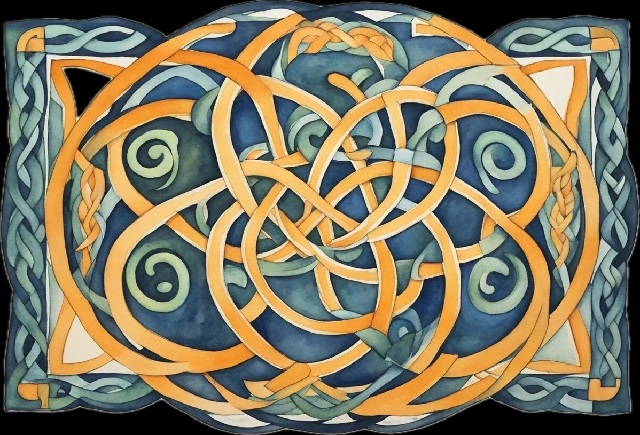
Illustration provided by L. Martina Young, credit unknown. All Rights Reserved, 2025
The Art of Dialogue
Exemplifying the arabesque aesthetic in art—one from the Persian imagination, the other Celtic, known as the Celtic Knot—each image represents an archetype of connection, a lens and a thematic by which dialogic conversations are interwoven. Each embodies what is sacred beyond measure: the unity of all life.
Contemplating its content, one enters a portal by which the eye is entreated to embark on a journey along moving involutions into-and-out-from a center. Beginnings and endings are undecipherable. And like conversations at their best, one is seamlessly transported into a rarified reverie while the unity of a central idea holds sway. The mind, body, and soul are refigured.
As a conversation, the arabesque propels wonderment and a sense of expansion. It is a rapturous dialogue, a sacred kiss, where ‘kiss’ means narrative, stories that are bound together. Locating something of ourselves in the image—an image within images—a coherence occurs, an exquisite logos. We feel it. And by feeling it, we know it. A bloom of peace salves the soul. Bohm calls this, “the implicit order.” Enthused, our bodies quiver, the workings of interconnected worlds revealed. It is tacit knowledge. Words are not necessary.
Conversely, we know coherence by its opposite: incoherence. We know the havoc incoherence wreaks. Erratic. Unstable. Inconsistent. Unintelligible. Senseless. Disruptive. Chaotic. Disordered. Turbulent. Confused. Center cannot hold. One way to address incoherence is with tacit knowledge of that which coheres: a grounded step; one stable gesture. Each day. Every day. For oneself and for another. Both follow-through and initiative, the one coherent step shifts the aperture like a kaleidoscope, guided by an interior compass and with a steady hand. Bohm calls this gesture, artemovement (1998), “a movement of universal fitting,” fitting meaning, harmony, a responsive move that acts in relationship to a knowing of the interdependence of things and an attention to the ‘world behind the world.’ Artemovement reconnects the felt aspects of aesthetic perception to the mental apparatus of conceptualization.Arabesque: an inner dialogue; a quiet and sacred kiss.
As every human being is always in a state of becoming, so too the whole of the universe and all its inhabitants. The individual and the collective are at once interrelated experiences to behold, each a possibility with hidden contents of numinous expansion beyond measure.
* * * * * * *
As it was, /As it is, /As it shall be / Evermore, / O Thou Triune Of Grace!
With the flow, / O Thou Triune / Of Grace!
With the ebb, / With the flow.
Scottish Invocation (Celtic Wisdom, 2008)
Swerves and Curves
The 1966 film thriller, Arabesque, directed by American choreographer and director Stanley Donen, tantalizes the eye with its opening credits styled in the psychedelic graphics of the time. Audiences would become familiar with this style through the early James Bond films as well as the television show, Rowan & Martin’s Laugh-In, in which Goldie Hawn dons miniskirts fashioned in colorful swirls of flowers, stripes, and triangles. While the film has little to do with the arabesque aesthetic per se—its opaque ins-and-outs of espionage and subterfuge driven by deviousness and chaos—there is one telling scene that unwittingly echoes the ‘animal-style’ of the steppe-land. Protagonists Gregory Peck and Sophia Loren flee from the palatial home where the film’s antagonists have taken up residence and make their way to the Zoological Gardens. With deft camera work—a montage of high, low, and off-center’d angles—a menagerie is amplified therein: monkeys, llamas, alligators, and snakes. Lions, tigers, orangutans, and giraffes. Blue-green water tanks teem with an underworld of sea creatures: crab, eel, octopus, and piranha. Hinting at the arabesque’s original craft, the movie has more to do with schemes of deceit than with the unitive forces of beauty. The film’s working title, “Crisscross,” was later changed to “Cipher,” the title of novelist Alex Gordon’s book, before settling on Arabesqueon, Arabesque.
* * *
American dance artist, Daniel Nagrin, offers an illuminating thought on the arabesque in his book, Six Questions. Insisting that artists “do something,” that is, “fill all motion with action—an action from within,” Nagrin’s aesthetic is clear: make every act a meaningful act. “[By] action,” he asserts, “I mean [recognizing] that an arabesque is a metaphor for an action. [The] sheer elegance and physicality of an arabesque is one of the many ways of seeing and experiencing [the arabesque]. It can be a metaphor for flight, for offering oneself to another, to baring one’s vulnerability to others, or it can be an exquisite and awesome configuration”(1997). Nagrin’s dedication, his réverénce to Helen Tamiris—20th century artist with whom he danced and to whom he was married—is also significant: “She gave me [the] liberating insight that the art of dance and the art of acting were rivers waiting to be joined as one.” Rivers to be joined. A meaningful act and an idea to which we must hold in uncertain times. What joins us, an ‘us’—a you and a me.
I had a delightful conversation with an Uber driver, Mahmud. Flowing from the car speakers were the rhythmic melodies of Persian music. I remarked on its beauty. “You like it?” Mahmud asked. “Oh yes!” I responded, mentioning that I was a dancer, to which he cast a wide smile in the rear-view mirror. In time we found ourselves talking about art, culture, and the intermingling of both. I shared that I was writing on the arabesque dance form, understanding that the arabesque aesthetic originates with the Persian culture. Mahmud’s eyes brightened. Arriving at our destination, Mahmud turned to me and said, “The three Persian virtues are: Good Thought; Good Word; Good Deed.”
I thanked him. We both smiled and wished each other a peaceful day.
The Other Leg
The other leg! Where may it be staying and mourning, forsaken? The lonely leg?Thus Spoke Zarathustra, Nietzsche (1972)
A practice the Greek philosophers advocated for is known as askêsis. It’s a term referencing the rigorous self-discipline of athletic training as well as spiritual development. And there is never one without the other. Demanding perseverance and endurance, askêsis enlists resistance to the elements, to emotional upheaval, and in some cases, periodic abstinence from food and water in order to achieve a steady state of mind. For Nietzsche, it is a “gymnastics of the will” (Merton, 1999), one that employs restraint and a depth of perception for what’s at stake.
From the Greek, askêin, meaning, ‘to prepare by labor,’ ‘to adorn,’ and ‘to become adept by exercise,’ in ancient traditions askêsis was applied to all dimensions of life: physical culture; moral aptitude; and the religious imagination. In other words, life lived at its most coherent: grounded and in proprioception to intrinsic harmony. No different than living an aesthetic life, askêsis implaces radical spaciousness in thought and action and does away with needless distractions. Conscious No’s imply emphatic Yes’s, being centered on connection to a sense of expanded and relational reality. It’s “living the life best suited to you,” affirms Nietzsche (Merton), and by extension, for and with the world.
Most notably, askêsis entails a state of being for which author James Baldwin argues: “being alone,” (1985) a state of being by which all relations become clarified. Michel de Montaigne likewise writes, “The greatest thing in the world is to know how to belong to oneself” (1947).
While related to the ascetic—its emphasis on denying oneself—askêsis, on the other hand, emphasizes training oneself, as with a life practice, an art. Askêtes are known as the devoted athlete, the artist, the monk,—each waking with morning-song and a listening heart.
As the artist steps into the arabesque, attention is on the standing leg: the other leg. Trained to endure weight and the tension between opposites, center holds. The standing leg is the performative still point as all else gives way to flux. As the architect of the imaginative thrust, the imagination takes its flight toward the cosmos.
Remembering this, one’s worldly participation becomes clarified as the wholeness and unity of the arabesque comes to be. “Just as in the dialectic of love,” states Proclus, “we start from the sensuous beauties [until] we encounter the unique principle of all beauty and all ideas, so the adepts [take] as their starting point the things of appearance and the sympathies they manifest among themselves and [the] invisible powers. [All] things form a whole” (Huxley, 1945).
Jesuit philosopher, Teilhard de Chardin, concurs: “Mankind, the spirit of the earth, the synthesis of individuals and people, the paradoxical conciliation of the element with the whole, and of unity with multitude—all these [are] thought Utopian, yet are biologically necessary. [For] them to be incarnated in the world [is] to imagine our power of loving developing until it embraces the total of [humankind] and [the] earth.”
Poet and potter M.C. Richards voices a resounding thought on wholeness: “To do the work of the earth and to build community are new priorities. [One] is a supportive daily and seasonal rhythm, connected with the stars and planets in a cosmic cycle. The other [a] glowworm lighting up the dark. Accepting [our] suffering, we may relate to others. [By] grace we may become free. [Best] of all, we may find our humor [expanded] in the warmth of our heart center, the deepest crossing point” (1989). Merleau-Ponty’s intertwining chiasma. Earthly and cosmic. Gravitas e levitas. Temporal and eternal. A whole universe in a grain of sand.
A Pause, a Breath
Tread softly
on the surface of the earth
for you tread on the pretty faces of the fairy-born.
Amīr Khusrau (2013)
In the Introduction to The Poethical Wager, poet and Humanities scholar Joan Retallack writes, “Life is subject to swerves—sometimes gentle, often violent out-of-the-blue motions that cut obliquely across material and conceptual logics. [As] it is, they afford opportunities to usefully rethink habits of thought” (2003). Reflecting on a post-September 11th culture, Retallack adds, “What [times] like these have in common is an unsettling transfiguration of once-familiar terrain [producing] disorientation, even estrangement, by radically altering geometries of attention. [In] today’s world politics a geometry of straight lines [is] obsolete. [The] fractal geometry of coastlines, with their ecologically dynamic [and] infinite detail may be a more productive model for the interrelationships of cultures.”
Published in 2003, Retallack’s thoughts remain timely. Retallack questions, “How can one frame a poetics of the swerve, a constructive preoccupation with unpredictable forms of change?” For my part, the arabesque aesthetic is a poetics of the swerve. It offers a reminder of how we inhabit our lives in the current and wayward world order, affording us a rethink of individual and collective acts in order to renew meaningful ways of being,—with oneself and with one another. Facing you with the leg I stand on, we have the opportunity to reimagine the center together—each of us a make-weight that forms the balance—. Too many of us are being thrashed and consumed, flailing about in this upside-down orb and whipped by its ouroboros tail. This eternal return beckons recall of our faces before we were born and remembrance of the generative unity of our collective souls at the deepest levels of our being.
At this hour, my concern is for the youngest among us. The world’s breakage may be all they’ll know, this blitz, this miasmic heart of darkness. This now is their beginning. To others I ask “How do we cultivate the other leg by which which their centers hold? How do we embrace this life pilgrimage such that the young ones regard how they inhabit their lives?” —to direct their eye toward an inner compass that points north, true north. To my mind, the spatial, rhythmic, and meandering flow of the arabesque, intwining worlds within worlds, proffers this relational compass. Day in. Day out.
As I look on the us’s in stride—every face a possibility, each body a language—the choice is clear: pause before alterity, for every one of us is an ‘other’ to someone and to some thing; marvel at a child enchanted by an interior world; follow the path of the pollinating oak and the scent of the withering rose. And know that every air-born, land-darting, water-frolicking creature exhibits a way of being in a realm of unpredictability, vast imaginations venturing beyond the surface.
My wager is this: live each day with attention to the lifetime given us, with courage, commitment, and courtesy. Walk with a ‘Yes’ in every step. Feel true north from the ground up. As things fall apart, be accountable for practices of presence with hope that clarity may dapple through. Be devoted to meaningful work that fosters constructive creativity and a curious intellect. Resist mass culture’s flatlining attention strategies through network ecologies. And be a caregiving agent of restoration. What does this mean?
It means living with a concept of the human. Live a poethical life—relational, reciprocal, and responsive—attentive to tangible and intangible beauties that appear mostly in slow motion, like the slow-dancing Kiwa Puravida crab.Gaze at stars and wonder how those lights light our own on this celestial ground. Know that, this is an imagination of how our centers will hold, yours and mine.
References
Arendt, Hannah. Thinking Without a Bannister | Essays in Understanding. Ed. Jerome Kohn. New York: Schocken Books, 2018.
Armstrong, Karen. Islam | A Short History. London: Phoenix Press, 2004.
Arrien, Angeles. The Nine Muses: A Mythological Path to Creativity. New York: Tarcher, 2000.
The Apocrypha. The New Oxford Annotated Bible. New Revised Standard Version. 3rd ed. Oxford: Oxford UP, 2001.
Bachelard, Gaston. The Poetics of Space. Trans. Maria Jolas. Boston: Beacon Press, 1994.
Bakhtiar, Laleh. Sufi: Expressions of the Mystic Quest. New York: Thames & Hudson, 1976.
Baldwin, James. “The Creative Process.” The Price of the Ticket: Collected Nonfiction 1948-1985. New York: St. Martin’s / Marek, 1985.
Bohm, David. On Creativity. Ed. Lee Nichols. New York: Routledge, 2004.
On Dialogue. Ed. Lee Nichols. New York: Routledge, 1998.
Celtic Wisdom | The Poetry and Prose of a Mystic Tradition. Ed. Gerald Benedict. London: Watkins Publishing, 2008.
Corbin, Henry. Alone with the Alone: Creative Imagination in the Sufism of Ibn ‘Arabī. Bollingen Series XCI. New Jersey: Princeton U P, 1997.
de Chardin, Teilhard. The Phenomenon of Man. NewYork: Harper & Row, 1959.
Eliade, Mircea. The Myth of the Eternal Return. Trans. Willard R. Trask. Bollingen Series XLVI. Princeton: Princeton U P, 1971.
Ellis, Havelock. The Dance of Life. New York: Houghton Mifflin Company, 1923.
Essential Sufism. Ed. James Fadiman & Robert Frager. New York: HarperCollins, 1997.
Grant, Gail. Technical Manual and Dictionary of Classical Ballet. New York: Dover Publications, 1967.
Hahn, Thich Nhat. Old Path White Clouds. Trans. Mobi Ho. Berkeley: Parallax Press, 1991.
Huxley, Aldous. The Perennial Philosophy. New York: Harper & Brothers Publishers, 1945.
Hytier, Jean. The Poetics of Paul Valéry. Trans. Richard Howard. Doubleday & Company, 1966.
Janson, H. W. History of Art | A Survey of the Major Visual Arts from the Dawn of History to the Present Day. Ed. Milton S. Fox. New York: Harry N.Abrams, Inc., 1969.
Kashavarz, Karim. https://artebox.org/arte-pedia/keshavarz-01/ . Accessed 1 March 2025.
Kirsten, Lincoln. The Classical Ballet | Basic Technique and Terminology. New York: Knopf, 1979.
Kriwaczek, Paul. In Search of Zarathustra: The First Prophet and the Ideas That Changed the World. New York: Knopf, 2003.
Khusrau, Amīr. In the Bazaar of Love | The Selected Poetry of Amīr Khusrau. Trans. Paul E. Losensky and Sunil Sharma. India: Penguin Books, 2013.
Merleau-Ponty, Maurice. The Visible and the Invisible. Ed. Claude Lefort. Trans. Alphonso Lingus. Evanston: Northwestern U P, 1968.
Meyer, Marvin. The Secret Teachings of Jesus: Four Gnostic Gospels. New York: Random, 1984.
Montaigne, Michel de. Essays of Michel de Montaigne. Trans. Charles Cotton. New York: Doubleday & Company, 1947.
Nagrin, Daniel. The Six Questions | Acting Technique for Dance Performance. Pittsburg: Pittsburgh U P, 1997.
Nietzsche, Friedrich. Thus Spoke Zarathustra. Trans. Walter Kaufmann. Princeton: Princeton U P, 1972.
Retallack, Joan. The Poethical Wager. Berkeley: University of California Press, 2003.
Richards, M.C. Centering | In Pottery, Poetry, and the Person. Middletown: Wesleyan U P, 1989.
Rumi, The Book of Love | poems of ecstasy and longing. Trans. Coleman Barks. San Francisco: HarperCollinsPublishers, 2003.
The Inner Journey | Views from the Islamic Tradition. Ed. William C. Chittick. Parabola Anthology Series. Ed. Ravi Ravindra. Sandpoint: Morning Light Press, 2007.
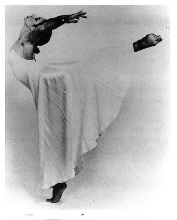
Born in Los Angeles into a multicultural family, Martina languages a depth of perception rooted in a poetic, phenomenological, and humanist worldview, while translating insights informed by a lifelong discipline as a dance artist. Tending a daily writing ritual from 6 AM to 9 AM following her 5 AM contemplative movement practice—all punctuated by morning-song—these activities bring her immeasurable joy.

Like what we do? Buy us a Cup of Coffee!


