Artist’s Profile
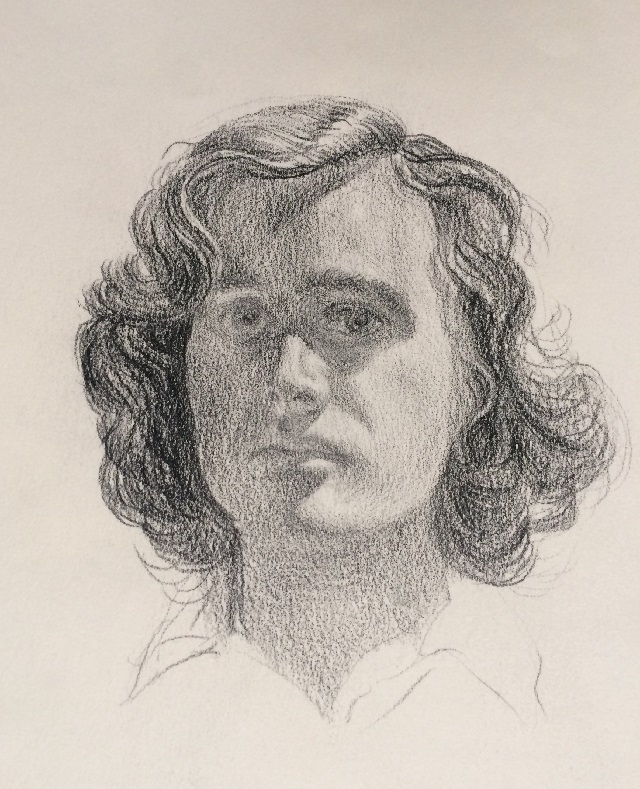
Kevin Kihn, “Portrait”
Math and Magic: The Art of Kevin Kihn
by Jack Ruttan Artist in Residence, 2025/26
Jack Ruttan: Kevin, how big are your works? What media are they created in?
Kevin Kihn: My early paintings are oils, and I created them fairly large, from twenty-eight to sixty inches wide and up to forty-five inches high. My more recent work in watercolors is smaller, each piece being typically about twelve by sixteen inches, sometimes larger. My drawings and graphic works are also in that range or smaller.
I’ve also made brush drawings using handmade ink and watercolors on handmade paper. One of my ongoing projects is to further develop the skill of creating such media and explore them in greater depth.
Jack Ruttan: What subject matter has inspired you?
Kevin Kihn: I love mythology and fantasy. Hellenic mythology in particular supports or is compatible with the Hermetic world view, which conceives of the universe as one great living being. While fantasy offers the possibility of creating a world that fulfills the heart’s desire, or a world that will embody and instantiate whatever we wish to express about our inner life.
I am also fascinated by the geometry of Platonic solids such as the dodecahedron. I love to take the rigorous forms of geometry and subject them to processes of deformation, generating shapes that question the distinction between living and inanimate matter.
Jack Ruttan: Who is your intended audience?
Kevin Kihn: I would like my work stumbled on serendipitously by those who enjoy what I love creating. I fancy they are likely to be people who are long on imagination and who enjoy unusual and challenging perspectives.
Jack Ruttan: What emotions and feelings do you wish to instill in your audience?
Kevin Kihn: I wish to invite people to enter and explore the world which it is my task to create. It seems to me essential to convey a sense of wonder, and the sense of beauty as a value is paramount. I would like to enable people, including myself, to experience the perception that the spaces inside our heads are as vast as the universe outside them.
Jack Ruttan’s note: Geodesics are figures made from straight lines, and simple linear shapes, combining to make a round shape.
Kevin Kihn: Geodesics are generally spherical figures based upon one of the five regular solids of Platonic geometry, usually the icosahedron. This figure’s triangular faces are subdivided into smaller constituent triangles, making larger structures feasible for components of any given size. Geodesics are very strong for their weight. This concept was first elucidated by the inventor Buckminster Fuller in the mid-twentieth century.
I’ve developed a simpler version of Bucky’s “fly’s eye” dome, a geodesic variant whose many circular faces suggest the facets of a fly’s eye. My design has twelve faces rather than Bucky’s thirty-two (or more). Its purpose is to support a cosmographic image employing the immersive perspective that is one of my creative obsessions.
Jack Ruttan: Winged beings, seen in your art, also figure in Christian mythology. How should Christians and people from other religions look at your art?
Kevin Kihn: One of my paintings shows a winged figure ascending toward a source of empyrean fire. While creating it, I thought of this figure as Eros ascending toward the Ineffable One, an emanationist concept similar to the Tao. But the artist’s conscious thought about a work while creating it isn’t necessarily its only valid interpretation.
It would be just as valid to think of this picture as a representation of a soul aspiring toward the divine, or the Holy Guardian Angel, or a companion of the Peacock Angel worshipped by the Yazidi. Really I would prefer not to tell people how they should interpret my art, for that would flatten it out, oversimplify it. Open to varied interpretation, it retains dimension.
Jack Ruttan: Also, tell us about nudity, and sea, and nature imagery.
Kevin Kihn: Nature and the sea are integral parts of the sphere of life in which we have our being. Without them we would be dust. So though they can sometimes be menacing, I feel that they are on the whole positive. Since it’s my nature as an artist to depict what I wish to see – only when representing a monster will I deliberately portray the negative – landscapes and water tend to show up in my work a lot. I also feel that human beings are fitting denizens of the natural world. I think that a good relationship with nature is crucial for humans to maintain. And I am committed to the artistic tradition that treats the human body as a focus of beauty and an instrument of expression.
Jack Ruttan: The patterns involve a lot of precision and repetition. Are computers or computer imagery used in any way to create your art?
Kevin Kihn: I’ve experimented a good deal with digital media. However I find that I usually prefer to make my pictures using traditional drafting tools, exercising direct manual and mental control, rather than outsourcing the process of creation to a machine. I feel that one’s own understanding and application of the principles involved is essential. That said, given the right project, I would use computer imagery for any task that is too number-crunchingly time-consuming and tedious to be accomplished feasibly by hand, as with certain tasks in filmmaking or digitally printed sculptures.
Jack Ruttan: Do board games such as Dungeons and Dragons and those characters have any influence on your work?
Kevin Kihn: No, rather I have been influenced by some of the same sources that have evidently inspired these games.
Jack Ruttan: Anything that I missed that you would like to mention?
Kevin Kihn: My cover image uses stereographic projection as a form of perspective. It’s the same projection used in the star map of an astrolabe, an ancient astronomical device.
I have an abiding fascination with curvilinear perspective. Over many years, I’ve developed a rather elaborate system or array of systems of perspective.All share the same geometrical and mathematical basis as the mapping of the earth or the stars. Recently, I’ve come to realize that, having forebears who were sea captains and navigators, I’ve inadvertently recreated the whole system of celestial navigation. I’ve unwittingly recapitulated ancestral knowledge, only as an artist rather than as a navigator.
My work runs in two streams. In the one, fantasy and mythology represent all that is mysterious and subtle and difficult to apprehend in the human psyche and for that matter in the universe. In the other, geometry and geodesics are an attempt to grasp the underlying structure of things, while perspective rationally seeks to describe our perception of the visual world.
Can there be a confluence? Is it possible to create an aesthetically satisfying fusion of the two, of fantasy and the inner worlds with the rational perspective? It’s one of the challenges I’ve set for myself.
Jack Ruttan: Finally, where can people find you on the web?
Kevin Kihn: I can be found on Substack and Instagram under the handle KevinKihnArt.
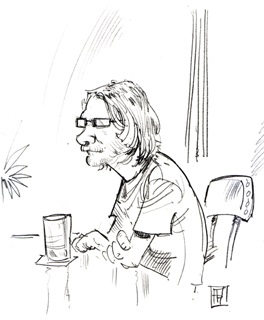
Jack Ruttan is a Montreal, Canada-based freelance writer, translator, critic, and illustrator. He’s been an arts journalist, book and movie reviewer, used bookstore clerk, and a graphic artist at the Calgary Zoo. He published a series of comics, “Ruttan” in Books in Canada Magazine. Jack has exhibited cartoons in Thailand, scripted seven science documentary shows for Discovery TV, and written for the DVD project Creating the Lord of the Rings Symphony: A Composer’s Journey. Interview and Gallery: http://coreopsis.org/profile-jack-ruttan-on-himself/

Like what we do? Buy us a Cup of Coffee!


