Back to Journals
Home
First Wonderous
Story
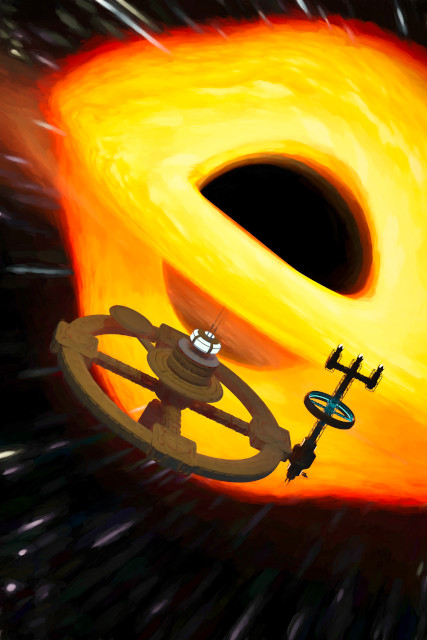
Flight of the Synths
by M. Frost
Illustrated by Joel Bisaillon
Rain streaked off the glowing lights of the advids to drip onto broken mirrors of water in the alley below. Paul listened to the sound of falling water while he built his courage, then splashed across the alley to the door beyond. He knew the codes and was admitted.
Paul’s treatments had begun months prior. At first, they had been easy. Increasingly, it took him longer to recover, and the pain of the treatments was getting worse.
People kept telling him. “It’s your choice. You can stop if you want.”
He was starting to have peculiar dreams. In the last one, he piloted a starship in orbit above a planet he didn’t recognize.
“Are you okay?” Nin asked. She had volunteered to support those on treatment after her recent rebirth. They’d never met during his early sessions, so he only knew the name she had taken after her change was complete.
No, I’m not sure I’m okay. He thought privately.
“This is the worst one.” She cautioned.
Paul swallowed. How can anything be worse than the last one? She took both his hands in hers while medical aides administered the drugs and gene vectors.
He realized quickly that she had been right—it was worse.
Paul lost all sense of time. His pain was so intense, it felt like his bones actually would break. Waves of nausea coursed through him—he barely was aware that Nin was holding a basin for him. He couldn’t keep anything down.
He wondered if he would die without the IV fluids and nutritional support. Paul briefly thought about pulling out the IV to see if that would end his misery.
On the worst day, it felt like the strange ship he commanded was rocked by an explosion. His whole body was shaking. When he opened his eyes, Nin looked concerned.
Paul felt that her concern was not for him. Something happened.
She touched his cheek. “We lost Feanor.”
“Lost?” Paul was confused.
“His flat was bombed.” She clutched his hand.
Paul clung to her. Feanor had been one of the Council who had voted to admit Paul.
Should I stop? Paul wondered. The hate has been growing.
Nin kept crooning to him, whispering that the treatments would be easier after this.
“What about the Council?” Paul managed to ask, worried for Huan.
“They’ve gone into hiding.” She assured him. “We have a contingency plan.”
Paul wanted to ask what that was, but he felt that he was drifting again.
The next time he woke, there was a man. “I’m Feryn, Nin’s brother.”
Paul tried to speak, but his words slurred.
“I almost stopped when I was where you are. Nin kept me going.” The look of joy on Feryn’s face was startling.
Feryn seemed to be trying to keep Paul distracted. He brought over a small red bird. Paul vaguely recognized that the group were making creatures at the same time they were re-making themselves, but this was the first time he had seen one.
He swam in darkness and pain for a while longer. The next time he woke, Nin was there again. “You’re almost through.”
She helped him sit up. Paul was surprised to find that he was hungry.
Nin brought him only broth. “Trust me. Start with this.”
She forced him to sip it when all he wanted to do was pour the whole liter down his throat.
A few minutes later, he realized why.
Nin gave him nausea tabs and stroked his back while they kicked in. Slowly, Paul’s stomach settled, and he was able to take more broth.
“Have you chosen your name?” She asked.
She’s like her brother—trying to distract me from how bad I feel.
He remembered how his life had led him to this abyss. When he closed his eyes, he felt again the blast that had rocked the ship he once commanded.
Then he considered the look of joy he had seen on Feryn’s face. He decided he was going all the way.
#
The deck had rocked, the vidscreens had flashed, then everything had gone dark—the lights, the consoles. It was the moment where Paul felt it all began.
Paul had jerked in the blackness. What just happened?
There was a murmur from everyone on the deck. The emergency lights came on first, then the consoles began to reboot.
Bethany muttered over her station. He came to her side.
She practically shouted at him. “I don’t know yet!” He could see the tension in her neck. The stakes are so high. Every second this takes—
Paul forced himself to breathe until the vidscreens came back online.
The starship he commanded was tethered to the new Waystation they were working to deploy. This deep in the gravity well, the dimensions of time and space were so warped that what might be seconds or minutes here would mean days, weeks or years Terra time.
Paul tried not to curse as the reports came in.
The crew on the Waystation had been nearly done when the main battery caught fire. A chain reaction had triggered a small explosion in a hydrogen generator. One crewmember was dead. The rest were fighting the blaze.
Should we pull back, send a new team in?
But then he got the next report. Two of his engines had been damaged in the blast. It was going to be a race—whether the repairs on the Waystation or the repairs to his ship would be done first.
Terrence was sending messages to Earthforce on the ansible, but there were no replies.
Paul saw Bethany pull away for a moment. She has a wife and daughter on Earth.
How old will her daughter be by the time we are able to return?
He recognized that while Earthforce preferred to hire people like him—without spouses or children—to spend years in space, losing time at the edge of a black hole, the hazard pay was so attractive, those with few other options were likely to take the posts.
Paul expected that Bethany was here so her daughter could have a brighter future. But what future will she have without Bethany to help raise her?
He went to her. “Come on, you and I both have training in engineering. Let’s see if we can speed things up. I’ll have Terrence relay anything critical through the comms.”
The look of gratitude on her face shook him. But halfway to the lift, another concussion sent him to the floor.
When he could see again, Bethany’s face was streaked with red. As Paul looked around at the chaotic scene on the deck, the vidscreen displaying only static, it felt like the air had gone out of his lungs.
“Captain.” Bethany tugged his arm.
“Get to medical,” he ordered when he could speak again.
She shook her head. “What should I do?”
Paul forced himself to focus. “The power supply to the deck.” He pointed, watched her sprint to the panel.
Assuming we can repair the ship, how long will this take? Paul pushed past a wave of despair, then started giving orders.
#
Almost fifty years.
Paul considered the weeks of repairs it had taken, but that deep in the gravity well, the Waystation pushed deeper by the explosion, the consequences had been extraordinary.
Paul felt like his world had been inverted. What had been bright now seemed so dark. He’d heard from Bethany that her daughter was still alive. That was the only good news any of them had.
When he checked in on the people he considered friends, he’d lost more than half of them—those still alive were in the silver years of their lives. What surprised Paul most was how they had grown in different directions than he had anticipated.
He felt bizarrely outside of it. One of the reasons he had signed up to pilot another Waystation mission was that he already had felt lost after his mother died, leaving him without any family.
It wasn’t reasonable to expect anyone would wait fifty years for a spouse or lover, especially given what little they had been able to communicate through the ansible. Any technology besides the one we were installing works so poorly deep in the wells.
When he met Bethany for dinner, he was disturbed by how haunted she looked, the scar above her left eye joining wrinkles on her forehead.
“Your daughter—” He started.
“Is perfectly fine without me. I took that job because we were broke, and Sarah and I wanted her to have a university education, which the company did pay for even when they couldn’t reach us. But she was two years old when I left. Now she’s grown with a family of her own. I’m meaningless to her.”
He didn’t know what to say. They all had gotten generous payouts and likely never would need to work again, but in that moment, it didn’t seem enough.
When he left the restaurant, advids on the screens outside displayed coordinated images, recruitment for the Colony recently established in Theta quadrant. Paul felt uncomfortable at the tag line. “Just two Waystations away!”
Then one of Paul’s friends from university reached out, only he had a new name.
“Really, just call me Huan.” The man who had been Hunter said as he opened the door to his magnificent flat.
Paul walked in, shocked by his friend’s appearance.
Hunter—no, Huan—still seemed young, a far cry to Paul’s other friends, but how he looked and the way he lived had changed dramatically. The Hunter Paul had known at university was an utter slob, living in stacks of old food, magazines that didn’t need to be printed, and ancient books.
This new person called Huan kept little, his spacious apartment spare and clean.
“What did you—” Paul began.
“It’s okay. You can touch them.”
A moment later, Paul recognized his friend meant his ears.
“No, I’m fine.” Paul realized his friend had undergone a conversion. What do they call them?
The application of synthetic biology principles to human evolution—at least on a societal scale—had been something relatively new when Paul left for the Waystation. Now, it seemed like it had developed to a point of application he had not dreamed could exist.
The name came to him. Synthetic or Augmented Humans. Isn’t that what I heard them called on the newsvid the other day?
Huan raised his eyebrow. Then, as if he knew what Paul was thinking, he explained. “Synths is the slang term in case you missed that too on your adventure.”
Paul huffed at the euphemism for the accident at the Waystation, but he was curious. “When did you—what do you call it?”
“Rebirth.” Huan shared. “Decades ago now.”
“And you just stopped aging?” When Huan stood, Paul wondered if he’d pushed too far. But his friend simply poured them both drinks and sat back down.
“Mostly, yes.”
“Is that true for all Synths?” Paul wondered.
“I can’t speak for the others, but I don’t think so. Most of us do this because we want to embody our model. With the Edhel, long life is one of the key characteristics, and we are lucky enough that we aren’t hiring gene engineers. We have our own dedicated to the rebuild.”
Paul vaguely understood from the newsvid he’d seen that some groups were prey to low-tier genetic physicians or charlatans. That seemed to be one of the arguments in favor of a Parliamentary decision. Now he was disappointed that he had not paid more attention to the ongoing public debate.
I suppose all the noise about a ban simply could be rooted in racism. The Synths look so different. He studied his friend, thinking of the year in university the two of them had chosen to read only books that once were banned.
But there was something else Huan had said that didn’t make sense to Paul. “Edhel?” He fumbled over the word.
“Oh come on. You loved the books too.” There was a smile on Huan’s face. Paul realized he wasn’t talking about the banned books, but another set of Pre-Pox classics, the first stories they had read together.
That was before they became famous again. For a few years, it had seemed like all the storyvids were retellings of something famous from before.
It had made bizarre sense to him. If we focus on stories from before the Pox, especially the fantastical ones, then perhaps we can pretend like the Pox never happened.
“So you’re saying I shouldn’t call you an elf?” Paul teased back.
Huan winked. “Only in private. I don’t care so much, but some Edhel do. But you should know that we took more than a few liberties with the model. We’re trying to be something more—a people in harmony with nature instead of working against it.”
As they continued to talk, Paul was struck by his friend—he remained as laid back and funny as Hunter ever had been, but Huan seemed at peace in a way that was new.
It’s like he’s found his place in the world.
Paul never before had felt so outside the world, so he envied Huan.
#
Paul felt betrayed.
Huan had spent months wearing Paul down, convincing him to undergo the rebirth and join the Edhel. But as soon as Paul said yes, Huan warned him. “There’s going to be an interview.”
“An interview—you mean like a test?”
Huan had the decency to look chagrined. “Exactly a test.”
They were in Huan’s apartment. When his friend picked up his pad and swiped, an entire wall swung open to reveal shelves of books bound in the old way.
Some of these look hundreds of years old. It had been their shared enjoyment of actual printed books that had kindled his friendship with Hunter.
Huan pointed to a large section in a prominent position on the shelves. “Read these.”
“All of these?” Paul was dumfounded by the sheer number of texts. He recognized only five of the titles as ones he had read before.
Although I’m pretty sure I never finished the Sil.
“Yes, all of them. And since they require temperature and humidity control and therefore have to stay here, you might as well give up your flat and move in. It’s not like I don’t have enough space.”
Then Huan gave him a truly evil look. “Oh, you’ll need to learn the language. One of them at least—probably Sindarin.”
Paul glared. “That was always your thing, not mine.”
“I know.” Huan answered cheerfully. “How do you think I was able to afford this?” He indicated his high cheekbones and curved ears.
Paul knew that he was going to have to cover the costs of the treatment. He now understood that what he would pay was a quarter of the expense for most Synths because the dedicated gene engineers for the Edhel donated their time. Most of the money went to necessary materials and equipment, which Huan assured him were top notch.
What else do I have to spend my payout on?
Paul glanced at Huan, curious. “How were you able to afford this?”
Before Paul had left, Hunter had been in a linguistics PhD program. Not exactly a high-paying career.
“I traded my skills for this.” Huan explained. “The language wasn’t complete, so the Council approached me to fill in the gaps.” He had a mischievous look on his face. “I may have taken a few liberties there too.”
Paul had a sudden vision for the academic hell his next few months were likely to be.
Huan clapped him on the back. “Let me make it up to you.”
The bar was a dive. Paul quickly recognized it was Huan’s nod to their college days.
“Two beers,” Huan ordered, then he sat next to Paul. “I still don’t understand this push for further Colonization, past Beta and Epsilon. I mean, look what installing another Waystation cost you.”
Paul recognized his friend was trying to get him to open up about the accident. He wasn’t ready to do that, so he explained why he had joined Earthforce. “It think it’s human nature to explore, and I wanted to be on the leading edge.”
Huan nodded, sober. “You still are.”
How Paul felt about the process of rebirth suddenly transformed.
#
Paul was nervous to face the Council, despite Huan’s unswerving dedication to his tutelage.
“Don’t worry. Only some of them are completely obsessed with the source material.” Huan said. That’s not reassuring.
The first questions were easy—his name, his background, how he knew about the Edhel.
Huan was sitting in a corner and waved.
The Council members chuckled. From their familiarity with Huan, Paul intuited that he was a member of the Council who had been excused from the decision due to the conflict of interest. I should have known.
The questions got harder. Paul could tell he sometimes gave an adequate answer, but other times, fell short of the mark.
Huan had warned him it would be bad to try to invent something. “They’ll know better than you.”
Finally, one of the Council named Feanor asked about his own namesake from the books.
Paul decided he should just say it. “Look, I’m not doing this because I can’t live without being Edhel or know the source material by heart. I enjoyed the novels and the storyvids based on them, sure. I actually got through the Sil the second time but couldn’t do more than skim the Histories.”
There was unexpected laughter, the good kind. “Me neither.” Melian, one of the gene engineers, agreed.
Paul was surprised to see smiles on several faces, with only a few more chilly expressions.
Feanor still seemed serious. “You must have encountered anti-Colonial groups. How do you expect to handle the growing backlash against people like us?”
Paul hesitated. At Huan’s nod, he replied carefully. “I think you’re right that there is a connection between anti-Colonial sentiment and what is happening to the Synths. Perhaps they both press boundaries too extreme for most people to accept.”
“You’re not doing this just to live longer?” Feanor probed.
Paul shook his head, then shared his birth date to obvious startlement. He hurried to explain about the Waystation. “What it really taught me is that it’s hard to be alive later than you expected.” He looked down. “It’s hard to be alive when most of the people you know have passed on.”
“Why are you doing this?” A man named Elros asked.
Ah, that I recognize—he took his name after Elrond’s brother.
Paul gave the only answer he had. “I’ve been adrift ever since I came back from the Waystation. I’ve now realized I want to be part of something larger, and this feels right to me.”#
Feanor had been killed when his flat was bombed, and Paul, with his recent rebirth, still was coming to terms with it. But when Parliament issued the Ban on Synths, Paul knew exactly why Feanor and the Council of the Edhel had accepted him, why Huan had recruited him. Leaving Earth is the contingency plan, and I can fly any ship we might find.
They had a lead on one and—thanks to Ninwiel and Feryn, whose father was wealthy—the funds to do it. Paul thought about contributing to the cause, but decided that he would rather save his funds to invest in spare parts or repairs after they bought the ship.
No way will we have enough for a top-class colonization model even if I donated to its purchase.
The problem was they had to colonize a new planet on the edge of what was known or face the impact of the Ban, since they expected the ripples of this decision to color laws and policies throughout the Earth Coalition. We could just keep running every few months or years, but that seems exhausting.
He had tried to reach out to Bethany a few times, but she refused his calls. Paul remembered the look of shock and horror on her face the only time they had seen each other after his transition. He felt her reaction was emblematic for how the whole of society had turned against people like him.
Nin went with him to look at the ships the Council had identified. He understood the Council trusted his judgment on whether the ships were space-worthy. Nin was there to negotiate the financial details.
Given her compassion, she was far more shrewd in business matters than he had expected.
She looked confused when he shared that. “Whoever would show compassion for a company? People, sure. Animals, absolutely. But a company?”
Watching her negotiate their chosen ship down by almost a quarter of the asking price brought him joy.
“How did you do that?”
She rolled her eyes. “Father desperately wanted us to follow in his footsteps. As if.”
“I thought he was a diplomat.”
“He’s always been a businessman.”
He gave her a small formal bow.
“The difference is yours to spend.” She told him. “What does the ship need that they haven’t told us?”
Paul felt a sense of relief so profound, he could not express it. He had figured out that what he had to donate to what he felt were necessary repairs was entirely inadequate. So he told her what he wanted, then told her how much he was adding, and asked her to help.
She took his hands as she had during the worst of the treatments. “It would be my pleasure.”
#
With the chaos, Paul wasn’t sure which way to go.
Huan grabbed his arm to drag him down a side street.
The protests that had erupted from some of the other Synth groups at the news of the Ban had escalated, engendering a backlash that he felt he should have seen coming.
Huan had a gash on his face but waved Paul away when he tried to tend it. “We just need to get to the ship.”
“But your flat?”
“People are more important than books.” Huan replied.
Paul wasn’t entirely sure that was true, given that the entire structure of their society took its inspiration from a collection of extraordinary books. Huan had so much more than Tolkien in his print collection. Some of his books are the foundation of revolution.
Paul understood the Edhel meant to be quiet—to do things under the radar in their own way. To build what they wanted to build outside of the expectations or control of an increasingly autocratic society. Their goal was to achieve true harmony with the universe in a way humans had not yet been able to do.
Utopian.
He found Utopia fine as a distant, aspirational goal but felt it lacked something in the day-to-day application.
The large piece of him who was still Paul—perhaps also a small piece of Huan who was still Hunter—recognized that sometimes, society needed to be burned down to be reborn.
As Paul looked up at what seemed to be actual flames and the concussions of bombs in the distance, he wondered what was being burned.
“This way.” Huan urged.
Paul didn’t understand until Huan led him to a hanger where there was a small aerial transport. He keyed in the codes to the hanger, then to start the small ship.
“You’re not a bad pilot.” Paul commented.
“Not like you.”
“What did I do? Flew a ship that practically could fly itself.”
Huan handed him earbuds for the comms, which Paul dutifully pressed into his ears. “That’s not what I heard.”
Paul scoffed. “What did you hear?”
“That your crew would have been in that well a hundred years or more if it wasn’t for you. That at every single decision point, you made the choice that got the most people out the fastest. That your unconventional strategy is now taught to the pilots who attend the Waystations.”
Paul knew that he had been asked to speak to Waystation pilots, but he never had been presented with this version of what had happened.
They flew low over the city towards the dry dock where their ship was berthed.
Halfway there, Paul jerked as he saw an explosion on the horizon, red flames like a mushroom halfway across the city.
“Not us.” Huan grunted, steering his small transport at an angle to the madness.
“Who?” Paul wondered.
“Probably the Klingons.” Huan answered with a note of certainty.
“Klingons, really?”
“Really.” Huan said. “We declined their invitation to join.”
Paul caught Huan’s eye, then saw his friend shrug. “It’s possible some of us might have contributed privately to their cause.”
Paul felt like that was something Hunter would have done.
#
Right after they launched, Paul had a moment of fear. An Earthforce Destroyer moved towards them as soon as they cleared the atmosphere.
He had the entirety of the Edhel on his ship, including what remained of the Council.
Paul punched the comm himself, a hailing protocol. Then he looked down at the response, surprised.
A request for a private conference.
He keyed the authentication for the reply, then gave Huan what he hoped his friend would understand as an apology as he headed for the Captain’s office adjacent to the deck.
Paul produced the codes, then worried that they might be over fifty years old.
“So it’s true.” The woman on the other side of the vidscreen actually smiled at him.
“What’s true?” Paul dissembled.
“You are—or were—the Captain Paul Revan who commanded the Nimbus trapped by an accident during the installation of Waystation 71301.”
He inclined his head, concerned to give more.
“Relax Captain. I’m here to escort you to the first Waystation. Parliament privately endorses Colonization as an alternative to the Ban, but don’t expect them to say that out loud.”
Her eyes flicked. He realized she had another message when she paused their vid.
When she returned, her eyes were apologetic. “We have orders to search your ship before you leave.”
Because members of the Council had been monitoring the newsvids, he understood quickly that Parliament itself had been targeted in the latest wave of violence.
Paul pulled Huan aside. “Any way what’s happening below can be traced to us?”
Huan looked nervous, which set off Paul’s anxiety.
The large Earthforce contingent insisted to see everyone on the ship. The Council split up to accompany the teams on their search of the quarters and the storage areas.
The group included a science officer who wanted to see their ark. Paul escorted her team himself.
They didn’t have the funds for a separate ship for the animals, so their ark was with them on the main vessel. Not that it’s wise to have anything that breathes fire on a starship. He admitted as much to the officer and pointed out the special fireproofing he and Nin had negotiated to have installed in the room where they kept the dragons.
“Could something like this creature intentionally burn down a building?” One of the team asked.
Feryn spent most of his time working with their ark. Paul waved him over.
“Oh no. None of them has that level of control.” Feryn assured the Earthforce team. “The fireproofing is mostly because—ah, well—they burp sometimes after they eat.”
Paul had not known that either. With a renewed feeling of alarm, he led the team to another section.
After Earthforce left, their ship was ordered to remain in orbit while the results of their inspection were processed. Paul felt nervous all the time, especially when Huan showed him some of the vids that had not made the news.
Vids of Synths being killed in the streets.
Paul felt nauseated.
Finally, the signal came. The Council joined Paul in his private office off the deck.
The Earthforce Captain looked tired. “You’re cleared, but there are other ships preparing to leave, and we have to stay to inspect them too, so we can’t escort you.”
She tapped a code, so Paul waited until the Council left before he re-opened the channel.
“Look. I admire what you did on the Waystation, so I’m going to tell you something in confidence. You can’t continue to your original target planet. We’ve gotten word of a major illness on other colonies in the sector, and it’s not clear yet what it is.”
Paul was dismayed. “I don’t have clearance for—”
“Hold, Captain. I have an alternative for you, and I’m working to arrange the clearance. Ever since the accident, despite your salvage of the Waystation, no one has colonized Sectors 71301 or 71303 yet. The candidate planet in 71301 has been claimed, but no one has touched either of the two options in 71303.” Then she added. “Do you have climate stabilizers?”
“A few.” Paul said. Their original target had a climate that would be acceptable without them, so they had invested little in the technology. He pulled up the targets in 71303 in his database and felt his heart sink. We’re going to need more.
“Get started. The first Waystation is the same either way. I’ll signal through the ansible once I’ve arranged clearance. And Paul—” Then her face changed, and she apologized. “Captain, Beta Colony is only a short detour for you either way, and they usually have a good supply of stabilizers.”
“Thank you.” Paul said too late after the vid ended.
He was going to have to go back to Waystation 71301, and the only test they had of its accelerator were the unmanned ansible probes the company deployed well after he and his crew had returned.
The irony that he would be the one to test whether the accelerator actually worked was not lost on him.
#
Paul stared at the dark horizon on the vidscreen as they approached Waystation 71301. He felt like everything was going wrong, and this could be the capstone of all the failures in his life.
What if the accelerator fails, and we get stuck in the gravity well for centuries?
Months ago, when they left the accelerator of the first Waystation, news had come in first through the ansible, then via the local Colony vidnets in the sector. Martial law had been declared on Earth and the Inner Colonies. They would not be permitted to land on Beta Colony or any other.
Will our climate stabilizers be enough? He wondered. Will the rest of our supplies?
They meant to resupply at least once enroute, given that their exit from Earth had been rushed, and not all of the supplies they intended had made it onto the ship.
There was one thing that had gone right—the Earthforce Captain had made good on her promise. Paul found the clearance codes waiting for him for all the Waystations they would need to transit, ending with 71301.
One way clearances. They do not mean for us to return.
Huan pulled Paul aside. “How are you?”
Paul realized his friend understood the charge this particular leg of the journey held for him, so he tried to be strong.
“You’re not fooling anyone.” Huan whispered, then led him to the command deck where everyone came up to him, one at a time, to touch his hands or give him assurance.
Nin was last. She took both his hands in hers. “We’re almost through, Captain Parevan.”
They were his family now. He only hoped he would not let them down.
Entering the accelerator always felt like slipping down to him, even though he knew that the compensators on the ship would mask any changes in the gravitational forces around them. He expected the transit to feel like a week to them and take months Terra time, but since they would be beyond any local vidnets, the only news they were likely to get on the other side would be short ansible communications from Earthforce.
It’s not like we can do anything for the Synths who remained. It’s been almost a year for them.
The night before they exited the accelerator, he dreamed again being in orbit over a strange world—only this time, he felt something was calling him. When he woke, that feeling continued to vibrate through him. It was like he could see a green and blue planet in his mind.
But when he arrived at the deck, stared at the bright horizon that was the edge of the gravity well on the vidscreen, the deck jolted, almost knocking him down.
For a moment, all he could see was Bethany, her face covered in blood. He pushed past the sudden clench of fear. This time, the consoles remained active. He was able to navigate to diagnostics, deploy an engineering crew to engage the backup system for the rotational engine. If we slow down too much, we might start to slip—
Being stuck in time again seemed worse than death. He looked around, wishing he had more crew, only to realize that Huan and several others must have rushed to the deck. He pointed to the terminal he needed his friend to cover. “Navigate to the sub-engineering level. We need to divert the power.”
Huan just gave him a blank look. Of course, he doesn’t know the language.
He closed his eyes, thought about what the tap points looked like, then guided Huan through it in Sindarin.
The warning lights faded from flashing red to solid white. The deck shifted, the subtle tell that meant they had resumed speed.
He held his breath until they began to clear the accelerator. As the new canopy of stars replaced the false color image of the edge of the gravity well on the vidscreen, he was surprised that what he felt was not just relief, but hope.
Huan and Nin came to his side. “So this is our new home?” Nin asked.
The man who once was Paul, who now was Parevan, smiled. “Technically in the next sector, the stars will look different, but yes. This is our new home.”
Nin took one of his hands, and Huan touched his shoulder.
“I feel like this is where we are supposed to be.” Huan agreed.
That’s it exactly. Parevan realized. He felt like, after a lifetime of pushing the edge, he had reached the place he would call home.

By night, M. Frost writes speculative fiction, essays and poetry; by day, the alter ego considers how to address health disparities, especially for vulnerable workers, whether you consider the temporal dimensions of their work or not. Work appears in Utopia SF, Strange Horizons, AntipodeanSF and many other venues. Connect at mfrostwords.com.

Like what we do? Buy us a Cup of Coffee!


