Back to Journals
Home
Featured Story For Autumn 2025
On to the
Wonderous Stories
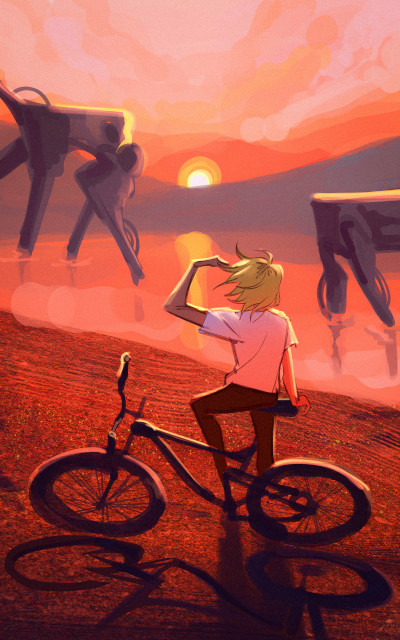
Wet Socks Drying in the Tide
by Renan Bernardo
(Originally appeared in Solarpunk Magazine #17 in September 2024.)
Illustrated by Thana Meejinda
The glint of sunlight over the flooded streets. That’s what Cássio picks while he wades toward the mecha garden, water up to his ankles. Mãe says everyone should have a favorite thing in Santa Virgínia, something beautiful, perhaps enticing or unique, something that makes you call that scorching, bland town home. It’s how you grow roots, she says. Not that there’s a way not to grow roots. Santa Virgínia dos Beija-Flores is the only town for many kilometers, surrounded by a vastness of nothingness, caatinga, and long-dead towns. A pimple in the middle of nowhere.
Cássio stops before the mecha garden. It’s a wide swath of mud jumbled with the algal juice of the river tide. Its flowers, the thirteen functioning mechas of Santa Virgínia, are all as ugly as Cássio: bulky, rusty, five-meter tall giants used as a means of transportation between the town and the school.
Tia Neide and the other students are already kick-starting their allocated mechas when Cássio enters his, a dismal giant with hints of forgotten purple and meaningless logograms. Cássio climbs it and accommodates himself on the ruptured cushion, absorbing years of sweat—from others, from unknown soldiers, his own. Stale hydraulic fluid lingers in the air, a remainder from before the time the mechas were powered by light, as if all good things must come with a price. The worst is the rustiness, though, ingraining the mecha and himself. Feels like he always has his teeth clenched around an iron bar.
No. His favorite thing can’t be the sunlight over the streets flooded with muddy water, always too shallow and marshy for boats, too deep for feet. It reminds him of how his sneakers and socks are always stinky, his toes always wet and wrinkly, his sweat a permanent coat clinging to his skin. Roots don’t grow well in soggy soil.
#
The outsider comes from Cássio’s left.
The boy rides an adapted bicycle with motorcycle tires, picking a craggy road that’s luckily above the waterline today. Cássio has seen a man break his knees there once. A shriek and a fall and the man vanished forever in a riptide. Not that Cássio cares about the outsider. The outsider steals food. No one needs to steal food in Santa Virgínia. The olericulture compound provides for everyone.
“A boy on the left,” Iracema says, opening a private channel with Cássio. She’s in the discolored mecha in front of him. Most of their mechas are inactive, except for their basic comms, the levers that control their mechanical parts, and the air conditioning system that keeps the conductors from toasting. “Can we help?”
Technically, yes. At least warn the boy that crossing that way is a crazy thing to do. But he won’t.
“The tide cuts the road up ahead,” Cássio says after pressing the button to open a channel with Iracema. “He will have to come back.”
Santa Virgínia dos Beija-Flores is the tide. It stays high for most of the year. The town itself gets the best of it, with most streets inundated only by shallow waters and its houses having their first floors empty as if they’re tributes to the tide. But all the lands around the town spawn kilometers of quagmires, swamps, and marshy terrain, punished by riptides, strong currents, whirlpools, and the rocky and wooden remains of the old, drowned parts of Santa Virgínia. It’s impossible to travel them without the use of mechas. In the times of Mãe’s granny, there were green woods between the town and the school, thickets of trees where people met for a walk or to have a picnic on a warm day. There were wooden houses back then, Mãe says, not only the brick ones, pockmarking the town like chickenpox, and the windows didn’t have clotheslines filled with pants, socks, shoes, and boots. Now all that’s left is the river’s desire to grow wider and taller.
“Should we tell him?” Iracema’s voice is crackly over the obsolete speakers. The outsider is stubborn. He keeps pedaling across the broken road.
“He won’t hear us from here,” Cássio says, pinching his lips, trying to ward off the memories of his mother, all sweat and paleness, arriving at home after a hard day in the brickworks. “And… Iracema… We shouldn’t deviate our mechas from the predefined paths. You know that.”
Iracema closes the comm.
The outsider passes him by, faster than the sturdy mechas. For an instant, Cássio sees him flicker, as if a trick of the heat. He wears a mantilla around his head to protect him from the inclement sun. If it wasn’t an outsider—that outsider—Cássio would veer from the mechas’ submerged, reinforced path to help. Tia Neide says helping is the core of Santa Virgínia dos Beija-Flores. If not for a sense of community, Santa Virgínia would be long dead at the mercies of the river. But the outsider isn’t part of this community. He wasn’t born here. He steals food. He’s like a treacherous rock pinning the leg of a mecha.
Days before, Mãe had told him her packed lunch had been stolen and her blood pressure dropped. Cássio knew exactly who had done that. The boy who came from another town as if Santa Virgínia had anything to offer besides heat on the head and water on the feet. Cássio had seen the boy with Mãe’s lunch bag earlier that same day and thought it was just a similar one. At night, he fed his mother a leftover stew from the compound. She threw up after a coughing fit and went to bed early.
Cássio clenches his teeth in a grunt of anger, pummeling the lever to move the mecha’s left leg and free it from a quagmire.
#
There’s one thing Cássio almost likes about Santa Virgínia: the other mechas sloshing in front of him while they plod to school, their matte greens and purples and blues dissolving in the dullness of ancient machinery. Cássio likes to see their sturdy legs splashing on the tidal flood, making it ripple around them with each pull. Tia Neide leads the party, a procession of students between thirteen and sixteen years old, thinking there’s a future on the other side. Sometimes, he stops briefly in the middle of the road, where both the town and the school are out of sight. It’s the only moment when he deceives himself, half-believing there’s a place where he can think of favorites.
#
Fireworks mottle the sky in blue and red. Tia Neide sets them off every day as the kids arrive in Colinalta. A colorful message of relief to the people in town to reassure that everyone arrived safely.
Colinalta is on a plateau. It’s the safest place from the violence of the tidal waters, which had been a secondary reason to turn the ancient mecha factory into a school years ago. It’s a wide compound full of hangars, plazas, and pads, most of them still encrusted with the metal skeletons of the mechas just waiting for the final touch of time. It’s the grown-ups’ favorite place. They say it’s a temple for hope, decadent and broken, but still a place for them to believe there’s a path to better times. For Cássio, the only thing interesting about Colinalta is that his feet get to dry off.
In the classroom—a repurposed and gigantic garage—Tia Neide stands on the dais, wearing her glasses at the tip of her nose, the lenses greasy and cracked at the corners, the frame slightly crooked. Her blouse is the same as the day before, yellowed under the armpits and frayed at the borders. Before her, sitting on the floor is the primary reason for turning the mecha factory into a school. Us.
“It seems we have a new student today.” Tia Neide picks up a brush and finds a spot to clean on the repurposed mecha chassis in front of her on the dais. Others, older and less preserved, are lined up against the far wall of the classroom like severe spectators. “Please, boy, state your name.”
The outsider remains silent. Somehow, he managed to get to Colinalta only at the expense of the ripped mantilla on his lap. Blotches of mud stain his curly black hair. His bicycle lies in a corner, smudged by stripes of algae but intact. That boy shouldn’t be there. Cássio wants to say that. He wants to tell Tia Neide that the boy steals food from the town, that he will be a problem for Santa Virgínia when he grows up, just like the bandits that stole mechas and fled the town two years before. But the words catch in his throat the same way they seem to be in the new boy’s.
“You don’t need to tell me if you don’t want to or can’t, of course,” Tia Neide says, dusting off a schematic and pinning it to the wall. “Get acquainted with your fellow students in the meantime. Today we’re going to study the basics of ratios, or why we shouldn’t build disproportionate mechas.”
Cássio pinches his lips when the outsider’s vile eyes meet his. Black pupils underneath a thick unibrow. The boy quickly lowers his head, as if he can hide the blame for stealing Mãe’s food and for being where he doesn’t belong.
“Cássio, you’ve been quieter than usual lately.” Tia Neide shakes him out of his thoughts. He shudders. It’s his cue. Say it. Tell her the outsider is the enemy. He’d read about bad people in one of the ancient magazines at the back of Seu Mário’s bakery, the ones he keeps from before the weather cracked. Outsiders come from far away to wreak havoc and steal and turn good into trash. Oilmen, Mãe calls them, big boogeymen in black suits, leaving tracks of filth from the big cities, with their pitchy eyes and fuel-blotted bodies. He can imagine the outsider metamorphosing into one of them as he grows up, his skin peeling off and cracking to exude oil.
“Yes?” Cássio says, clearing his throat.
“Should you use reinforced glass for the main hatch of a mecha?” She pats the chassis in front of her, though most of its materials are cheap replacements. Santa Virgínia doesn’t have enough of anything—steel, rubber, aluminum, silica, hope—to build even the simplest parts of real mechas.
“Only if the surrounding beams can prevent it from cracking.” The answer is ready on his lips. He reads the books Tia Neide tells them to read. He goes to the town classes, as Tia Neide calls those that don’t require a commute. In Colinalta, he goes to the hands-on classes, builds mecha prototypes, paints rusty chassis, and repairs junk in the hangars and plazas. He learns it all. He finds it all useless. The grown-ups of Santa Virgínia dos Beija-Flores believe if the kids can learn how to build and repair the mechas, then one day they will be able to use them in their daily lives. Hope’s a grown-up trait. He’d seen Tia Neide’s sketches. Mechas building houses, planting trees, carrying a dozen people inside gigantic chassis, dredging the river banks to control the tide, and even marching toward the distant towns hundreds of kilometers away from Santa Virgínia.
When Cássio looks sideways, the outsider is staring at him with a glint in his eye. The paradox of anger: the fact that Cássio doesn’t feel angry at the enemy looking at him makes him angry.
Tia Neide says something, but he doesn’t listen. He doesn’t want to. He just wants to go back home and crash on his mattress without even drying his feet. If Mãe asked him about what he despises the most in Santa Virgínia, it wouldn’t be easy to find an answer. He’d have tons of options.
#
The outsider is also a fool. Despite all the red flags, he keeps going to school on his bicycle. And every day, Cássio is bothered by it.
On the sixth day since appearing on the craggy road, the outsider disappears into the water with his bike. Like he was never even there.
Cássio’s heart races like he’s the one falling. Before he even realizes he’s thinking about the boy drowning, his arms grip tight against the mecha’s levers to move left. He surmounts a few quagmires, trips, pulls the arm levers to kneel and stand, then keeps plodding. The mecha’s junctions yowl their years. The merciless terrain scratches, bats, strains its legs. The seat jostles, throwing him back and forth, the worn-out seat belts tugging at his chest. He shouldn’t be doing this. Tia Neide’s guidelines for conducting a mecha say they should always communicate to others if—for whatever reason—they need to deviate from the predefined paths. But he’d never admit he’s about to help an outsider.
This is how kids die, Tia Neide scowls in his mind. The waterline is at the mecha’s knees, which means it’s about his height. He presses a button to anchor the mecha onto the ground below, unsure if that feature still works, and opens the cockpit hatch. Heat and the invasive pang of algae bloom hit him. Hot and smelly. Maybe it’s how death feels after all. According to Tia Neide, most of the children and teenagers’ deaths in Santa Virgínia happen at the crossing between the town and the school.
Cássio climbs down the mecha, gripping the girders on its belly tight. He leaps onto a stretch of land above the water, ignoring that it might only be a loosened patch of dirt floating about. It’s not. He kneels and catches the wheel of the bike, which got stuck in a rock. The part of the road where the outsider fell is no longer visible, so he must’ve fallen after an upsurge of water inundated it.
“Idiot!” Cássio screams, unsure if to the outsider or to himself. He pulls hard, and the bike comes up with the floundering outsider still tied to its pedals by his threadbare trousers. He flails around on the ground, and Cássio pulls him up by the shoulders.
The boy is a lumpy creature of mud and algae. The first thing Cássio does is punch him in the face. It’s almost as if the punch is just a sigh, a mere release of the tension held in his chest.
“That’s for stealing my mom’s lunch.” Cássio is barely able to murmur the words. Both of them are crying, he realizes.
The outsider is moaning, his lips sticking with mud, blood, and regret. He looks like a person rescued in the burst of a dam. Cássio had seen them in Seu Mário’s magazines: spirits with relief and despair stirred in swampy eyes.
“Get up and climb!” Cássio pushes the outsider toward the mecha.
This is how kids die.
#
Mãe’s dark skin is covered in a film of fiery red. When Cássio approaches her in the brickworks’ entrance, he catches the glimpse of a smile on her lips. She climbs down the stairs that lead inside, wipes the sweat on her brow with a kerchief, and sits on the bench in front of him, crossing her legs to avoid the wet road that leads to town. The click-clacking of conveyor belts inside is as comforting as everything that muffles the pervasive shuffle of the tide.
“Why do people come from other towns to Santa Virgínia?” Cássio asks, gently grabbing the kerchief from her hand and pressing it against her left nostril, where a bead of blood is starting to froth up.
“Sometimes just to eat,” Mãe says, holding the kerchief in place but without letting go of his hand.
“And to study…”
“That too.”
“Mechas?”
“Anything there is to study.”
“We only study mechas out here.”
“It’s the most useful thing we have… to solve a lot of things, including… this.” Mãe shrugs at the building behind her, her chest wheezing softly. The noisy world of bricks inside agrees with her.
Tia Neide says if their mecha dreams become reality, then the work of making bricks and using them to construct buildings could be performed easier and faster. The town could grow, expand, though Cássio doesn’t know why they’d want Santa Virgínia to grow.
“Tia Neide is the only person qualified to teach anything in the country,” Mãe says.
He knows that when Mãe says “country,” it doesn’t have the same meaning as the country of Seu Mário’s magazines.
Today’s country is a series of towns, all far from each other, all poor, all unsure of each other’s business. The magazines’ country means something they don’t have anymore, with tall buildings, pretty boys with combed hair, forced smiles, and men who look like boogey oilmen. There was a war a long time ago, Mãe says. Seu Mário’s magazines also hint at it. That’s why the ancient factory is out there in the hill, and that’s why there are mechas in Santa Virgínia. No one knows the reasons behind the war. When war happens, Tia Neide says, it’s because it’s too late to understand why it started. Seu Mário believes it has to do with the weather and oilmen and cities with tall buildings. But it’s a guess. All they know is that the war left the mechas behind in Santa Virgínia. Like an offering.“So some people come from other towns to study even if they don’t have an allocated mecha to reach Colinalta? Isn’t it dangerous?”
“A life without a future sometimes seems darker than no life at all. And—”
Mãe’s chest heaves. The kerchief drops and gets soaked on the boggy road. She coughs. It was never the lack of food that made her blood pressure drop when the outsider stole her lunch. Mãe is ill. Cássio has known that for a while but only needs to deal with the reality of it when he’s face to face with Mãe. Something he’s been avoiding lately.
“Why don’t we have doctors here?” Cássio says, thinking of all the white, shiny buildings with red crosses he’d seen in Seu Mário’s magazines. There’s more than enough space in the school for a place like that. They should be learning how to repair people, not junk.
“Bad luck, I guess,” Mãe says, recomposing herself. The feeble traces of a smile on her face have faded. “We had one years ago, but she drowned.”
It’s something in her lungs. Cássio knows by the wheezing that joins the whistles of the wind at night.
#
The outsider has a name.
Cássio knocks at his door to demand something for Mãe’s lunch, the rescue, and the mecha ride to school and back two days before. They’re a community. They exchange. It can’t be only one way.
A toothless old man comes to the brick hut’s door, a black mustache falling over his upper lip like a curtain. The man’s wearing a stained white jacket, as shabby as the place, which was probably put up in a matter of hours by the outsider family.
“Juninho is at the compound.”
Juninho. It’s almost as if the outsider belongs. In the few days at school, the outsider has been a silent spectator, nodding at Tia Neide with an effusiveness that doesn’t marry well with Santa Virgínia.
Cássio wades to the olericulture compound and finds the outsider eating a mix of vegetables in front of the compound’s main gate. His threadbare shoes and three pairs of socks hang on a clothesline nearby, but there’s a solitary wet sneaker on the steps. Other kids lie around too, some of whom Cássio recognizes from school, none of whom he cares about. At the west side gate, a line of citizens starts to form to get their food allotment, shoes and slippers in hand.
“You learned how to eat,” Cássio says, frowning at the bowl in the outsider’s hands. The boy startles, his shoulders stiffen, but he relaxes when he sees Cássio. The boy offers him a sickly smile and a nod. “You don’t need to worry about food.”
The boy nods again and props his bowl on the steps of the compound. He raises one hand to his forehead and the other to his chin, then pulls them out.
Thank you.
Mãe taught Cássio sign language years ago. He raises his hand with his thumb and little finger up, only to realize it means “I’m sorry,” not “You’re welcome” as he’d intended. He doesn’t correct himself. The boy nods. A scab draws in the left corner of his mouth, a mark left either by the tide’s rage or by Cássio’s punch. Without the tide all over his body and the fear in his eyes, Juninho is a pretty boy. Not magazine pretty, but in a fiercer, almost aggressive way. His skin is brown like Cássio’s, but peeled and slightly burnt at the forehead—meaning he’s been outside a lot.
Juninho moves his hands. What’s yours called?
Cássio frowns at him. “My what?”
Juninho imitates a muscly creature trampling along the compound’s steps, his arms moving like pendulums. For the first time in a long while, Cássio muffles a laugh. Then he bites his lip and straightens his back. He can’t forget he doesn’t like this boy.
“I don’t give it a name. It’s not a person.” Other folks do. He finds it silly. “Don’t you have an allocation?”
Juninho shakes his head.
Getting an allocation isn’t easy. It never was, but in the last few years it has been a lot harder because they have only thirteen functioning mechas in the garden. Anyone who doesn’t get the best grades during the Colinalta Entrance Exam isn’t exactly prohibited from going to school, only strongly discouraged. It’s dangerous to cross the tides with a mecha—without one, it’s madness. The grown-ups say this is going to change one day, drawing those words from their weird hope. They say they’ll find ways to build safe roads across the tides. Most of all, they’ll find ways to build more and more mechas.
“Why don’t you hang that one too?” Cássio points at the wet sneaker lying on the compound steps.
Juninho makes a series of gestures. Cássio stares intently at his hands. If a shoe is heavy enough to snap a clothesline, then every piece drying on it gets wet.
Cássio bites his lips, feeling the weight of the boy’s gaze on him. Helping is at the core of Santa Virgínia. He despises the boy but should at least warn him about the dangers of crossing the tide. He nods at Juninho’s shoes and socks, softly swishing on the clothesline.
“When the mecha’s cells heat up its back motor, it gets hot enough to dry your things in less than twenty minutes. Come, bring them.”
#
Cássio is unsure why he didn’t tell Juninho about the pair of socks he forgot when he went home the day before. He’d seen the flimsy, grey socks hanging on the unnamed mecha’s back, hardened and muddied but dry. He could’ve yelled for Juninho. Instead, he picked up the socks and folded them in his pocket while Juninho padded away through the boggy garden.
Cássio is also unsure why he didn’t tell Juninho about the dangers of the tide. Nor did he demand anything for having helped the boy. But there would be other opportunities. After knocking on Juninho’s door to give back his socks, Cássio invites him to go to school in the mecha. He sets up a cushion behind his seat, in a vacant spot where the payload of some side weapon used to be installed ages ago. The boy needs to lower his head at all times and keep his legs crossed. He doesn’t complain.
#
“Do you like Tia Neide’s class?” They march through the tide, always the last in line. Cássio has stuck a mirror near the right-hand lever so he can see Juninho’s gestures.
She’s the best. I want to be an engineer.
The mecha quivers. Cássio grips the proper levers tight and propels it forward in an out-of-step hobble. It takes a while to adjust. With the extra weight, the battery seems to deplete quicker, and the mecha lingers a bit more in quagmires. But it’s manageable. Cássio has seen mechas in worse shape functioning for months before becoming scrap for Tia Neide’s workshops.
We shouldn’t be doing that.
Cássio doesn’t reply.
I’m sorry.
“For what?”
Your mom’s lunch.
Cássio nods slowly. He tries to suppress his anger, only to realize he feels a bit curious.
“Why did you do that? We have the compound for food.”
That is how I ate. A pause. Before.
“In the place where you lived?”
Juninho nods.
“What was it like?”
Juninho gestures with his two hands toward his belly like blades penetrating through his skin. Hunger. But it’s his eyes that give Cássio a chill.
“Did your parents come with you?”
Uncle.
Cássio wants to ask about his other relatives, but it’s not the time. In the mirror, Juninho’s eyes become blank like they did when Cássio rescued him from the tide. A spirit, surprised to have found his way out of somewhere. Surprised to be just here.
“Juninho…”
The boy seems to be shaken out of a torpor.
“What’s your favorite thing about Santa Virgínia?”
#
“Mãe is going to die.”
When the mecha’s left arm fails completely, Cássio judges it’s a good time to tell Juninho about his mother’s condition. “I don’t know why or when, but I know she will.”
What does she have?
It’s been sixteen days since they started going to school together. Tia Neide and the other students have certainly found out about it, but they keep their mouths shut.
“I think it’s the bricks.”
Uncle says we should recycle the big cities.
“But they don’t exist anymore.”
They do. Far away from here. Not many live in them after the wars, but there are a lot of things there. We wouldn’t need to use bricks all the time. Here, we have only mud.
Cássio stares at the boy through the mirror. He’s been doing that a lot, not only to watch when he speaks. Now Juninho sounds like a grown-up, thinking there’s a way out of the tide. Cássio takes a deep breath and tries to think like Juninho. He can’t. Maybe one day he’ll trick himself to seek something beyond the tide of Santa Virgínia dos Beija-Flores, perhaps the hummingbird part of the town’s name. For now, hope is like hanging your socks to dry despite knowing they’re going to get wet again soon.
The mecha’s legs sink in a muddy whirlpool. It stops. Each day, they leave the line of mechas further behind, to the point of arriving late at school and delaying the fireworks. Each day, Cássio suctions out the excess water from some of the mecha’s inner workings. He doesn’t know how long he’ll be able to keep doing that.
Do you want me to get out?
“No!”
I’m too much extra weight for the mecha.
“You’re not.”
To prove his point, Cássio twiddles with the levers and manages to get it out of the whirlpool and back onto the predefined path. The air conditioning system whizzes, trying to compensate for the drafts of hot air that find their way through unseen cracks.
Tell your mother to visit Uncle.
“Why?”
He studied medicine.
Something unfurls within Cássio’s belly. The mecha halts for a moment before he can steady his quivering hands around the levers. He thinks of Tia Neide drawing pictures of mechas planting trees underneath cloudless, unmarred skies. The quiver converts into a smile. He turns his head slightly down to the left, so the boy won’t see it through the mirror.
Juninho pokes his back. Cássio grits his teeth to hide his smile.
Juninho moves his hands. It’s this trip.
“What’s this trip?”
The way to school and back. My favorite thing about the town.
Despite the answer, Cássio notices the grim lines around Juninho’s cheeks.
#
Cássio has been knocking at Juninho’s door. For a month they’ve been going to school together. So it comes as a shock when Juninho isn’t home early one morning. His shock isn’t because Juninho isn’t there, but because, being a citizen of Santa Virgínia, Cássio never thought he’d come to take anything for granted.
“He’s busy,” Uncle says. “Tell your mother I’m going to check on her later.”
Cássio nods. The next day, Uncle says Juninho is busy again, and after two more days, Cássio feels like he’s been hit by a mecha.
“Juninho doesn’t feel like the school has much to offer him anymore,” Uncle tells Cássio, a furl of worry in his flaccid lips partially hidden by the mustache.
“But he wants to be an engineer…”
“Does he?”
“Can I see him?”
“He’s not home.” Uncle shrugs.
Cássio walks to the olericulture compound. Juninho isn’t there either. Cássio checks every street and corner of Santa Virgínia, even wading through the lower streets where the water reaches his waist. No sign of the boy. For the next several days, Juninho is never at home. All Cássio sees are his socks and sneakers dangling from the hut’s clothesline, bashed by the warm wind like almost-ripe fruit.
#
After seven days with no sign of Juninho, Cássio decides he was a mirage all along.
#
To please his now-recovering mother, Cássio keeps going to school, except now the crossing has become boring and tiresome. During the classes’ breaks, he walks around the multitudes of mecha skeletons laying around behind the main buildings. Vines push their lives through rusty carcasses; wind sings its dissonant and tinny requiems along hundreds of loosened plates and flailing limbs. The fact that grown-ups see hope down here is beyond comprehension. The fact Juninho saw hope in this place is an indication he was an illusion. Juninho is Cássio himself. Cássio has read in Seu Mário’s magazines about mirages and hallucinations in the extreme heat. Mãe’s disease made him devise a boy in his mind, someone he wanted—needed—to see and be.
But despite the lack of flowers in the mecha graveyard, the mirror remains in the cockpit.
#
One day, Cássio steals a pair of Juninho’s sneakers and socks from the clothesline. No illusion comes after them.
#
It’s only raining lightly when the mecha bogs down in a quagmire. This time the mucky water catches it up to its knees. Cássio grunts in anger. All the levers are stuck. The next thing to fail is the air conditioning system. It hitches up a last whoop, then the only sound is the rain pitter-pattering on the mecha’s broken glass, its drops slowly crying their way inside. Iracema’s mecha is the next in line, a blur in the drizzly horizon. When Cássio partially opens the cockpit to allow fresh air to come in, the battery LEDs warn that five power cells have failed. Not enough power to go on or come back, not even for a broadcast.
Cássio sighs and stares at the mirror. This is what a dead kid looks like. Tia Neide always said they should fear the place in the middle, where no matter which direction you go, there’s no way to reach a safe spot alone. He never feared it, though. If anything, places in the middle are the most peaceful ones. Right there on the drowned riverbank, with Colinalta and the town hidden from his sight, Cássio often imagined he was about to arrive anywhere else. And the anger he had nurtured almost fondly until a few weeks before had been another place in the middle, a comfort zone between hating what he shouldn’t—because his mother battled and inhaled dirty air for him—and loving what he couldn’t—because no matter how much he dried his feet in town, he knew the next day they’d be drenched in mud and algae.
The mecha subsides into the tide with a grumble. It hunches. All the lights go off. As the giant vehicle stoops and sinks, the tide slowly fills it up. He releases the seatbelts and crouches on the seat, pushing up a tad more of the cockpit hatch. It’s his island now, but it won’t be for long. In front of him, a whirlpool swirls its muck and pulls the mecha toward it.
That day, the fireworks won’t paint the soup of grayness in the sky. Tia Neide and the others will be there soon, or someone from town, but it will be too late. There will be nothing to be found but the tide.
#
The bicycle comes from his left, from the town.
Cássio stands and waves to the blurry silhouette coming at him. A thrill tingles through his skin. He’s crying, he’s smiling, but most of all he feels like a grown-up: silly and hopeful. He turns back to the cushion behind the seat and picks up Juninho’s dry sneakers and socks. While he’s loosening the shoelaces, he realizes he has a favorite thing about Santa Virgínia after all.
***
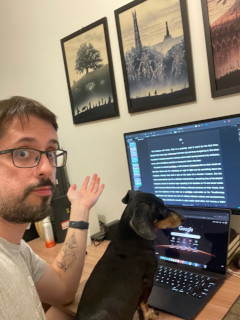
Renan Bernardo (he/him) is a Nebula and Ignyte finalist author of science fiction and fantasy from Brazil. His fiction appeared in Reactor/Tor.com, Clarkesworld, Apex Magazine, Podcastle, Escape Pod, Daily Science Fiction, and elsewhere. He writes from secondary world fantasy to dark science fiction, and he enjoys the intersection of climate narratives with science, technology, and the human relations inherent to it. His solarpunk/clifi short fiction collection, Different Kinds of Defiance, was published in 2024. His dark sci-fi novella, Disgraced Return of the Kap’s Needle, was published in 2025 by Dark Matter Ink. He also had stories recommended by Locus and longlisted for the BSFA.

Like what we do? Buy us a Cup of Coffee!


