Back to Journals
Home
Next Wondrous
Stories
A Note from the Guest Editor
T.K. Rex
As I read through these stories, in a year that feels more than ever like we are feeling our way through the dark, it struck me how much stories like these are needed. Solarpunk is not a well-defined or well-established genre; it is not fully formed yet by the forces that transmute the present into history. It is a guessing game, a race against reality, a stubborn insistence on the kind of hope that shows us what the next step might be. Sometimes it’s magic. Sometimes it’s science. Sometimes it’s literal solar power, and most of the time it’s whatever straw we can feel tickling the tips of our fingers as we grasp, and keep grasping, despite everything. Carl Sagan described science as “a candle in the dark,” and even the kind of magic that shows up in solarpunk is usually the kind that helps us find real-life solutions—some even see the act of writing it as magic, as work that helps to manifest a new reality, which storytelling has, in fact, been known to do.
I see each of these stories as a candle in the dark, lighting the way with curiosity and intention to a slightly brighter world. Laura Briskin’s “Of Cats and Other Strays” is a beautiful slice-of-life peek into the kind of foster care the author herself wished she’d had growing up. What could young people do and become if we all approached each other with such care? Torger Vedeler’s “The Tunnel To Forever” confronts the inevitability of death with curiosity, determination and love. How might the inevitable chaos in front of us play out if we stood facing it, shovels in hand, no matter the outcome? Mark Mitchell’s wildly entertaining “Captain Ahab’s Seafood Galley” tackles the working-class struggle of food service employees. What would work look like if we could simply trust each other to do what we’re good at, without parasitic middle-management and condescending customers? M. Frost’s “Flight of the Synths” explores identity and transition. What would it feel like to move through a world where we are all allowed to be fluid? Reginald Kwok’s “How a Phoenix Comes Back” shows us, through a fanciful lens, how real climate solutions can be horrifically unjust if executed callously. Richard M. Ankers’s “Rainy Days and Sun Rays” introduces us to a novel climate solution that merges nature and science, fighting for the future without forgetting the wonder of possibility. And in our featured reprint from Renan Bernardo, a community struggling to survive in a world of climate catastrophe acquires a hapless stranger.
How will our own communities handle outsiders when shared understanding and local expertise are the difference between life and death? How do we handle outsiders now, when the stakes are still relatively low compared to the horrors that might await? What we create, question and imagine today is the material we have on hand as we construct tomorrow.
May these stories light one more step in the dark for you, as they have for me.
T. K. Rex
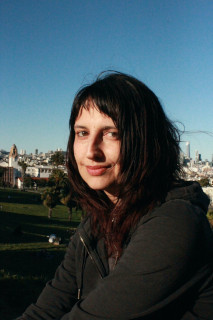
T. K. Rex is a science fiction and fantasy author from the western states, whose stories can be read in more than forty publications, including their solarpunk collection, The Wildcraft Drones, coming fall 2026. They’re an alumni of the Clarion, Taos Toolbox and Futurescapes workshops; a member of the Science Fiction & Fantasy Writers Association, the Authors Guild, and the Writers Grotto; and the co-host of Stir, a reading series in San Francisco. T. K.’s stories, socials, and newsletter can be found at tkrex.wtf.


