Back to Journals
Home
Next Wonderous
Story
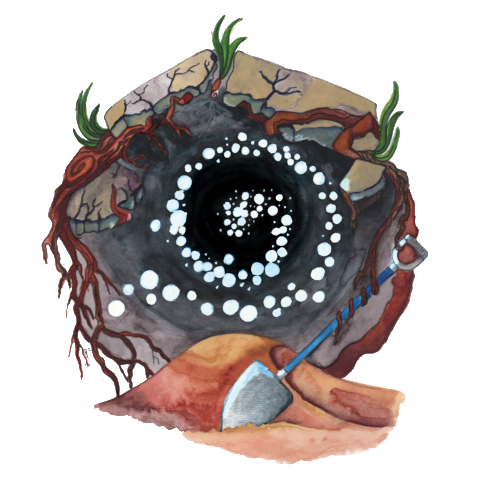
The Tunnel To Forever
Torger Vedeler
Illustrated by Kerry Mairie Scott
“There’s little more we can do,” the doctor said in his most professional tone. “It’s just spread too far.”
He had her test results before him, the MRI and the biopsy, all the wonders of modern diagnostic medicine laid out like a sterile symphonic score, and the look on his face suddenly made her think of Beethoven. How had the composer felt when he learned that he was going deaf? Had he thought then about the masterpieces unwritten, or the ones unheard, the ones that would never be played? He was working on a tenth symphony when he died, you know.
What an odd thought to have just now, Claire told herself. I’m neither a genius nor a composer. I’m not a Beethoven, but just a nobody who now is going to die.
Other words followed while the doctor gave her details that no longer mattered.
I have a tumor in my brain, she thought, a malignancy chewing through my identity. I never smoked or drank, always tried to take care of myself. I’ve always done everything I could to make other people happy, and now my own body is betraying me as though I should be punished. Sometime soon I will be angry with God. Sometime soon, I will need to hate him.
But not just yet.
Claire heard her own words then, the two words no one ever thinks they will hear from themselves, so cold, so sterile.
“How long?”
“With a cancer this aggressive, six months, maybe. With intense treatment, we might be able to add one or two more.” Despite being just middle-aged, the doctor had short, graying hair, his lab coat clean and immaculate over a bolo tie and blue shirt. Yeah, middle-aged, not that much younger than her, his expression gentle and his skin charcoal black. His name was Worrell, a gentleman.
But, his eyes said, and the images flashed before her: If we do the drugs and the radiation, you will be bald, thin, vomiting from the nightmare stereotype of chemotherapy, a riktus dead already. Gone. All over.
“No. I don’t want chemo,” she told him, making up her mind so quickly that it surprised her. “No radiation. I don’t want to go like that.”
He nodded. “I understand. We’ll make you as comfortable as we can. I can refer you to a therapist, and a good hospice company. You aren’t alone in this.”
Then why does it feel like I am? she thought. I can’t fight and I can’t win. I can’t run away. All I can do is die.
#
Claire went home to her small house and garden, to the safe place she had bought after her divorce ten years before. The quiet place with her things, the familiar things that she had gathered over a lifetime: A favored old book by John Steinbeck that had actually been printed before his death, the foreword referring to him in the present tense, and the wall in her bedroom decorated by a small, framed painting that she had bought in Vienna from an artist who she couldn’t name. Little dolls on her dresser that she had played with as a child and never brought herself to give away to her nieces. Polly and Penny, they were named (the dolls, not the nieces), and now they smiled at her as they always did.
We are with you, they said silently. Always. We are your friends.
That night she sat alone drinking herbal tea. I need to get things in order, she thought. So many things.
#
The next day Claire rose, having slept fitfully but surprisingly well considering, and after breakfast she went down to the basement. As basements often are, this was filled with other things, some of them clutter and some not, and not knowing why she found the shovel she had sometimes used for gardening. She found her hammer too, and the chisel she had bought years ago but never needed, this on the advice of her mother: “Better to be prepared, to have it and not need it rather than to need it and not have it.” And Claire took these things and stared at them for a long time.
Dig, the voice suddenly told her from nowhere. Dig.
Claire stiffened, looking first left and then right. “Hello?” she asked.
Silence, as there should be in a basement you visit alone. But then, more urgent, the voice.
Dig!
A breath, her breath, in with a snap. Up the stairs then, hurrying, startled. Up, away, the rush of adrenaline that comes with fear.
Dig! The voice called, echoing behind her.
#
Later, sitting in the dining room and staring at her shaking hands, the rational and logical explanation came. You have a brain tumor, you fool. You’re dying. Nothing you see or hear can be trusted.
But the voice, she answered. It was so real. It had something true in it.
I don’t want to die.
So dig.
How long she wept now, Claire didn’t know. This isn’t fair, she thought. Why is this happening to me? How long do you just sit alone, in the end?
Rising finally, Claire made her way back to the basement door. The voice met her.
Are you afraid? it asked.
“Yes,” she managed.
Of me?
Again, “Yes.”
Now the voice went silent. Claire waited, then asked her own question.
“Who are you?”
The first answer, even before it had a chance to come, rose from nowhere. I am the cancer. I am death, your death, your own body betraying you, rotting you out from the inside. You are going to die and I am the manner of it. So be afraid, Claire, because after me there is nothing, your identity and all you have ever been or done erased. Meaningless. But then the actual voice came, not her imagination, not harsh, not gentle, aloud, answering nothing.
I am that which I am. You need to dig, Claire. Now! While there is still time.
“I can’t,” she protested. “I’m too weak. I’m afraid.”
You are stronger than you think. I am that which I am. I will help, but you are the one who must do the work.
Words now, questions. Help me live, or help me die?
#
So she began.
The concrete broke under her blows (again, to be prepared she also owned a hammer and a chisel), even as it struck her as odd that the floor should give way so easily, for she was not a strong woman, nor a big one. But after a day or two the floor crumbled until there was room to cut away the rebar (she also had a hacksaw), leaving a hole big enough for her small frame to pass.
Dig, the voice said. I will be waiting. Where you are too weak I will help you.
“Why?” she asked finally. “Why are you doing this? I’m dying. I’m nobody. Why should I do anything?
You need to do this, the voice answered. You need to do something, anything, because that is why you are here. Do not ever say that you are nobody, Claire. To be somebody is why you were born.
“To obey you?”
To obey me is to obey yourself. It is to obey all things. Look how strong you are.
Foot after foot down, excavating, and suddenly Claire realized that if she was worried the soil might collapse in on her, this fear did not stop her. If it buries me then it buries me, she thought, only a little ahead of the soil of the graveyard.
Yes, said the voice. You are learning.
“Learning what?”
The most important lesson.
After a while disposing of the dirt proved a problem, and so Claire started carrying it up and out to her backyard garden, scattering it among the flowers there. I will miss you, she thought to them, remembering how she had planted each one, how she had tended them with water and fertilizer. Will you remember me?
Yes, they answered silently. Always.
Down. The earth smelled rich, welcoming.
Keep going.
“Where are you?” she asked. “Who are you? Why are you talking to me?”
Down here, there are answers to questions that no one ever seeks to ask. Keep going so you can ask them. Then you will understand.
“Who are you?”
Does it matter? Keep going.
#
Somewhere up there, in the world of before, in the world where she had once been Claire, people came to visit, to console her. Her sister wept on the phone and promised to come out. There will be hospice care, the experts said, when you want it, when you need it. Please don’t think you are alone.
“I know I’m not alone,” she told them, and wondered why she had said it.
Dig.
Perhaps this struck them as odd, living where she did, how she did. Cut off, no real friends, but kind neighbors who were so often too busy with their own lives to be as attentive as they should.
“No,” she told them. “I’m fine, really.”
A grief counselor? they asked again. Clergy?
“I’m fine.” They all knew she was hiding something, but how do you ask?
#
She was at Dr. Worrell’s office now, surrounded by the clean and sterile walls, the paper folders on the desk awaiting each new patient, and he regarded her. “The cancer has slowed,” he said. “You’re doing better than we expected.” His young, dark eyes, gentle. A different bolo tie.
How many others have sat in this office? she wondered. How many others have thought what I’m thinking right now?
How many others have been told to dig?
As he talked, the more important words came from elsewhere. Have I led a good life? Has my time here been worth it?
What will it feel like to die?
“How is the pain?” he asked.
“It hurts,” she answered.
“We can get you things for that. The normal rules don’t apply. Morphine, or stronger things. Just say the word and the hospice company will provide them.”
“Will they dull my senses?”
“They might.”
“I want to feel,” she said. “I want to feel while I still can.”
“Even pain?”
“Even pain. To a point.”
#
He gave her the prescriptions just in case she passed that point, little bottles clearly marked, pills and syringes. Two days later, the hospice nurse came for the first time. He had a kind smile and was a little heavy, though a lot of this was muscle brought from lifting and moving the sick.
She had dirt on her hands. “Doing some gardening?” he asked.
“Yes.”
“That’s good.” It was impossible to hide the growing mound of dirt outside. “How do you feel?” He was handsome, and a small part of her envied his wife.
“I’m all right. My sister will visit in another week. She wanted to come earlier, but she has things to do, and I told her to do them.”
“Are your affairs in order? Your will and the DNR paperwork? Are there possessions you want to go to particular people? We can help with that sort of thing.”
“Thank you. They’re fine. My money will go to some charities, my things to my sister and her kids. She and I will work all that out when she arrives.”
“Good. If you need anything, even just some company, you can always call. And I will check in with you every few days.”
#
Her tunnel grew. The roof held even though it shouldn’t have. Sometimes Claire would look up at it, at the way the roots of plants overhead traced in the brown, illuminated by her flashlight. She tried hard not to disturb them.
It’s all right, the trees said. We’re fine. Dig deeper.
“What am I digging for?”
You’ll find it when you find it.
Wendy, who insisted on taking a cab from the airport, arrived at last. “My God!” she exclaimed. “What’s with all the dirt?”
“I’ve been gardening.”
Wendy did that thing with her nose, not quite a scrunch, not quite a wiggle. The two of them had the same nose, inherited from Dad.
“Well,” she said, “we’ve been talking. We want you to come and stay with us.”
Until….
Wendy. Family. Claire felt the pull, the old, loving pull. When I die, will you be there to hold me? You will. I don’t want to lose you. I don’t want to lose a lifetime of you, my sister.
Claire realized that she was weeping, and that Wendy was weeping also, holding her.
“I’m afraid,” Claire admitted.
Wendy’s face. What do you say to that?
“Come home with me, Claire. You should be with family.”
When you die.
But then, there was also more. This something more, calling her, drawing her. Deeper and deeper. Claire heard her own voice, weak but real.
“My garden,” she said. “I don’t want to leave my garden.”
Wendy’s face, her confusion. But we are family, her eyes said. We love you.
Dig.
Finally: “You’re alone.”
You’re dying.
Dig.
“I’ve been alone for a long time. And I’ve made some new friends here. You and the kids are always welcome.”
Wendy’s lips parted, her jaw open, then closed. “Yes,” she managed. “That’s good. But….”
But you’re dying. You’re my sister and you’re dying. Dying changes everything. When Mom died, it changed everything. When Dad died….
Everything.
Where was Dad, there at the end, when the two of them had stood beside his bed? His body, yes, but it wasn’t him. Looking out into nothing, it wasn’t him, talking to Mom like she was still alive. Claire remembered holding his hand, and the way it all just… stopped.
“Do you really want to stay here?” Wendy asked.
I have this thing I need to do, Claire thought. I hope it’s the right thing. I can show you down there, if you want. I’m sure they won’t mind. You’re my sister.
Discomfort. Life is busy. Living is busy, getting affairs in order, busy. But you, Claire, you have nothing to do now. Everything that matters has been stripped away. A few months, and then?
Come down here, the voices called. You’re almost there.
And then?
You’ll see.
“I want to stay,” Wendy managed, “but….”
Claire. “It’s all right,” she said. “You are forgiven. For anything you might regret, that you ever might have done, you are forgiven. I want you to know that.”
They wept together again, the two sisters. And Wendy promised that she wouldn’t be far away.
#
The roots now held the soil, parting it for her, making it easier to dig despite the pain. Claire kept the morphine close, still not wanting to start with it.
“I don’t want to lose you,” she told the voices. “I’ve lost so much, so many. I think I’ve lost my sister. I think I drove her away. I should have let her take care of me. Why do I always do what people tell me to do? Is there anything I have ever done simply because it mattered to me?”
You have never lost anyone, Claire. Listen to me. What matters most are those things you have done for others that you never knew you did. They are close, we are close. You are close. Keep going. Keep going.
How far? How long?
Forever. So close. Forever.
And then….
#
The pain, real. Her eyes, blinking away tears, real in the darkness, not needing the flashlight. Listen, the silent voices said now. The pain binds you, it ties you to here, to this place and world. But you are now deep, and the path forward is open for you to walk. Don’t be afraid. We are waiting to love you. We love you already. We have always loved you.
“But I am afraid,” she admitted. “It’s hard to move, and I feel so weak. I feel so helpless.”
The roots moved quickly now, no longer needing to hide their true nature, parting to show the way, the rich soil no impediment. They and the earth and she were one, joined.
We will dig for you now, Claire. Your work is almost complete. We will carry you the rest of the way.
Finally they reached a place and stopped, not knowing why but knowing she should, and the path behind her vanished into the cool earth. The embrace of the roots gently tightened and time ceased to be. Wendy, she thought. I’m so afraid to leave her.
It’s all right. The fear is a part of the greater whole. The pain also. But more than these is the joy, the love that is all creation. Do you feel it now? It is greater than any pain can be. It is forgiveness, absolution, a thing beyond any words or even what words can comprehend. Do you feel it?
“I think…. Yes…. There are no words….”
The roots caressed her, the rich soil close. No words. You have come so far, Claire. You have reached the final place and the beginning place and you are safe here. Wendy will never be far away. She will understand and you will greet her again in time. All of them will understand, as your mother and your father do.
Please, Claire thought. Please….
Let go. You are loved, forever.
Claire obeyed, surrendering at last, and the last of the rich soil, thick with the roots of the living, compassionate trees, closed gently and finally around her.
THE END

Torger Veleder is a graduate of the Taos Writers Workshop in 2024, Torger Vedeler has had work published in a variety of science fiction and fantasy venues, including Not On of Us, Palimpsest, and The Fifth Di…. His story Ilium received an honorable mention in Year’s Best Fantasy and Horror: 20th Annual Collection, in 2007.

Like what we do? Buy us a Cup of Coffee!


