
Mythical Kings, No Iguanas,
An Analysis of the Annotated King in Yellow
Reviewed by Rev. Denise D. Dumars, MA, Professor of English, retired, Los Angeles Harbor College
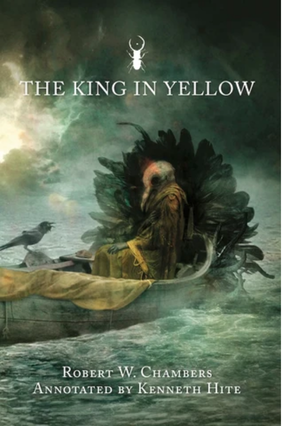
King in Yellow
By Robert W. Chambers, Annotated by Kenneth Hite
I have flown to star-stained heights
On bend and battered wings
In search of mythical kings,
mythical kings
–Dory Previn, “Mythical Kings and Iguanas”
In modern times The King in Yellow Mythos has taken on a life of its own, in much the same way that H.P. Lovecraft’s Cthulhu Mythos has done. There is one big difference, however: while Lovecraft championed other writers playing in his sandbox, so to speak, we cannot say the same of Robert W. Chambers, the author of the stories in The King in Yellow (KIY) (1895) collection. And the obsession with Chambers’ KIY stories which has engendered other fiction, film, television, games—not to mention extensions of and revisions of the actual King in Yellow play itself—is most likely due to Lovecraft’s involvement with it, and August Derleth’s continuing involvement with it after Lovecraft’s death. Chambers was still alive when Lovecraft was adding elements of the King in Yellow world to his own mythos; we do not, however, know whether Chambers had any knowledge of this; although he is listed as publishing three collections of weird tales (Hite 2019), they were but a small portion of his literary output (p.236). Most scholars seem to believe that he didn’t read Weird Tales or similar magazines and was not acquainted with the Lovecraft mythos or its proponents (John Linwood Grant, personal communication, August 16, 2026). Others known as scholars in the field concur (Katrin Pulver, personal communication, August 17, 2026).
Just as nothing occurs in a vacuum, the stories that fit within the KIY universe in Chambers’ collection owe their existence in part to already-existing work. Ambrose Bierce gave us Carcosa, Hali, and Hastur, which Chambers references in his own way (Morales 1996-2026). The author of The King in the Golden Mask might have been an influence on Chambers, having first been published in 1892, three years before the first printing of The King in Yellow. Riffing on Lovecraft’s mention of Hastur, the Lake of Hail, and the Yellow Sign in his tale “The Whisperer in Darkness,” (1931) August Derleth morphed Chambers’ and Bierce’s references (Hastur as a half-brother of Cthulhu, for example) to fit within his own monstrous universe (1939). After all, Lovecraft had encouraged others to build upon his work, and he mentioned many other authors, including Chambers, in his essay “Supernatural Horror in Literature,” (1927) which Lovecraft spoke of after he had read his work in the same year. It is doubtful that Chambers knew anything about what Lovecraft, Derleth, and other writers of horror and science fiction at the time were doing in regard to his work as he was not part of that group of writers (Jean-alain Moens Puyaubert, personal communication, August 16, 2026).
It helps that the play The King in Yellow, which famously drives one mad, isn’t finished in the tales; I know at least one thespian who has done a revision and expansion of it (Michael Eastman, personal communication, August 2nd, 2025). That the tales themselves seem fragmentary and not consciously building upon a mythos seems to make fans want to delve deeper in order to find connections to these tales and to help explain them—assuming that they do exist. The fact that the most common edition—published by Dover (1970)—does not contain the same stories as the annotated Hite edition (2019) and the Horror Writers Association edition (2021) adds to the confusion. Until I got the Horror Writers Association version and the Hite version, I was surprised to see that the listed tales were not the same as in the Dover edition, which I had been reading all along and had assumed were correct.
This is not the only book to annotate the collection (Unfading Pages 2024) and won’t be the last. There are different approaches to annotation, and the approach taken here is sometimes to speculate upon origins and ideas of a variety of possible sources and meanings, not just to explain or add to what the author has to say in his works. Again, not the first time this has happened, but as each annotator brings their own approach to the work, this volume should be of great interest to those who want to teach the tales, understand outside work in the KIY mythos, write some KIY fiction themselves, or just enjoy these stories more. As such, this volume is highly recommended with only some slight qualification.
For example, in discussing the lyrics of Cassilda’s Song (p. 9) Hite (2019) opines that King Lear and his daughter Cordelia may have been the inspirations for the King in Yellow and Cassilda (p. 11), but I see no objective evidence for that assumption. Rather, there is an historic king who was masked: his name was Baldwin IV of Jerusalem, known as “the Leper King.” He wore a mask to hide his disfiguring illness (Seaver, 2024). If you have seen the 2005 film Kingdom of Heaven, then you have seen this king (who wears a gold mask) portrayed by Edward Norton. And Hite (2019) does mention that some of the ideas in the stories might have been inspired by Marcel Schwob’s The King in the Golden Mask (1892). Hite (2019) also mentions a St. Casilda of Toledo and other uses of the name in Spanish culture and literature (p. 11). Although I have never met a woman named Casilda spelled either way despite a lifetime in California, it would be not much of a leap of faith to assume that it was once a popular name in Spain if not here in New Spain. Since many if not most of Chambers’ characters are francophone, the inclusion of a Spanish name amongst the French does not in any way refer to the Briton known variously as King Lear or King Leir (Morris, 2020, May 26).
If I have one main problem with the Hite edition it is that the annotations are microscopic, possibly 2-4 pt. With a lot of wasted white space on each page, the typesetter could have formatted the book differently which would have made the annotations more readable. They crawl alongside the text rather than the standard formatting which usually has the annotations at the bottoms of the pages. This became a genuine problem at times when I tried to match footnote number with footnote text, both of which were extremely difficult to read.
Scholars such as PhD&D (2026, February 18) are fond of the Hite (2019) annotated edition. The annotations do tend toward the comprehensive, meaning that they address not only the requisite explication of the stories, but also the objective and sometimes speculative explanations of real places and events that are noted within the stories. For example, in the tale “In the Court of the Dragon” Hite (2019) tells us that Rue Saint-Honoré is a real street in Paris and outlines its importance to the time and place of the story and also its importance in the history of Paris (p. 71). As such these types of annotations may seem like side quests, yet for scholars and completists they can prove valuable.
Another valuable component of Hite’s annotations is in evidence when he links examples and themes. While scholars from all these sources (Black 2024) tell us that yellow was the color of the Decadent movement—the fact that most brands of absinthe are a sickly chartreuse is not a coincidence—Hite (2019) comments on the color in several places. “In the Court of the King” he compares the yellow jonquils at the story’s flower market to what he calls the “dual nature” (Hite 2019) of the color yellow (p. 71).
In another example, the almost ubiquitous “Pallid Mask” (Hite 2019 p. 58) as mentioned in the story “The Mask” gets the full treatment of footnoting (p.57) as Hite (2019) lists its appearance not only in “The Mask” but also in the story “the Yellow Sign” and in the King in Yellow play itself. He continues by discussing the phrase “the Pallid Mask” as it appears in unrelated authors’ works including William Smart’s 1829 translation of the Satires of Juvenal and other sources that Chambers may have read (p.57).
Annotations can be helpful in illuminating an author’s pop culture references that may mean nothing to us a century and a quarter in the future. For example, there’s a quote that doesn’t make much sense unless you know the reference in “The Yellow Sign” (Hite 2019): “I prayed inwardly that fate would keep her away from men like me and throw into her path nothing but Ed Burkes and Jimmy McCormicks” (P. 87), states the doomed artist of his equally doomed model. Hite (2019) informs us that, according to scholar S. T. Joshi, he must have been referring to popular 19th century baseball players of the same names, which are likely forgotten by all but baseball historians (87). This mention would perfectly align with what we know of Chambers himself.
In addition, the book contains three appendices (Hite 2019): Appendix I: Robert W. Chambers, (pp. 234-238); Appendix II: The King in Yellow, (pp. 239-247); and Appendix III: Three Names from Bierce (pp. 249-254). I found these very helpful in tracking the publication of the work, the character of the author, and the background information on the Ambrose Bierce contributions to what has become the King in Yellow Mythos. Nothing exists in a vacuum: This annotated volume helps the reader see the genesis of important elements of the work and how they come to have meaning in the history of the larger context of the King in Yellow.
In her song “Mythical Kings and Iguanas” (1971), Dory Previn decries our focus on lofty things, be they mythical royalty, intellectualism, or mysticism, when such a focus takes us away from the more grounded world, as in the example of the titular lizards, which are perfectly adapted to several diverse ecosystems and therefore provide a great example of the success of earthly life. As we go chasing off for lost Carcosa and drive ourselves mad perhaps at trying to understand exactly who and what the King in Yellow really is, perhaps we need to take a step away, and remember that Chambers loved the sunshine, sports, and the natural world and stated vociferously that he was not part of the Decadent movement (PhD&D, 2026). I’m sure he’d be peeved to find himself listed as one of the Decadents in the New World Encyclopedia (n.d.)! Perhaps the real mystery is how someone who presented as the very model of wholesome American manhood managed to creep into our imaginations with ideas that are the very opposite of his reality. Or perhaps I should paraphrase Mystery Science Theater 3000: They’re only stories, and we should really just relax and enjoy them.
References
Bierce, Ambrose. (1984). The Complete short stories of Ambrose Bierce. Bison. (Original work published 1909-1912).
Black, Jon. (2024, October 13). Yellow signs: the decadent movement and its influence on weird fiction. Jon Black Writes. https://jonblackwrites.com/2024/10/13/yellow-signs-the-decadent-movement-and-its-influence-on-weird-fiction/
Chambers, Robert W. (2024) The king in yellow (annotated). Unfading Pages. (Original work published 1895).
Chambers, Robert W. (2019) The king in yellow: annotated edition. (Kenneth Hite, Annotations). Arc Dream. (Original work published1895)
Chambers, Robert W. (1970). The king in yellow and other horror stories (E. F. Blieler, Ed.)
Dover. (Original work published 1895, 1896, 1897, 1904)
Chambers, Robert W. (2021) The king in yellow. (Eric A. Guignard and Leslie S. Klinger, Eds.) Introduction by Nic Pizzolato. Horror Writers Association.
Decadent Movement. (n.d.) New World Encyclopedia. https://www.newworldencyclopedia.org/entry/Decadent_movement
Derleth, August. (1998). The return of Hastur. The Hastur Cycle. https://lovecraft.fandom.com/wiki/The_Return_of_Hastur (Original work published 1939)
Lovecraft, H. P. (2011). Supernatural Horror in Literature and other Literary essays. Wildside. (Original work published 1927)
Lovecraft, H.P. (2016) The whisperer in darkness. The complete fiction of H. P. Lovecraft – Vol II: The whisperer in darkness and other tales. Chartwell. (Original work published (1931).
Morales, Joseph F. (1996-2026) AB: Ambrose Bierce. The Cthulhu Mythos: An annotated bibliography. https://cthulhufiles.com/biblio/cthabib_bierce.htm
Morris, Mathew. (2020, May 26). Leir of Leicester: The archaeology behind the legend. ULASNEWS. (https://ulasnews.com/2020/05/26/leir-of-leicester-the-archaeology-behind-the-legend/
Mystery Science Theater Theme song (2026) Mystery science theater 3000 theme song lyrics. Lyrics on Demand, https://lyricsondemand.com/tvthemes/mysterysciencetheater3000lyrics.html
PhD&D. (2026, February 18) What unites “The King in Yellow” (1895)’s tales? Decadence, true love, and Robert W. Chambers’ life. YouTube. https://www.youtube.com/watch?v=hvSg_Q-6Zck&t=171s
Previn, Dory. (1971). Mythical kings and iguanas [Song]. On In search of mythical kings: the UA years [Album]. Capitol.
Schwob, Marcel. (2017) The king in the golden mask. (Kit Schulter Translator). Wakefield. (Original work published 1892)
Scott, Ridley. (Director). (2005) Kingdom of heaven [Film]. 20th Century Fox.
Seaver, Carl. (2024, December 10). The life of Baldwin IV of Jerusalem, the leper king. History Defined.net. https://www.historydefined.net/baldwin-iv-of-jerusalem/.
For further reading:
Barrass, Glynn Owen, Ed. (2014) In the court of the yellow king. Celaeno.
Barrass, Glyn Owen, Ed. (2025 Spring) Weird fiction quarterly: The king in yellow. Weird Fiction Quarterly LLC.
Chambers, James, Ed. (2021) Under twin suns: alternative histories of the yellow sign. Hippocampus.
McLaughlin, Mark and Michael Sheehan, Jr. (2020) The Prisoner of Carcosa. Privately published.
Price, Robert M., Ed. (1997) The Hastur Cycle. Chaosium.
Rawlik, Peter, Ed. (2019). The Chromatic court. 13th Wall.
Shirley, John. (1988). The Black Hole of Carcosa. St. Martin’s.

Throughout her prolific writing career Denise Dumars has written and published poetry, short stories, articles, and reviews in journals such as Terra Incognita, Cinefantastique, and Talebones. She is a columnist for Star*Line, the journal of the Science Fiction Poetry Association, and a peer reviewer for Coreopsis: A Journal of Myth and Theater. She has also published two collections of short stories; two non-fiction books, including The Dark Archetype (with Lori Nyx), and numerous chapbooks of poetry, the most recent of which is Letting in the Dark (Yellow Bat Press). Denise teaches a variety of English courses in Southern California colleges.

Like what we do? Buy us a Cup of Coffee!