
The Vision Keepers: Review of Custodians of Wonder
By Yvonne Owens, PhD
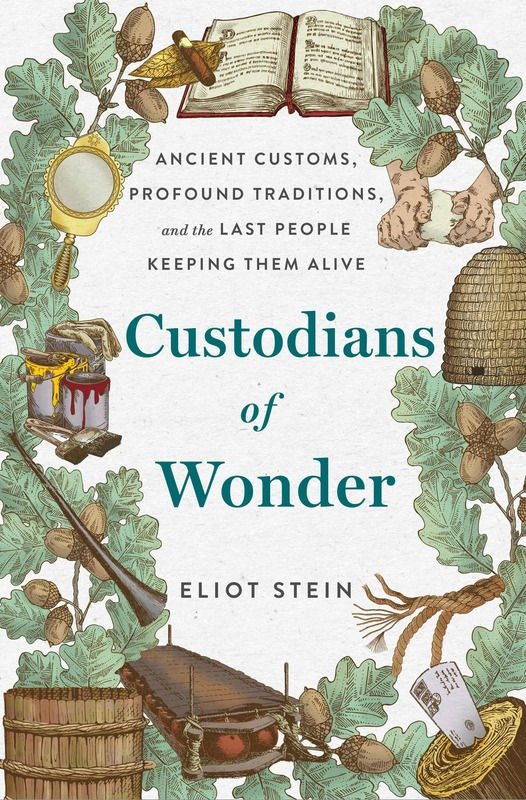
Stein, Eliot. Custodians of Wonder: Ancient Customs, Profound Traditions, and the Last People Keeping Them Alive. St. Martin’s Press, 2024. $35.80.
This collection is an anthology of stories in the Wonder Tale tradition. Eliot Stein tells us the stories of some of the last custodians of age-old rites on the brink of disappearance in an increasingly tech-savvy, tradition-impoverished world. Each of the ten stories focuses on a single individual who acts as a custodian of a legacy cultural artifact, festival, folkloric custom or collective ritual observance. Evidently, the world is rich with these touchstones, even if some of them are little known outside of their immediate communities, villages or towns.
Preserving arcane and fascinating roles, practices and customs, the unusual characters profiled include the last living Inca bridge master, Victoriano Arizapana. Living in Peru’s Southern Highlands, Arizapana annually rebuilds a particular grass-woven bridge called the Q’ueswachaka, a survivor from the fabled Inca Road System This dangerous enterprise is only undertaken after the solemn sacrifice to the celestial deities of a sheep’s heart and a llama fetus, and an offering of cañazo cane liquor for the apus, the four mountain spirits. Arizapana takes his life in his hands each and every time he reweaves this bridge, “diligently fulfilling a duty that the men in his family have maintained for more than 500 years.(p. 69)” He remembers the words of advice his father gave him: “Trust yourself, have faith in the apus, and don’t look down.” (p. 69)
The last suspended woven rope bridge that remains from the ancient Inca Empire, the Q’ueswachaka spans a thirty-meter crevasse, at the bottom which rushes the Apimurac River rapids. In 1548, the Spanish chronicler Pedro Cieza de León wrote a pean to the Inca road system: “I believe since the history of man, there has been no other account of such grandeur as is to be seen on this road, which passes over deep valleys and lofty mountains, by snowy heights, over falls of water, through the living rock and along the edges of tortuous torrents.” Cieza de León was deeply impressed by the engineering of the Qhapaq Ñan (the Inka Road), which he described as spanning thousands of miles across hazardous mountain terrain without the use of wheeled vehicles, iron tools, or large draft animals.
Stein’s global search for magical cultural survivals took him deep into a German forest, seeking the official mail carrier delivering to the only tree in the world with its own address. Countless people from across the world have written letters to this tree in hopes of finding love;being directed to a legitimate, official address, their letters must be delivered. The Bridegroom’s Oak (Bräutigamseiche) in Germany’s Dodau Forest near Eutin is a famous centuries-old tree used as a unique mailbox to connect singles for love, with letters dropped in its knothole and delivered by postal workers, leading to numerous matches and marriages since its legend began in the late 1800s, when a forester’s daughter and a chocolatier’s son secretly exchanged letters in the tree to bypass her disapproving father, and eventually married under its branches.
The tree is rumoured to have fostered over one hundred marriages and countless romances. Seekers after love can visit the tree, climb the short ladder to the knothole that serves as a post box, read the letters and respond to any that seem suited and compatible. These days, the many letters from the lovelorn are delivered by a new mail person who keeps up the tradition. But for twenty years, starting in 1984, the letters were delivered by Karl-Heinz Martens. Now in his eighth decade of life, Martens reminisces in Stein’s book, relating how, in his time, he delivered letters from every region in Germany. Despite having sworn off romance in his personal life, Martens himself found a great and lasting love through his service to the tree and its communicants.
Stein relates the Bridegroom’s Oak to the German love of fairytales and forests, and the romantic tradition of waldeinsamkeit. Loosely translated as “solitude of the forest,” waldeinsamkeit is the practice of wandering aimlessly in deep forest. An archaic German term for the feeling of “forest loneliness,” it is currently enjoying a resurgence of interest in Germany, where the German proverb, “With the cutting of the first trees, culture begins, with the falling of the last trees, it ends,” holds deep meaning and relevance. Stein ends this tale with his observation: “…in a way, the Bridegroom’s Oak is the most sublime example of waldeinsamkeit—an enduring reminder that if you put your faith in the spirit of the forest, it can help you not only find yourself, but to lose yourself in something greater than yourself.” (p. 264)
The story of the Bridegroom’s Oak reminded me of the ancient Celtic Oak god, Bel, patron of Beltaine, the festival of erotic love, trial marriages, fertility and pair bonding. At Beltaine, youths of all ages were encouraged to at least strike up a romance and hook up—even if not for life—in celebrations of lust, love, fecundity and the flowerings of early summer.
My favourite narrative in the book is of a British beekeeper who maintains the custom of “telling the bees” important news. There are many reasons for this: Bees were sacred to one of my favourite civilizations, the Minoans of Thera and Crete; they’re social insects who form a matrifocal collective where all members selflessly serve the greater good; and, far from humans occupying top slot, Bees are now widely considered the most important species on Earth. This distinction is primarily due to their crucial role as pollinators, pollinating about a third of the world’s food and maintaining biodiversity by enabling plant reproduction, which in turn forms the base of vital ecosystems. Also, they’re strangely smart; you can talk to them and they’ll respond, en masse. There are several stunning accounts of bees’ perspicacity and seemingly magical comprehension of human desires, wishes, problems and grief in Chapter 7, “Where Bees Are a Part of the Family.” They seem to want to help. Stein says at the close of this chapter that the book really belongs to his mother because her extraordinary, trusting, optimistic relationship with bees formed the foundation for his crafting of it.
Other stories in the collection include the tale of the only three women in the world who retain the knowledge of know-how to make the world’s rarest pasta. In India, Stein discovered a family known to make a mysterious metal mirror that can reveal your truest self, and in West Africa he found a 27th-generation Ghanan griot, a living archive of oral history and chronicles who maintains the traditional roles and duties of the ancient Ashanti royal bards. The tales relay instances of unobtrusive magic and lore, faithfully observed in situ over decades or centuries, so embedded in the quotidian lives of participants and adherents that they are largely taken for granted in their wondrous strangeness. Yet the rites, routines and processes constitute some of the oldest, rarest cultural traditions that remain in the world. Anyone interested in story, world culture, tradition, magic, and the human capacity for wonder will be interested in this book.

Yvonne Owens writes art and cultural criticism, exploring contemporary post-humanist discourses in art, literature and new media. She is author of Abject Eroticism in Northern Renaissance Art: The Witches and Femmes Fatales of Hans Baldung Grien (Bloomsbury, 2020), and Editor of Trans-Disciplinary Migrations: Science, the Sacred and the Arts (Cambridge Scholars, 2024). Earlier publications include The Witch’s Book of Days (Beach Holme, 1993), The Cup of Mari Anu (Horned Owl, 1994), The Journey of the Bard (Horned Owl, 1996), and The Saturnine History of Jews and Witches (Penn State University Press, 2014).

Like what we do? Buy us a Cup of Coffee!