
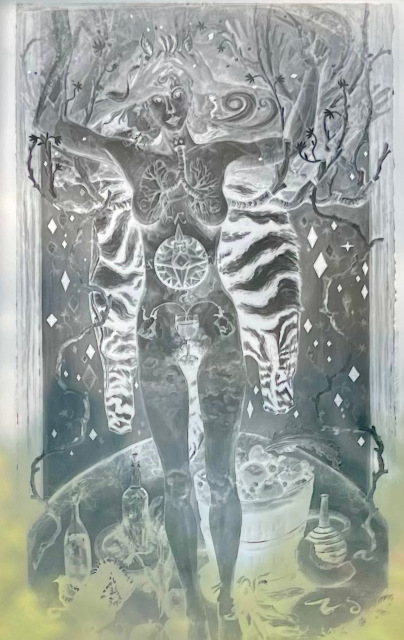
Illustrated by Denita Benyshek
A Mother’s Inquiry Into The Neurobiology of Geophilia
By Sabahat Fida, M.Sc, M.A.
Abstract
This essay examines the neurobiological foundations of geophilia , the innate human affinity for the earth and the natural world, through the lens of a mother’s encounter with her toddler’s irresistible pull toward soil. Beginning with the serotonin-stimulating bacterium Mycobacterium vaccae, the inquiry moves through Howard Gardner’s naturalist intelligence, the anxiolytic chemistry of plant aromas, and Attention Restoration Theory (ART) to argue that our connection to nature is not sentimental but structurally embedded in human neurobiology. Drawing on research in biophilic design, fractal aesthetics, healthcare environments, and outdoor learning, the essay demonstrates that geophilia is simultaneously a neurological inheritance, a perceptual preference, and an educational and therapeutic resource.
Keywords: neurobiology, biophilia, geophilia, Attention Restoration Theory (ART), fractals, golden ratio, Fibonacci sequence, biophilic design, naturalist intelligence
A Mother’s Inquiry Into The Neurobiology of Geophilia
“Be like the earth: despite being trodden upon, it continues to give. It is stepped on by the righteous and the sinner alike, yet it remains generous.” Imam Ali (Nahj al-Balagha)
I watched my toddler’s small hands plunge into the soil, fingers wriggling with delight as the damp mud raked underneath her fingernails. Her face alight with a particular unmatched joy and I can hear myself saying no, repeatedly, but she returns to the soil like a compass needle swinging north and each time my irritation grows. I drag her away. Her hands, still flecked with mud, I wipe them clean and pull her from the soil to the cleaner indoor.
I searched for the root cause of her pull, which has a name Geophilia ( love for earth) – describes the innate human affinity for the earth and the natural world. It is a subset of Biophilia, the broader evolutionary hypothesis, stating that humans have instinctive bond with other living systems. Behind my toddler’s instinct lies a bacterium Mycobacterium vaccae which brings a remarkable cascade within our bodies. It stimulates the production of serotonin, the neurotransmitter that regulates mood, eases anxiety, and cultivates a sense of calm (Lowry et al., 2007). It made me understand that the deep, often inconvenient urge to connect with the natural world is not frivolous. It is a biological inheritance; an innate intelligence embedded in us.
Howard Gardner identified “naturalist intelligence”, the ability to recognize and classify plants, animals, and natural phenomena as a core human intelligence (Gardner, 1983, 1999). Young children often exhibit this more than adults because they experience the natural world through “primary perceptions”: direct, sensory-based engagement.
Research shows that the fragrance of lavender increases serotonin, dopamine, and noradrenaline—neurotransmitters that regulate mood and ease anxiety. Inhaled linalool, its active compound, activates olfactory neurons that trigger calming effects comparable to benzodiazepines, but without the sedation (Schuwald et al., 2013; Takahashi et al., 2011). Plant aromas aid stress recovery by reducing global brain activity and enhancing information exchange between brain regions. The olfactory system connects directly to the limbic system, the brain’s emotional centre, bypassing the cognitive filtering that visual and auditory stimuli require. This is why fragrance can calm us almost instantaneously.
But the olfactory system, powerful as it is , is not the only entry point for nature’s calming influence. The human visual system is exquisitely attuned to the natural world, and this connection exerts a profound, measurable influence on our neural pathways. When we observe vegetation, flowers, or natural landscapes, our brains respond with a pattern of activity associated with calmness and restoration. This phenomenon is partly explained by Attention Restoration Theory (ART), which posits that natural scenes engage our attention through “soft fascination”, a gentle, involuntary form of focus that allows our directed attentional capacities to rest and replenish (Kaplan, 1995; Kaplan & Kaplan, 1989). Unlike the harsh, sharp edges of urban environments or digital screens, which demand constant cognitive effort, the fractal patterns found in tree canopies, the gentle curves of petals, and the layered depth of natural scenes allow the brain to enter a state of effortless alertness (Basu et al., 2019).
What makes ART genuinely scientific is that its predictions can be observed directly in brain. Neuroaesthetic research supports this: functional MRI studies have shown that viewing natural scenes activates the anterior cingulate gyrus and the insula, regions associated with empathy, emotional regulation, and parasympathetic nervous system activity ,while simultaneously reducing activity in the amygdala, the brain’s fear and stress centre (Ulrich et al., 1991). Even the colour green, dominant in vegetation, has been shown to reduce physiological stress markers such as heart rate and cortisol levels, while the presence of flowers specifically triggers immediate, genuine smiles and positive emotional responses across cultures (Haviland-Jones et al., 2005). In the context of geophilia, this visual dimension reveals that our affinity for nature is not merely poetic but deeply encoded in our neurobiology- refers to the measurable ways our brain structures, neural pathways and neurochemical pathways and processes which shape our emotions, behaviours and preferences. The earth does not only calm us through what we smell or touch, but through what we see—offering our overstimulated minds a visual architecture designed, by millennia of co-evolution, for peace and restoration.
But the patterns of the natural world run deeper than scent and soil. They run in mathematics. The golden ratio phi, approximately 1.618, appears throughout nature: in the spiral of a sunflower, the curve of a nautilus shell, the branching of leaves. What fascinates me is that even the human cerebrum and corpus callosum, the bundle of nerves connecting the brain’s hemispheres, appear to respect the divine proportions of the Fibonacci sequence. Our brains, it seems, are built from the same numerical grammar as the natural world we are drawn to.
A 2023 study demonstrated that the golden ratio distribution in neural spike codes, the patterns of electrical impulses neurons use to transmit information, gives rise to optimal information processing rates and channel capacity (Deng, 2023).
If our brains are literally built on this grammar , then exposing them to that even indirectly should be therapeutic. One study that illuminates this comes from Shaimaa Kassem and her colleagues at Helwan University in Egypt, who explored how the Fibonacci series could be applied to the design of textile printing to support the psychological aspects of cancer patients (Ibrahim & Kassem, 2016). Their research was both analytical and experimental, taking the Fibonacci series and rendering it in contemporary artistic forms, with diversity in colour groups and a multiplicity of sensory and visual effects. The goal was not merely aesthetic. It was to achieve balance in shape, colour, energy, and function, all working together to generate positive energy that helps increase the performance of human vital functions. What struck me about this research is the recognition that pattern, when drawn from nature’s own mathematics, can become a form of care.
This approach aligns with a broader movement in healthcare design known as biophilic design. The Biophilia 2.0 Collection by Designtex, for example, is a series of woven and coated textile upholstery designs created specifically for healthcare environments (Designtex, 2020). Each textile is inspired by natural patterns—fractals, chaos and flow, and the Fibonacci sequence—with the explicit goal of bringing a sense of calm, clarity, and connectedness to spaces of treatment and recovery. These designs are informed by extensive research proving a tight link between the design of a space and the effectiveness of treatment and the general well-being of patients and staff.
Florence Nightingale understood this in 1859. She spoke of the benefits of light, colour, and the hospital environment on healing and illness (Nightingale, 1859). What she intuited then, research now confirms: a rich sensory experience that engages the user through visual and haptic elements can have significant positive psychological and physiological responses. Even subtle uses of biophilic design can transform the built environment to better serve the well-being of its occupants.
The mechanism behind this is not mysterious. Superior pattern processing is a fundamental part of the human brain. We are evolutionarily inclined to recognize patterns, and this instant identification is conducive to stress-relieving properties. Fractals, for instance, have been shown to reduce stress by up to 60 percent (Taylor, 2006; Taylor et al., 2011). Humans display a consistent aesthetic preference across fractal images, regardless of whether these images are generated by nature’s processes, by mathematics, or by the human hand. This suggests that our brains are attuned to processing these complex shapes in a way that fosters visual comfort and ease.
The growing body of evidence supporting geophilia is further substantiated by research demonstrating the superior efficacy of learning in natural environments. Recent meta-analyses have quantified this advantage, revealing that outdoor learning significantly improves academic achievement across disciplines—from sciences and mathematics to reading and social studies—by fostering engagement, motivation, and deeper conceptual understanding (Pulido et al., 2025). Studies show that “green classrooms” designed with natural elements, such as plants and natural light, are not only perceived as more restorative but also more effective in supporting students’ attentional performance compared to conventional “grey classrooms” (ZHAW, 2026). This confirms that even modest integration of natural elements into built learning environments can enhance both cognitive performance and emotional state.
So when my toddler chases around the birds and giggles out loud, her pronounced urge to sit by our chicken coop for hours and her favourite pastime by the water tap, I know it’s the orchestra of her nervous system making her happy. She is not being unruly. She is being human in the oldest, most neurologically honest way.
I began this inquiry wondering why my daughter loved dirt. I end it watching her stand perfectly still, head tilted upward, tracking a bird’s arc across the sky with a focus I can no longer summon. Her newest passion is birdwatching and I watch her with something close to envy. She does not check her phone to identify the species. She does not photograph it for later. She simply sees it, lets it fill her attention completely, and then moves on when it flies away. My attention is contaminated, fractured, untidy. My daughter, by contrast, still possesses the original operating system: curious, patient, fully alive to the world as it is, not as it is mediated. I want to unlearn my restlessness by watching her stillness. I want to set aside the phone let her be my teacher since the earth is her classroom.
“The earth is your cradle, your mother, and your abode. From it you were created, to it you return, and from it you will be resurrected.” (The Holy Quran, 20:55)
References
Ali ibn Abi Talib. (2008). Nahj al-Balaghah: Peak of eloquence (S. Ali Reza, Trans.). Tahrike Tarsile Quran. (Original work published ca. 10th century)
Basu, A., Duvall, J., & Kaplan, R. (2019). Attention restoration theory: Exploring the role of soft fascination and mental bandwidth. Environment and Behavior, 51(9), 1055–1081. https://doi.org/10.1177/0013916518774400
Deng, B. (2023). Golden ratio information for neural spike code. Journal of Neuroscience and Neurological Disorders, 14(S7). https://doi.org/10.4172/2171-6625.14.S7.001
Designtex. (2020). Biophilia 2.0 collection. https://www.designtex.com
Gardner, H. (1983). Frames of mind: The theory of multiple intelligences. Basic Books.
Gardner, H. (1999). Intelligence reframed: Multiple intelligences for the 21st century. Basic Books.
Haviland-Jones, J., Rosario, H. H., Wilson, P., & McGuire, T. R. (2005). An environmental approach to positive emotion: Flowers. Evolutionary Psychology, 3(1), 104–132. https://doi.org/10.1177/147470490500300109
Ibrahim, M. M., & Kassem, S. S. (2016). Taking advantage of Fibonacci’s series to support the psychological aspects of female cancer patients through printed textile designs. International Design Journal, 6(3).
https://jdsaa.journals.ekb.eg/article_70452.htmlKaplan, R., & Kaplan, S. (1989). The experience of nature: A psychological perspective. Cambridge University Press.
Kaplan, S. (1995). The restorative benefits of nature: Toward an integrative framework. Journal of Environmental Psychology, 15(3), 169–182. https://doi.org/10.1016/0272-4944(95)90001-2
Lowry, C. A., Hollis, J. H., de Vries, A., Pan, B., Brunet, L. R., Hunt, J. R. F., Paton, J. F. R., van Kampen, E., Knight, D. M., Evans, A. K., Rook, G. A. W., & Lightman, S. L. (2007). Identification of an immune-responsive mesolimbocortical serotonergic system: Potential role in regulation of emotional behavior. Neuroscience, 146(2), 756–772. https://doi.org/10.1016/j.neuroscience.2007.01.067
Nightingale, F. (1859). Notes on nursing: What it is, and what it is not. Harrison.
Pulido, L., Pépin, A., Bergeron-Leclerc, C., Cherblanc, J., Godue-Couture, C., Laprise, C., Paquette, L., Nadeau-Tremblay, S., & Simard, S. (2025). The effects of outdoor teaching on academic achievement and its associated factors—A scoping review. Education Sciences, 15(8), 1060. https://doi.org/10.3390/educsci15081060
Schuwald, A. M., Nöldner, M., Wilmes, T., Klugbauer, N., Leuner, K., & Müller, W. E. (2013). Lavender oil—Potent anxiolytic properties via modulating voltage dependent calcium channels. PLOS ONE, 8(4), e59998. https://doi.org/10.1371/journal.pone.0059998
Takahashi, M., Satou, T., Ohashi, M., Ikarashi, Y., Mizoguchi, H., & Koike, K. (2011). Interspecies comparison of chemical composition and anxiolytic-like effects of lavender (Lavandula spp.) essential oils. Natural Product Communications, 6(11), 1769–1774.
Taylor, R. P. (2006). Reduction of physiological stress using fractal art and architecture. Leonardo, 39(3), 245–251. https://doi.org/10.1162/leon.2006.39.3.245
Taylor, R. P., Spehar, B., Van Donkelaar, P., & Hagerhall, C. M. (2011). Perceptual and physiological responses to Jackson Pollock’s fractals. Frontiers in Human Neuroscience, 5, 60. https://doi.org/10.3389/fnhum.2011.00060
The Holy Quran. (n.d.). Surah Ta-Ha (20:55). (M. A. S. Abdel Haleem, Trans.; Oxford World’s Classics edition).
Ulrich, R. S., Simons, R. F., Losito, B. D., Fiorito, E., Miles, M. A., & Zelson, M. (1991). Stress recovery during exposure to natural and urban environments. Journal of Environmental Psychology, 11(3), 201–230. https://doi.org/10.1016/S0272-4944(05)80184-7
ZHAW Zurich University of Applied Sciences. (2026). Beyond grey walls: A living lab unveiling the benefits of biophilic design in university classrooms [Project description]. https://www.zhaw.ch/en/research/project/79720

Sabahat Fida is an educator based in Kashmir, holding Master’s degrees in Zoology and Philosophy. Her writing moves across the crossroads of science, metaphysics, spirituality, and philosophy, seeking common ground for human insight and flourishing. Her research on Shia eschatology and quantum consciousness is forthcoming in a Taylor & Francis journal later this year. Her work has appeared in The Wire, The Hindu, The Swaddle, Metapsychosis, Daily Philosophy, SUSPECT (Singapore Unbound), and Erraticus. “A Mother’s Inquiry Into The Neurobiology of Geophilia” continues her ongoing exploration of the biological roots of human longing and belonging.

Like what we do? Buy us a Cup of Coffee!