
Papers
Robert Holdstock’s Mythological Influences in Ryhope Wood and The Merlin Codex
By Christopher Tuthill
Abstract
Robert Holdstock’s fantasy fiction is a unique reading experience, unlike anything else in the genre. While he does use some familiar fantasy trappings, he takes his epics in entirely new directions. Blending ancient myths with Jungian archetypes, psychology, and horror, he offers us a different way to understand fantasy, a more unsettling vision that created a wholly new and unique fantasy experience. Beginning with his award-winning Mythago Wood, and continuing through that series, as well as his Merlin Codex, Holdstock’s oeuvre is one of the most impressive and wide-ranging in all fantasy literature.
Keywords: Robert Holdstock, Mythago Wood, fantasy, Merlin Codex, mythology
Introduction
Robert Holdstock’s fantasy fiction is difficult to categorize, and not always easy for readers to approach. His Mythago Wood series is nothing at all like the traditional fare to which modern fantasy readers have grown accustomed, such as Lord of the Rings, A Song of Ice and Fire, or The Wheel of Time, to name three popular epic fantasy series, though Holdstock’s writing is certainly epic in scope. Morse writes that Holdstock’s agent said of his client’s writing that “it was not exactly “beach reading”—a description that greatly amused Holdstock. And it is true, there is nothing frivolous or trivial about his fiction, for he raises profound and often difficult questions while exploring people driven to the very edge of sanity” (Morse 5). The edge of sanity, the edge of what is real, and the very edge of the genre, we might say, for in Holdstock’s worlds, the usual fantasy tropes and genre elements become something wholly new and almost unrecognizable to readers accustomed to those well-worn and much beloved genre fixations. We see mythical beings coming to life and interacting with humans in a realistic, adult way, unlike a reader might see in Narnia, for example. There are epic battles and sieges, but unlike the heroism one might find in Tolkien, the reader of Holdstock’s works might instead find heroes who are quite conflicted and even driven to madness during their adventures. There is also magic use, but in Holdstock’s writing, magic is something to be conserved, feared, and used only sparingly, if it is understood at all.
Holdstock, unlike most epic fantasy writers since Tolkien, mainly eschewed the heroic quest for a more psychological, realistic kind of writing, and created an entirely different kind of fantasy. Employing Celtic, Arthurian, Greek, and other myths, he uses a milieu in which characters interact with figures from our own primordial, mythic history, in surprising and not always pleasant ways. His works broke new ground and transformed fantasy writing, challenging the reader to reimagine what fantasy can be. By looking at the Mythago Wood series and his unfinished Merlin Codex, we can get a better idea of how Holdstock accomplished this, what some of his sources were, and learn about the kind of journeys his characters and his readers take in his fiction.
The Mythago Wood Series
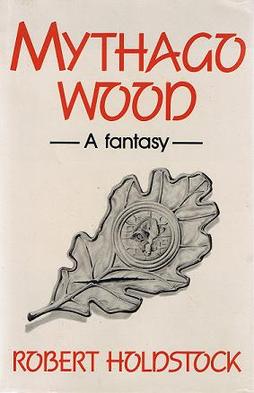
Mythago Wood was the first in that same series, and perhaps Holdstock’s best-known work, which won the World Fantasy Award in 1985. In this novel, characters experience a version of what we might call faerie in a different way than is usually expected in fantasy novels that use ‘portals’ to secondary worlds. It is helpful to compare Mythago Wood’s original conceit to these kinds of portal fantasies, since the characters must first find their way into the wood from the real world. Here, a magical woodland, the Ryhope Wood of the series, has been left untouched since prehistoric times on the border of the estate of the Huxley family, on whom the novel focuses. Stephen Huxley, recently returned from service in World War II, begins exploring this wood, with which his father had become obsessed; it eventually turned him mad before his death.
From the outset, we see some similarities to the fairie of writers such as George MacDonald, Hope Mirrlees, Dunsany, or C.S. Lewis, for example. Contemporary writers, such as Neil Gaiman in Neverwhere and Suzanna Clarke in Jonathan Strange and Mr. Norrel, have more recently written in convincing and satisfying ways of these kinds of alternate worlds as well. Holdstock’s version of fairie has several things in common with that of these writers. For example, Ryhope Wood has a border that, once breached, subjects one to the ‘laws’ of faerie, which are usually much different from those of the real world. One can interact with creatures of fairie, but must usually do so with great caution. For example, in Mirrlees’ Lud in the Mist, eating faery fruit is taboo to those who live in Lud, thanks to its fantastical properties. In Clarke’s Jonathan Strange and Mr. Norrel, characters may become lost forever in faerie, (or Eternal Night) if they are not careful. MacDonald and Dunsany have similar conceptions of faerie in their novels, for example, in MacDonald’s The Princess and the Goblin and Dunsany’s The King of Elfland’s Daughter. Examples of faerie abound in fantasy fiction, and these are just a few examples. As Senior writes, ‘Most portal fantasies feature a hidden or unrecognized entrance to the enchanted land: over the rainbow or through a wardrobe, down a water passage… or simply as a rift between worlds’ (Senior 14). But in Ryhope Wood, we’re faced with something different than any of these kinds of entrances or rifts; there is an unknown barrier that can’t be seen, but only psychically felt.
Stephen Huxley, the protagonist of Mythago Wood, initially has great difficulty penetrating Ryhope Wood, despite reading his father’s detailed notes before setting out to enter the woods. As Ekman writes, “to an observer outside the forest, the edge wood is dense and forbidding, a tangle of thorn and hazel and tree trunks,” and so Stephen is foiled in his first attempts to make it through (Ekman 47). Yet his father, George Huxley, has mapped the place, and his brother has entered it, and so Stephen is not so easily discouraged. After initially failing on foot, he attempts to fly over the area to see what mysteries it holds. But as soon as his plane makes it over the wood, “At once the plane was overtaken by a storm-wind of appalling strength. It was flung upwards, almost tilting nose over tail as Keeton struggled at the controls…Around the cabin a ghostly, banshee-like wailing began” (Holdstock 83). Though the rest of the sky is clear, further attempts to view the woodland are met with near disaster until Stephen and his friend Harry Keeton abandon the flight to save their lives (Holdstock 84).
The next day, while exploring the border of the wood once again, Stephen encounters “A royalist from the time of Cromwell, the mid seventeenth century” though the year is 1948 (Holdstock 86). The soldier shoots him with a flintlock, knocking him into a pond, from which he is saved by a ‘mythago,’ Guiwenneth (Holdstock 87). She pulls him from the pond, and he is soon smitten with her, despite knowing from reading his father’s notes and discussing them with his brother Christian, that she is likely not human. She follows him back to his home outside the wood, Oak Lodge, but leaves shortly after. This perilous introduction to ‘fairies’ is a harbinger of things to come. Stephen and his brother Christian will eventually fight bitterly as rivals over Guiwenneth’s affections, with Christian trying to murder his brother and stay in the wood for good.
The temporal shifts that characters face in Ryhope Wood are also similar to that of other fantasy fiction. In the Mythago Wood books, we learn that characters who are inside the wood have a much slower passage of time compared to the natural world, experiencing in a few hours or days what might be several weeks outside. As Ekman points out, “the nine months Christian spends there transform him from a young man in his mid-twenties to a man in middle age” (Ekman 49). Again in Lavondyss, the second novel in the series, ‘the few hours Tallis spends away corresponds to two days” and in The Hollowing, these “time differentials are shown to work both ways” (Ekman 49). We see this kind of time shift in other fantasy novels as well, with perhaps the most famous example being the Pevensie children in Narnia, who return from their adventures to find only a few hours have passed.
But this is where the similarities to other fantasy series ends. Alarmingly for Stephen and other characters in these books, the mythagos, or myth-images, are creatures within the wood created by the minds of interlopers there. Christian explains this to Stephen: “The old man believed that all life is surrounded by an energetic aura…in these ancient woodlands, primary woodlands, the combined aura forms something far more powerful, a sort of creative field that can interact with our unconscious. And it’s in the unconscious that we carry what he calls the pre-mythago, that’s myth imago, the image of the idealized form of a myth creature” (Mythago Wood 37). Their father, George, further believed that a device he created could boost his own aura to help him navigate the woods. As Senior writes of the mythagos, “the Wood itself draws upon cultural memories to provide the embodiment of figures within those memories…for example, the inhabitants of the ghost wood are variations on earlier figures elicited from the minds of those who can penetrate the Wood” (Senior 15). Stephen knows this after reading his father’s diary, and is certain that his lover Guiwenneth is his own mythago, created from his thoughts, but his brother Christian angrily tells him “your mythago is dead! This one is mine. Yours I killed years ago. She is mine! If not for that I wouldn’t take her.” (Mythago Wood 164). Stephen tells his brother that perhaps she belongs to neither of them, and that “she has her own life,” but his arguments have little effect on Christian, who is ready to kill his brother to have her. (Mythago Wood 164). Christian has spent so much time in the wood that has gone fully native, commanding a group of warriors in his quest to gain Guiwenneth for himself. The time spent in the wood has eventually driven him mad, just as it had done to his father.
Holdstock borrowed liberally from many mythic traditions and populates his fiction with characters, places, and legends from them. The name Guiwenneth derives from the Welsh ‘Gwynn,’ and is also the root of Guinivere; as Senior writes, the tragedy of Stephen and Guiwenneth recalls that of Arthur and Guinivere, or the Tristan legend (Senior 22). A spear that Guiwenneth uses reminds Stephen of one used by the Irish Celts, the ‘gae bolga’, a spear that was never supposed to be used in honor, for its recurved teeth would take out the innards of a man it struck. Perhaps in England, or whatever part of the Celtic world that had birthed Guiwenneth, no such considerations of honor were important in the use of weapons. (Mythago Wood 92). It seems that she is a princess out of time and place, though she comes to feel somewhat at home in 1948 England with Stephen for a time, even learning English, though she had been speaking a language resembling Celtic that Stephen could not understand. Christian alternately describes Guiwenneth in terms of the Celtic Queen Boudicca, saying that Boudicca was “historically real, although much of her legend was inspired by the myths and tales of the girl Guiwenneth” (Mythago Wood 39). He remarks, “She is lost from popular memory—” to which Steven replies, “But not from hidden memory!” (Mythago Wood 39). Here, we get an idea of how Holdstock conceived of the mythagos in this fantasy world; the half-remembered myths come to life from the unconscious mind of those who venture within.
Cúchulainn is another legendary Celtic figure in Mythago Wood, appearing as a hunter with an enormous dog (Mythago Wood 23-25). He tries to speak to Stephen, who cannot understand his language, but in trying to be hospitable, Stephen feeds Cúchulainn meat, bread and beer. The dog leads Stephen to the burial place of an earlier version of the Guiwenneth mythago, much to his horror. Only later does Christian explain to him that the strange man was the ancient Celtic hero come to life from the woods.
In other installments of the mythago series, the mythological and legendary references are equally dense. In Mythago Wood, we first hear a reference to Jack in the Green from George Huxley, who first sees it as a “hood mythago” (Mythago Wood 33). In his journal, George writes, “Hood is back—like all Jack in the Greens, is a nuisance” (Mythago Wood 35). Upon reading this, Stephen Huxley thinks it is evidence of his father’s madness, but he soon learns differently. The green man is a recurring figure in the books that follow, as well. In Lavondyss, the second book in the series, Tallis Keeton, the sister of Mythago Wood’s Harry Keeton, goes into the Wood and is eventually transformed into a creature called a daurog. As Kaszkiewicz writes, this is “Holdstock’s reworking of the Green Man figure– man-shaped tree creatures who are generous during spring and summer, but feral and bloodthirsty in winter” (Kaszkiewicz 48). The Green Man returns in The Hollowing, the fourth book in the series, this time as both the Green Knight of Gawain’s tale, and also “a malicious being known as the giggler,” showing some of the complexity of this legend (Kaskiewicz 45). This time, the Green Man has been created as a mythago from the imagination of a young boy in the wood, Alex Bradley, who has been captivated by the tale of Gawain and the Green Knight. The daurog also returns and acts as his protector. However, this is a perilous version of the Green Man, from whom Alex’ father, Richard, must rescue his son. The Bone Forest, a novella that serves as a prequel to Mythago Wood, also deals with a version of the Green Man, who in this case is usurping Stephen and Christian Huxley’s father George, taking his place in their home and creating havoc. Holdstock here describes him as the “Green-grey Man,” who communicates with Huxley by writing notes in his journal for Huxley to find. Again, we see the magical properties of the wood, as Huxley and his friend go there for what seems like months or years and return to his home just a few hours later.
Avilion, the final book in the series, which Holdstock published in 2009, just before his death, is a direct sequel to Mythago Wood, in which we learn more about Stephen Huxley and Guiwenneth. The title is a reference to Arthur’s Avalon, which figures prominently in the tale, and for which the characters are searching. Stephen and Guiwenneth have lived in Ryhope Wood and raised two children, Jack and Yssobel, who are each half human, and half mythago; Yssobel disappears and the search for her and Avilion, to which they think she has gone, consumes much of the book. Laskiewicz calls this a “fascinating continuation of the fairytale tradition of depicting the woods as a place of transition and transformation” (Laskiewicz 49).
Myth and Legend in The Merlin Codex
Throughout Holdstock’s work, we see ancient myths and legends from different cultures fused with the inner lives of characters from the modern world. As we have seen, these myths are readily apparent in the Mythago Wood series, and in the Merlin Codex series, Holdstock employs a similar technique. Here, these references become so dense and numerous the reader may at times be in danger of becoming overwhelmed by them and losing the narrative thread. As Shippey writes, “even a moderately well informed reader is bound to feel a constant ripple and urge of contradiction or anachronism” from the constant use and juxtaposition of these tales and legends which differ in origin but are in many ways similar (Shippey 170). Rather than a portal mechanism through which the characters enter fairie, this series takes place entirely within a secondary world, though Holdstock uses myriad settings, mythologies and characters within it. Instead of creating this secondary material from whole cloth, as in the case of other fantasy writers who may have been influenced by mythology, Holdstock again takes characters, legends, and myths directly from the ancient source material, and recasts them into something original and fresh, yet familiar.
In the first volume of the series, Celtika, we learn that Merlin—here called Antiokus, some eight centuries before the time of Arthur, will help his friend Jason recover his lost sons, taken from him by Medea hundreds of years before; they have not been murdered, as Jason was led to believe, but hidden. Jason, Antiokus, and the argonauts travel aboard the Argo in a sort of retelling of Jason’s epic voyage. The ship, sunken at the bottom of a lake, is recalled to the surface along with Jason and his companions by Antiokus, who speaks to Jason’s spirit, as well as the spirit of the ship. Holdstock’s Merlin, we learn, is not immortal, but is one of a group of magical beings who can live for many centuries. Merlin senses throughout the tale that he is meant for another purpose, and that hundreds of years later in Alba, or England, he will meet a great king. He is very careful in using his magic, because it ages him, but at times he will use it to see into the future or otherwise help his companions.
This three-book sequence is deeply infused with Celtic, Finnish, and Greek mythology. First, there are characters with Celtic names, as Shippey points out: “Orgetorix clearly has a name of the same family as Vercingetorix, the Celtic enemy of Julius Caesar” (Shippey 169). Sullivan also mentions the different Celtic gods names in the books: Morrigan, a prominent goddess of war, Danu, the mother of the Irish race, the goddess Brigit (Sullivan 125). There is a Celtic chieftain named Urtha, and “the three cowled, cloaked maidens who appear behind Urtha’s children are most likely an allusion to the Celtic triple goddess, a concept that appears throughout Celtic literature and art” (Sullivan 161). There is also ample use of Finnish mythology in the story, including Mielikki, the Finnish god of the forest, and others from the Kalevala (Sullivan 161). Holdstock also alludes to the Welsh sagas of Culwych and Olwen and the Mabinogion (161).
Holdstock also uses the idea of ‘Imbas forosnai,’ or the ‘light of foresight,’ which he explains is “referred to frequently in the Old Irish epic tales, in particular The Tain or the Cattle raid. It was a visionary attribute usually associated with young women” (The Broken Kings 366). Ní Bhrolcháin calls this “knowledge that illuminates,” and writes that women in these ancient sagas are prophets who “warn against courting disaster” (Ní Bhrolcháin 148). In The Broken Kings, two young women, Munda, and Merlin’s lover Niiv both possess it, and Merlin is wary of it. He says that “it was a small talent compared to mine, certainly, but it was sinister in that the vision was uncontrollable, unstoppable, sudden, often brutal, and told at once—there was no avoiding the expression of what had been seen, no waiting for the right moment” (Broken Kings 67). Merlin only reluctantly becomes Niiv’s lover over the course of the novels, since she is always seeking more knowledge of his powers, which he is reluctant to use, since it ages him to do so. She scares Merlin, who is afraid she will wantonly use these powers and wind up harming herself, or him.
There are also several duels between characters for various reasons, told with great attention to detail. There is a duel between the characters Urtha and Cunomaglos in Celtika in which the characters stop the action to deliver long insults and talk about the rules of combat. As they inspect one another’s weapons before the fight, Cunomaglos remarks: “I see you have begged, borrowed, and stolen a fine array of weapons. Those big shields are impressive, but they won’t hold me back,” to which Urtha retorts “Is that a stone groin plate I see? You must be truly scared of the strength of my blade” (Celtika 311). They go on this way for three pages until “they put down their weapons and embrace, each kissing the other three times before pulling away and picking up their weapons again” and finally beginning the fight (Celtika 313). Cathabach explains that the three kisses are for “A past shared; for kind words shared; for a future when they will ride the same valleys in Ghostland” (313). The battle continues for three ‘rounds,’ and before each, the combatants clearly spell out the terms of how they will fight. Shippey says that these combats “are strikingly Celtic rituals of challenge and arming, reminiscent of Urtha-Orgetorix duel in Celtika, a duel which is also retold with the characteristic Celtic rhetorical exaggeration…” (Shippey 171). Merlin watches the Urtha-Cunomaglus duel with grim resignation, not wanting to see such brutality and death, though he knows it is inevitable.
As Holdstock writes in the afterword to book two, The Iron Grail: “Most of what we know of Celtic ritual and belief at that time is anecdotal. But in the Irish epic “The Cattle (or Bull) Raid on Cúailnge,” we have a powerful window back to this period of transition in Celtic society from a wise, if remote and sacrifice obsessed matriarchy, to a boundary and symbol obsessed patriarchy, which brought with it the rise of the champion knight, the prophetic light of foresight, and the culture of kingly hospitality” (Iron Grail 323). Holdstock has also said that “The Iron Grail is a conscious recreation of the narrative style of an early Irish epic, The Cattle Raid, one of the most brilliant accounts of warfare, combat, gods, spirits and Celtic royalty ever written; it is a miracle and a delight that the ancient text has survived into the modern age.” (Aragao). Indeed, Holdstock used The Cattle Raid, also known as The Táin, to inform much of the Merlin Codex. In The Tain, Queen Medb asks a girl, Fedelm, if she has the imbas forosnai, and the girl says yes. When Medb asks the girl what will happen to her army, she responds cryptically: “I see it crimson, I see it red” (Tain 61). When Medb protests, Fedelm responds with the same words three more times, and finally poetically describes her foresight of the coming battle as a ruinous massacre (Tain 61-63). Here she also speaks of the gae bola spear, which appears repeatedly in The Tain, and which, as we saw, Holdstock writes of in Mythago Wood. There is also a lengthy, ritualistic combat between Ferdia and Cuchulainn, in which they trade praise and insults for several pages before beginning the fight. As in Celtika’s duel between Urtha and Cunomaglos, it takes place in a stream, and the two negotiate over which weapons to use, and kiss each other three times before beginning the battle, from which Cuchulainn finally emerges victorious after three days. Rather than rejoice in this victory, Cuchulainn mourns the loss of a worthy foe (Tain 199-205). The entire sequence is very similar to the Urtha-Cunomaglos duel in Celtika.
As Sullivan writes, the Codex “is full of names and terms from Greek, Finnish, and Celtic myth, legend history and culture,” and that “the similarity such materials have from culture to culture and from age to age” enable him to create a coherent narrative from them (Sullivan 162). So, in the same series of novels, we have the voyage of Jason and the Argonauts and Merlin, or Antiokus, as he is first known to Jason, coupled with Finnish deities as well as the Irish gods and the epic story of the Cattle Raid. The Celtic god Lugh is also in the novel and appears to punish his sons for stealing a chariot. Despite the similarities in some of the materials, there are few novelists who would attempt such a daunting project, let alone make all this work, yet Holdstock writes of all this with a keen eye for detail and character that helps keep the reader engaged, even when the ritual and allusions threaten to overwhelm the narrative.
Holdstock’s Creations and Fantasy Fiction
Shippey explains Holdstock’s mixing of fantasy legends by calling it an ‘intertextual liminality’ through which in the modern context, readers switch “from King Arthur to the Trojan War, from Julius Caesar to druids to Robin Hood, and from any of them to Star Trek or Star Wars. They all now inhabit much the same kind of imaginative space, and it takes both quite a lot of knowledge and a certain talent…for organization to keep them in any way separate” (Shippey 172). In the present day, one need only look to recent blockbuster films such as The Avengers Infinity War or Ready Player One, among many others to see this liminality at work; the first of which uses myriad superheroes and their mythic stories and mashes them up into an epic, and the second takes pop culture references from every era of the twentieth and twenty first century and does the same. The audience for these films likely experiences the same feeling of unease or vague recognition when faced with such an overwhelming multitude of sources, as Shippey says that Holdstock’s readers do, when we are faced with a dizzying mixture of folklore, legend, and fantasy from so many different myths. In fact, some New World myths are present as well; in Lavondyss, the second Mythago Wood novel, one character, Helen Silver Lock, is Native American.
Upon finishing the Mythago Wood series, the reader has nothing like the sense of completeness one might feel at the end of a heroic quest story, such as Lord of the Rings. There is more a sense of unease at what has happened, or disappointment at what has been left unfulfilled. Holdstock’s writing is also much more deeply psychological than in most fantasy fiction, veering toward horror in many points, as in The Bone Forest, when the Green Man is engaged with replacing a character in the real world, or in Lavondyss, where a child wanders into Ryhope Wood, never to be seen again by her parents. The same is true of Mythago Wood, where brothers are fighting to the death over a mythago woman with whom they are both in love, or Avilion, which again features a child lost in Ryhope. Usually, in most fantasy stories, there is some resolution—the quest is won, the child is found, the enemy defeated. These things sometimes happen in Holdstock’s worlds, but the result leaves the reader without the same feelings of satisfaction a reader may feel at the conclusion of a hero’s journey of a mythic quest.
There is also the psychological element to these novels, which is as prominent in the Mythago Wood series as the mythic references are. As Limpar writes, “For modern authors, the perfect site for the unknown is not to be found in another galaxy, but within the unconscious” (Limpar 142). George Huxley, Stephen and Christian’s father, and the one who initially discovered the strangeness of Ryhope Wood, is a psychologist who becomes fascinated with the wood out of professional interest. He has studied with Jung, and creates a device to help strengthen his aura, to help him interact with the mythagos. He keeps a detailed journal explaining everything he has done as his obsession with the mythagos and with Ryhope increases. It is this journal that helps Christian and Stephen eventually find the wood, after George’s death. Matolscy describes the mythagos in Jungian terms, saying they are “parts of ourselves, yet different from us; to simplify Jungian theory, they qualify as our ‘shadows,’ our ‘dark characteristics,’ a kind of dark matter from our unconscious (Jung, quoted by Matolcsy, 30). Much the same can be said of Ryhope itself, these ‘journeys to an unknown region,” as Holdstock calls them, can be seen in many ways as the characters descending into their own minds, memories, and unconscious desires as they trek into a mythic past. As we see through the Mythago Wood series, the characters do not always overcome the mythagos, and “get trapped in and are never released by the forest—the chaos of their own unconscious” (Matolscy 31).
One such example of the perilous unconscious is a being in the wood that George calls “The Urscumug,” or the proto myth, from which all other myths originate. Coming face to face with this beastly, part human, part boar giant is particularly dangerous for the psychic havoc it creates. Christian is terrified of the creature, as is Stephen, who barely escapes its notice (Mythago Wood 48-51). When he comes face to face with the Urscumug, Stephen writes: “I saw the face that had been painted across the blackened features of the boar. The Urscumug opened its mouth to roar, and my father seemed to leer at me” (51). Matolscy calls the Urscumug the ‘primal boar-spirit,’ part of the unconscious forces that draw the characters to the wood, creating tension between the primal and reality (Matolscy 31). As Stephen recalls of his father, “I had long since resigned myself to the fact that, even at best, he regarded me with total indifference. All his family had been an intrusion on his work, and his guilt at neglecting us, and especially at driving our mother to taking her own life, had blossomed rapidly into an hysterical madness that could be truly frightening” (Mythago Wood 8). The Urscumug, as it presents itself to Stephen, is clearly linked with some kind of crippling anxiety about his father, who Stephen mainly knows through his half-mad diaries and obsession with the wood; the spirit, embodied as a monstrous form of George, is hunting him down. George Huxley had also been in terror of the Urscumug, describing it as “most powerful because he is primary” (Mythago Wood 32). However, this doesn’t stop George from pursuing it, or from continuing his dangerous journeys into the wood, even when it terrifies and endangers his young sons and his wife. It seems there is something very powerful drawing him back to the wood, no matter the cost.
As with mythological interpretations of Holdstock’s fantasy, it is not a straightforward or simple process to look at these works through a psychological lens. There is not a direct way to see the works as Jungian or Freudian, though Holdstock uses these elements in his novels to create more tension and mounting horror as it becomes clear that the characters are not going to heroically escape; rather, they continue to become more deeply mired into Ryhope and its fantasy murk as the narrative unfolds and they descend further into their own minds. Personal and universal myths are blended in the wood, as characters travel through layers of history and their own pasts. It is often difficult for the characters, or a careful reader, to know whether we are encountering a mythago or a person at various points in the books, especially before we become familiar with the many ground rules that govern Ryhope Wood.
The Merlin Codex, which went unfinished, functions in a different, but related way for the reader. Here we are totally immersed in a fantasy realm of Holdstock’s creation. There are no characters from modern times finding their way into the past, but the ways in which the characters behave in the Codex can be quite modern and relatable. Merlin, the protagonist of the series, seems immortal by normal human standards, and moves across centuries while retaining his youth, yet he still worries about his mortality to such a degree that it almost prevents him from helping his friends or finding a lover. Jason gives up everything to find his sons, across centuries and against staggering odds. Rubobostes and other characters are loyal to Jason to a fault, sacrificing their own lives to help their beloved leader. Here, we are seeing these mythical characters through their own eyes, and it again has the effect of making these myths more relatable to us.
A recent example of another author who accomplished this feat to great effect is Ursula K. LeGuin, in her novel Lavinia, which takes place through the eyes of that character, from the Odyssey. Though Lavinia is only mentioned in a few lines of the epic poem, the entirety of the story is told from her point of view, and the reader gains a great deal of sympathy for her and an understanding of how the ancient people who created these myths shared our humanity, and how their voices resonate through the ages to our own times. The novel is stunningly successful at revealing the humanity in the Odyssey, and is similar to what Holdstock was setting out to achieve in his Merlin Codex, with its reimagining of Greek and Celtic myths.
Joseph Campbell was a great proponent of James Joyce’s work and wrote that “The big thing that Joyce did for me, and might also do for others, was bring the vast heritage of mythological images that we have from many sources and strains of thought into relationship with my own affect system” (Campbell 4). Holdstock said in an interview that he had been strongly influenced by Campbell, and that “The four volume Masks of God was essential reading for me…Campbell’s work, like that of Frazer (The Golden Bough), tickles the imagination, in fact, opens up the gates of the imagination” (Hall). Holdstock couldn’t be more different than Joyce in many ways, but it seems after reading Holdstock’s fantasy work that he was getting at a similar effect to what Campbell describes, for fantasy readers. Unlike those reading Joyce a century ago, modern readers might not be as familiar with the myths Holdstock uses, but most readers interested in fantasy will have some knowledge of them. The myths Holdstock recalls and recasts in the fantasy realm become, instead of ancient, remote stories of quests or heroic deeds, more psychological, realistic and modern, even as the characters become lost in distant eras and myths. Their problems are everyday ones—how to gain a lover, find a lost child, make peace with a difficult parent, or return to some kind of normalcy after strange events turn their worlds upside down. Characters suffer divorce, death, murder, and stinging loss as they move through life. Though sometimes Holdstock’s writing tends more toward horror than fantasy, in the end we are left with characters who must overcome something from their unconscious minds, made manifest in humanity’s shared myths. This creates a story in which ancient myths are more relatable to modern readers.
The lack of heroic quests and deeds in these works might account for why Holdstock’s name is not as well-known as some of the other authors in the fantasy genre, especially in the United States. Fantasy is often marketed more as a genre to which a reader might escape the regular world for a while. Much commercial fantasy functions in this way, even when the stories are dark, as in George RR Martin’s Song of Ice and Fire. As Holdstock’s agent said, the books aren’t exactly ‘beach reading,’ but they deserve a wider audience, especially among those who enjoy Martin, Tolkien, LeGuin, Lewis, and others. Holdstock’s work is difficult and embraces a darker side of the imagination. They aren’t escapist fare, nor are they the kind of grim fantasy epics that have gained popularity in recent years, with antiheroes driving an action-based narrative. Still, readers who are looking for something original and groundbreaking will find much to enjoy and enrich when they explore Holdstock’s fantasy worlds.
References
Aragão, O., & Completo, V. M. P. (2008). Heroes in the mist: Interview with Robert Holdstock. Retrieved 4 December 2025, from http://intemblog.blogspot.com/2008/07/heroes-in-mist-interview-with-robert.html
Campbell, J., & Epstein, E. L. (1993). Mythic Worlds, Modern Words: On the Art of James Joyce. HarperCollins.
Ekman, S. (2011). Exploring the Habitats of Myths: The Spatiotemporal Structure of Ryhope Wood. In D. E. Morse, K. Matolcsy, & B. A. Jefferson, Eds. The Mythic Fantasy of Robert Holdstock: Critical Essays on the Fiction (pp. 46–65). McFarland.
Hall, M. (2003). Merlin and the Eternal Pursuit of the Iron Grail. Publisher’s Weekly, 50.
Holdstock, R. (1988). Journey to an unknown region. W. Morrow.
Holdstock, R. (1993). The hollowing. Penguin Books.
Holdstock, R. (1997). Gate of ivory, gate of horn: A novel in the Mythago cycle. ROC.
Holdstock, R. (2003). Celtika. Tor.
Holdstock, R. (2004). The iron grail. Tom Doherty Associates.
Holdstock, R. (2007). The broken kings. Tor.
Laszkiewicz, W. (2017). Into the Wild Woods: On the Significance of Trees and Forests in Fantasy Fiction. Mythlore, 36.
Limpár, I. (2011). A Heap of Broken Images’: The Mythological Wasteland of the Mind: The Hollowing and Ancient Echoes. In D. E. Morse, K. Matolcsy, & B. A. Jefferson, Eds. The Mythic Fantasy of Robert Holdstock: Critical Essays on the Fiction (pp. 141–155). McFarland.
Matolcsy, K. (2011). Masks in the Forest: The Dynamics of Surface and Depth in the Mythago Cycle In D. E. Morse, K. Matolcsy, & B. A. Jefferson, Eds. The Mythic Fantasy of Robert Holdstock: Critical Essays on the Fiction (pp. 26–45) McFarland.
Morse, D. E. (2011). Stories to Illuminate Truth and Lies to Hide Pain: Gate of Ivory, Gate of Horn In D. E. Morse, K. Matolcsy, & B. A. Jefferson, Eds. The Mythic Fantasy of Robert Holdstock: Critical Essays on the Fiction (pp. 129–140). McFarland.
Ní Bhrolcháin, M. (2009). An introduction to early Irish literature. Four Courts Press.
Oziewicz, M. (2011). Profusion Sublime and the Fantastic: Mythago Wood. In D. E. Morse, K. Matolcsy, & B. A. Jefferson, Eds. The Mythic Fantasy of Robert Holdstock: Critical Essays on the Fiction (pp. 81–95). McFarland.
Senior, W. A. (2011). The Embodiment of Abstraction in the Mythago Novels. In D. E. Morse, K. Matolcsy, & B. A. Jefferson, Eds. The Mythic Fantasy of Robert Holdstock: Critical Essays on the Fiction (p. 13–25). McFarland.
Shippey, T. (2011). Thresholds, Polders, and Crosshatches in the Merlin Codex. In D. E. Morse, K. Matolcsy, & B. A. Jefferson, Eds. The Mythic Fantasy of Robert Holdstock: Critical Essays on the Fiction (pp. 165–176). McFarland.
Sullivan, C. W. (2011). ‘So Many Names in so Many Tongues …’: Allusive Mythology in Celtika. In D. E. Morse, K. Matolcsy, & B. A. Jefferson, Eds. The Mythic Fantasy of Robert Holdstock: Critical Essays on the Fiction (pp. 156–164). McFarland.

Christopher Tuthill is a librarian at Baruch College, The City University of New York. He is the author of articles on J. R. R. Tolkien, Ursula K. LeGuin, and Ray Bradbury. Chris is a native New Yorker who lives in the Hudson Valley with his wife and children. He enjoys hiking, board gaming, and telling stories to his three children. His novel The Osprey Man was published in 2022.
Like what we do? Buy us a Cup of Coffee!