
Papers
A Seeming African Origin of the Milky Way Mythology and Its Relatedness to Other Mythology
By Damien Marie AtHope
Abstract
This article can be roughly defined as an interpretive-comparative mythology paper or as hypothesis-driven exploratory research. When seeking to ascertain a reasoned hypothesis about paleolithic mythology now lost too deep time, more modern myths or interpretations derived from them are likely far removed from any clear conception of an original myth or its original meaning. A comparative mythological understanding is better, and by seeing the larger mytheme involved, their universality can be better understood. So, a general comparative analysis might suggest that Africa could not just be the cradle of humanity but also the home of the Milky Way myth and its skyward thinking about where souls or spirits go to reside among the stars. Based on an assessment of known archaeological and ethnographic data, as well as artifacts possibly linked to the Milky Way myth’s origin, it could be related to a time between at least 70,000 and 78,000 years ago, if not 100,000 years ago; connecting to three main artifact sites and their enigmatic art motifs. This paper proposes, the Milky Way myth’s origin would have then easily spread such mythological ideas before the “Out of Africa” hypothesis, lending more understanding of why it has been able to reach far and wide across the world and to seemingly all major continents as humans migrated and cultures dispersed. Religion, its mythology, and its supernatural beings/deities are cultural products and moved in cultural migrations. They evolved and changed a lot along the way but were human-created and recreated every time.
Keywords: Milky Way, Mythology, Africa, Comparative Myths, Paleolithic Art
Introduction
The individuals in the hunter-gatherer group are seated around the campfire and excited with anticipation as the day is ending and the night is coming alive. The day is full of tasks and community interaction. But the night is a time of spirit stories and awake dreaming under the stars. The Milky Way stretches from the dark horizon up into the heavens. A bright path to reach the sky spirits and the land of the ancestors. Like a celestial river of stars, a winding snake, or an otherworldly alignment with an earthly related belief that the Milky Way could be made from throwing campfire ashes into the air, as a glittering ladder to the land above, forming a glowing “Backbone of Night,” a believed spiritual pathway holding up the atmosphere, and part of the cosmic order.
Figure #1 “Milky Way Art Artifacts” Africa and Eurasia Map
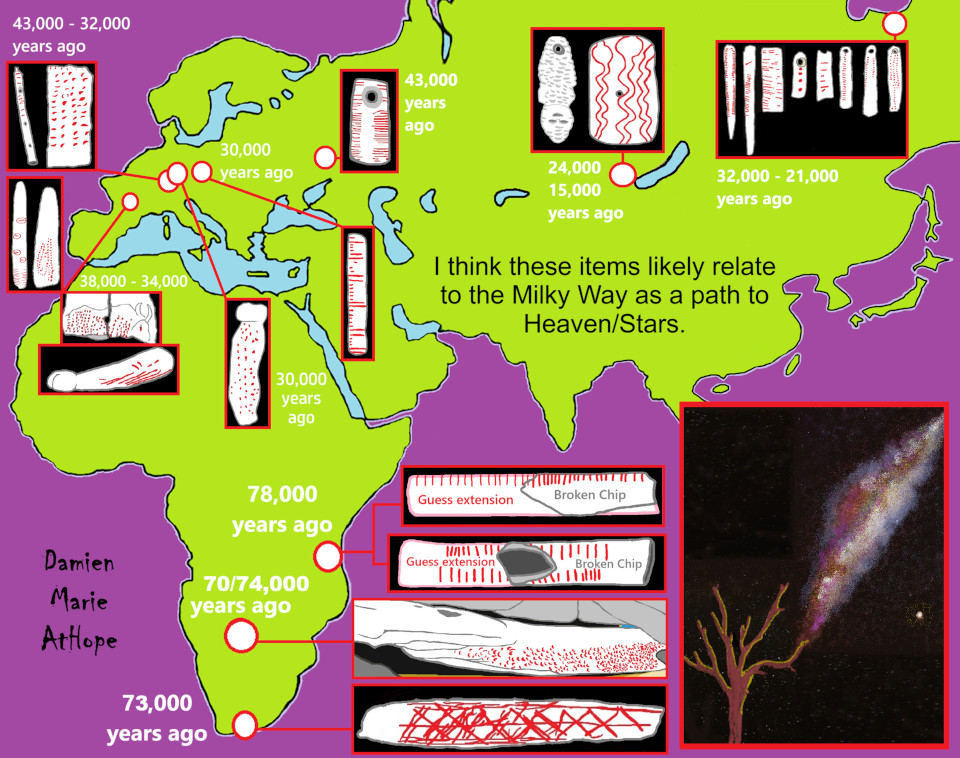
(The above are illustrated ancient art artifacts, such as lines on paleolithic bone tally sticks or a megalithic stone snake rock art as well as other art items in the drawing, which this paper proposes are hypothesized to be related to the Milky Way as a path to heaven/stars.)
Researchers argue in a new review that all human languages stem from a single linguistic family tree that emerged before our species split into distinct populations 135,000 years ago. By 100,000 years ago, this verbal revolution was cemented into the behavior of Homo sapiens, archeologically visible in our use of symbolism in body decorations and engravings. (Koumoundouros, 2025)
MIT researchers discovered when human language first emerged. Genetic and archaeological evidence now provides a clearer window into when linguistic ability first appeared. Some researchers argue that language emerged in our lineage around 100,000 years ago, while others suggest it predated the arrival of modern humans. A previous estimate was as early as 300,000 years ago. But a recent study analyzing genomic data suggests that human language capacity was present at least 135,000 years ago, with linguistic behavior emerging around 100,000 years ago. Genetic studies identify the Khoisan peoples of Southern Africa as the earliest branch of the human family tree. (The Brighter Side of News, 2025)
From the YouTube video “The Milky Way: Source of some of our Oldest Myths” by the Crecganford Channel, its producer and mythology expert John White stated, “That it is likely Milky Way mythology originated in Africa before the recent Out of Africa theory migration: about 70,000–50,000 years ago” (White, 2024)
Figure #2 “Evolution of Religion” Africa and Eurasia Map
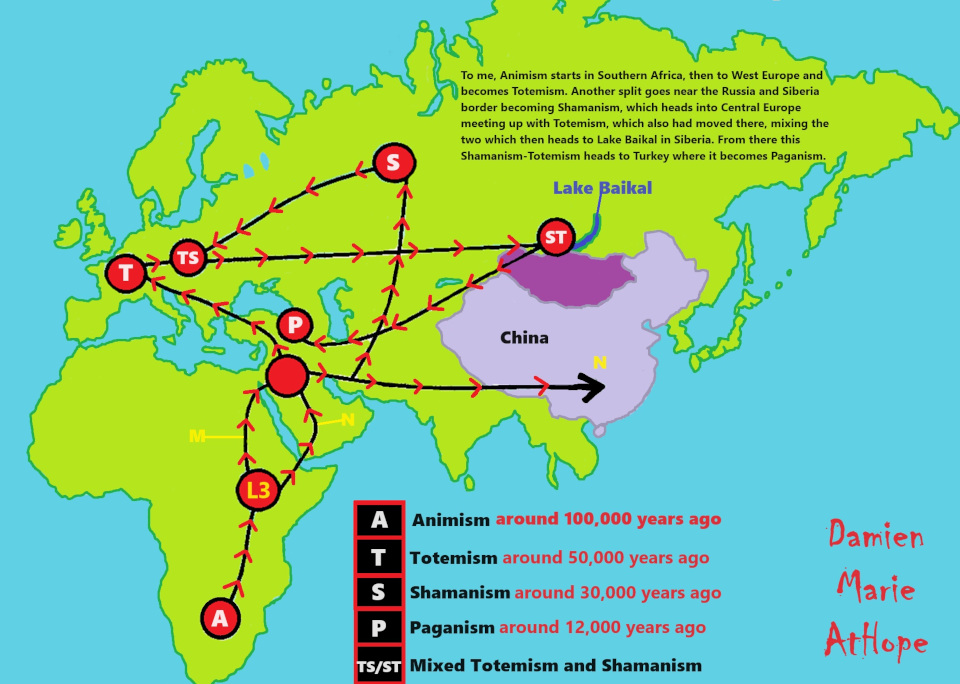
(The above illustration places the origin, or start of Animism in Southern Africa, then to Western Europe, and becomes Totemism. Another split occurs near the Russian-Siberian border, becoming Shamanism, which heads into Central Europe, meeting up with Totemism, which also moved there, mixing the two, which then heads to Lake Baikal in Siberia. From there, this Shamanism-Totemism heads to Turkey where it becomes Paganism.)
Understanding “Religion(s)” Evolution per Damien’s hypothesis:- Pre-Animism (at least 300,000 years ago) possibly in Africa, the Middle East, and Eurasia
- Animism (at least 100,000 years ago) possibly in Southern Africa or maybe in Central Africa
- Totemism (at least 50,000/45,000 years ago), possibly around France, Germany, or somewhere in Western Europe
- Shamanism (at least 30,000/35,000 years ago) possibly in West Siberia or East Russia
- Paganism (at least 12,000/13,000 years ago), Turkey / and maybe some parts of the Levant: “Israel, Jordan, Lebanon, Palestine, Syria.”
- Progressed organized religion (at least 5,000 years ago): (Egypt, the First Dynasty 5,150 years ago) and the Earliest attested ruler of Mesopotamia (Iraq) 4,750 years ago, “King of the first Dynasty of Kish” when Kish had hegemony over Sumer.
A comparative analysis indicates religion’s supernatural aspects are built upon a series of distinct, often foundational, conceptual components. Religious systems/aspects can be seen as having core “building blocks” such as Animism, Totemism, Shamanism, and Paganism. Within these blocks, there’s variation, allowing for diverse religious/spiritual practices and beliefs to be constructed.
- Animism: Spiritism and Supernaturalism/Spiritualism
- Totemism: Animism and Socio-Religio-Cultural Laws/Beliefs
- Shamanism: Animism/some Totemism, as well as Afterlife thinking
- Paganism: Animism, Totemism, and Shamanism; plus, Deity focus
- Organized Religion: Institutional Pagan Religion with all its aspects
The evidence suggests that Animism Milky Way mythology (path of the souls after death going to the stars/becoming stars but not life after death) originated in Africa, likely central East Africa or Southern Africa (between 100,000 and 70,000 years ago), before it moved out of Africa with human migrations to the Middle East around 60,000 to 55,000 years ago. Then one branch of humanity went to western Europe with animism, such as France, where this mythology merged/evolved into the Cosmic Hunt (still related to the Milky Way mythology thinking, though with less focus), where Totemism thinking also emerged between 50,000 and 40,000 years ago or so. A different branch of humanity left the Middle East heading for Siberia, still with just animism, where this path of souls evolved into after life thinking or souls living on after death around 30,000 to 35,000 years ago a long with the emergence of Shamanism thinking; a belief that a special person could contact/interact with souls. Sometimes this meant soul-travel beliefs, in which only the shaman before death was believed to use the Milky Way as a path to the souls of ancestors for help. Shamanism beliefs spread both further East into the Americas and further west into Central Europe, where they meet Totemism thinking and the Cosmic Hunt mythology. These now somewhat grouped mythologies Totemism and Shamanism both evolved from the Animism Milky Way mythology and larger religion styles of Totemism-Shamanism, headed/migrated back to Siberia and Lake Baikal, where the mythology evolved again, before heading to the Americas. But now with early Earth Diver myths, and to the Middle East, where Shamanism would evolve into Paganism by 12,000 to 13,000 years ago.
Figure #3 AtHope, D. M. (2025) “Evolution of Mythology” Africa and Eurasia Map
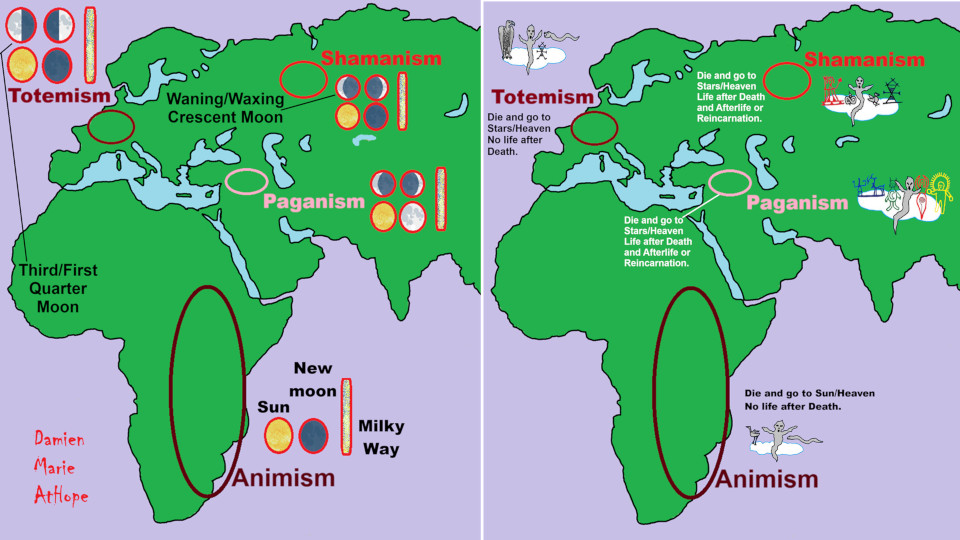
(The above illustration hypocrisies Animistic, Totemistic, Shamanistic, and Paganistic religious beliefs in their proposed origin areas as well as a differing comparative analysis of proposed mythology related beliefs they are thought to have related with.)
Animistic religious beliefs (Originating in Africa: 100,000 to 50,000 years ago): We die and go to the Sun/Heaven (by the Milky Way path), no life after Death. There is a sun spirit female and a moon spirit male. The new moon is favored for “sneaking hunting” (hunters are unseen) in the darkest night. All people are equal and dual-spirited, and animals also go to heaven, just like humans; they have a spirit while alive.
Totemistic religious beliefs (Originating in Western Europe: 50,000 to 40,000 years ago): We die and go to the Stars/Heaven (by the Milky Way path), no life after Death. There is a sun spirit female and a moon spirit male. The new moon is favored for “sneaking hunting” (hunters are unseen) in the darkest night. The Third/First Quarter Moon was likely also favored as it related to the first ancestor clan, the pseudo twin being that he-she-they were seen as duality: intersex, trans, bisexual, half-male and half-female, in “One Great” dual-spirit being.
Shamanistic religious beliefs (Originating in Western Siberia: 35,000 to 30,000 years ago): We may die and go to the Stars/Heaven (via the Milky Way path) or have rebirth/reincarnation, Life after Death/afterlife (ancestors can interact to help or hurt). There is a sun spirit male and a moon spirit female. The new moon is favored for “sneaking hunting” (hunters are unseen) in the darkest night. Additionally, the Waning/Waxing Crescent Moon is favored in relation to the boy twins’ mythology, which explains why these twins can have different fathers. And these moons are the darkest nights after the new moon, thus also aiding in hiding in “ambush” hunting.
Paganistic religious beliefs (Originating in Upper Mesopotamia (Turkey): 13,000 to 11,000 years ago): We may die and go to the Stars/Heaven (by the Milky Way path) or have rebirth/reincarnation, Life after Death/afterlife (ancestors can interact to help or hurt). There is a sun spirit male and a moon spirit female. The full moon is favored for “more safety for herders” (also, there is a higher number of births around the full moon for dairy cows) on the brightest night. Additionally, the Waning/Waxing Crescent Moon is favored in relation to the boy twins’ mythology, or the duality of bull horns and twin-peaked mountains, which explains why these twins can have different fathers. And these moons are associated with the Star of Venus, also known as the Morning Star or Dawn goddess.
The Moon and the Milky Way
Mythic ideas about souls taking a journey up the Milky Way may have been inspired by prehistoric peoples’ thinking about the moon phases that occur once a month and linked to the “New Moon.” This paper proposes that two of the night sky’s largest and dramatic sights, the Moon and the Milky Way, both with mythologies worldwide, sometimes held a relatedness. The thinking address is in what now may have been a lost mythological connection among the Paleolithic hunter-gatherers. The evidence on this Animism Milky Way mythology hypothesis suggests a comparative analysis reference to 78,000-year-old notched bones with Tally stick-like symbolic expression and related to the oldest human burial in Africa (Shipton, et al., 2018).
The oldest and clearest moon connected calendar/Tally stick like reference known is 34,000 years ago. (NASA, 2011) However, lunar timekeeping with tally sticks which are thought to relate to the moon and are dated to 22,000 years ago. (Taylor, 2023) There is a scientific connection between the New Moon and the Milky Way because of the astronomical fact that the Milky Way is most visible during the New Moon. (NASA, 2025) Also, in a mythological sense related to souls traveling to heaven, one could see the New Moon as after the dying of the moon and after the Last Quarter moon phase (Green J., 2025).
Thus, both from the evidence and comparative mythological analysis, one can see a possible connection between the New Moon and the Milky Way when it would have been the soul’s time to pass up to the stars. As well as a believed magical time before creation in a mythological sense. This paper proposes that this could link prehistoric so-called Tally sticks with the Milky Way visibility, which is beyond the belief that the tally sticks are limited to the Moon phases. The thinking of the moon phases is often limited to thoughts of fertility. This paper proposes adding the New Moon concept makes the moon phases life and death related. Moreover, as hypothesized, some things/marks on artifacts that look similar to what is called Tally sticks, but are not linked to numbers, could be crude ladder-like or star-like references to the Milky Way itself.
Snake/Serpent Mythology and the Milky Way
AI Overview: Serpent/snake mythology deeply connects with the Milky Way across cultures, often seen as a celestial river, path for souls, or cosmic creator, like Australia’s Rainbow Serpent, Mesoamerica’s Quetzalcoatl, or the Great Serpent Mound in North America, reflecting the hazy band of stars as a underworld-related entity symbolizing eternity, the cyclical nature of life and death, forming a universal archetype seen from ancient star maps. The Milky Way was the backbone of the night and became part of ancient people’s myths and beliefs based on their perception of it as a serpent.
Could the Milky Way be Related to the Oldest Worship in the World?
In Southern Africa, around 70,000-74,000 years ago, in a cave, there are carved marks that adorn a snake/python like rock that looks like it is alive because it sticks out from the wall and is off the ground and has seemingly ritualistic worship with offerings of carved spear points, making it possibly the earliest evidence of human religion and complex ritual behavior involving symbolic offerings.
The python is one of the Africa Indigenous San people’s most important animals. According to their creation myth, mankind descended from the python, and the ancient, arid streambeds around the hills are said to have been created by the python as it circled the hills in its ceaseless search for water (The Research Council of Norway, 2006).
A Serpent’s Tale: The Milky Way: In North America, whether as a giant form on the ground or pictured on a rock, the snake has a story to tell of the road for souls, one which goes back well over 4000 years and can be found in caves, on hilltops or as a pathway for the living to traverse, all reflections of the serpent stretching overhead (Bender, 2022).
The ancient Native American site of Cahokia features the Rattlesnake Causeway, believed to be a terrestrial metaphor for the Milky Way Path of Souls, used by the deceased to cross to the Land of the Dead (Bender, 2022).
In mythology of Andean civilizations of South America, the amaru or katari (aymara) is a mythical serpent or dragon often thought to live in water like lakes which had representations with cosmic renewal and connects the earthly world with the spiritual. Its symbolism is very broad: in addition to many associations with weather and the heavens (e.g. storms, hail, wisdom, rainbow, the Milky Way, etc.) (Steele, P. R., 2004, p. 95–98).
The Inca Empire’s “rainbow” banner sometimes as with the Banner of the Inca Empire having two snakes on either side a rainbow or Sapa Inca banner was depicted with two snakes on either end of the rainbow forming a crown or representing duality: like life/death (Bernabé C.,1653) and (Viajes Puma, 2025). “The Serpent was associated with the world of the dead, the serpent symbolized for the Incas the transition from earthly life to another dimension” (Republic of Peru, 2018).
In Australian Aboriginal traditional astronomy way of thinking, a mythological animal being in the Dreamtime, known as the Rainbow Serpent, is believed to be deeply connected to the Milky Way and is seen as a powerful creator spirit in many of the Australian Aboriginal traditional cultures. The Rainbow Serpent in Australian Aboriginal belief is seen as traveling across the sky and forming the river-like band of the Milky Way. The Rainbow Serpent in Australian Aboriginal mythology is believed to be able to travel between waterholes, and represents creation, life, and the very structure of the land, linking earth and sky through its celestial journey (Williams R., Norris R. 2010) and (Aboriginal Art Online, 2001).
This paper proposes seeing the Milky Way and Rainbows as a type of duality, such as yin-yang, which is the concept of opposite cosmic principles or forces and as a similar connected theme in the duality of day and night, like the sun and the moon mythology.
The Milky Way and Rainbow: Similarities can be found in diverse cultural references:
- The Milky Way is related to or with Snakes/Serpents/Dragons.
- The Rainbow is related to or with Snakes/Worms/Chameleons/Serpents/Dragons/Demons.
- The Milky Way is related to Dogs/dog-like: Wolf.
- The Rainbow is related to Dogs/dog-like: Silver Gray Fox/Coyote.
- The Milky Way is related to birds.
- The Rainbow is related to birds.
- The Milky Way as a Path.
- The Rainbow is a Path.
- The Milky Way is related to a bridge.
- The Rainbow is related to a bridge.
- The Milky Way is related to a river.
- The Rainbow is related to a river.
- The Milky Way is related to Milk.
- The Rainbow is related to Milk.
- The Milky Way is related to or linked with fire.
- The Rainbow is related to or linked with fire.
Was the Oldest Art of the Milky Way?
In a South African cave, there was found a 73,000-year-old rectangular piece of red ochre with carved lines or art on it, an item often thought of as “Paleolithic crayons.” This red ochre piece with lines is humanity’s oldest known abstract/symbolic art/drawing, a nine-line cross-hatched pattern. With six somewhat straight lines and a diagonal cross of three somewhat curved lines (Greenberg, 2018).
One reason this paper with a comparative analysis of abstract/symbolic art/drawing hypothesizes, there may be a loose connection to the Milky Way is that its artistic expression could be related to the Milky Way in a general way but also the number nine is associated in Norse mythology, with a World Tree, which is related to the Milky Way.
Ancient Norse mythology: People living near the Arctic Circle experience long winter nights, and during days with minimal sunlight, they can observe the stars in the pitch-black night sky. The World Tree is a tree in Norse mythology, specifically a sacred white ash or yew. In Norse mythology, the branches of this immense tree extend to form the entire cosmos, with nine realms or kingdoms situated above it. The Norse believed that the Milky Way represented the World Tree mythologically (Tian, 2024).
Figure #4 “Milky Way Mythology” World Map and Americas Map
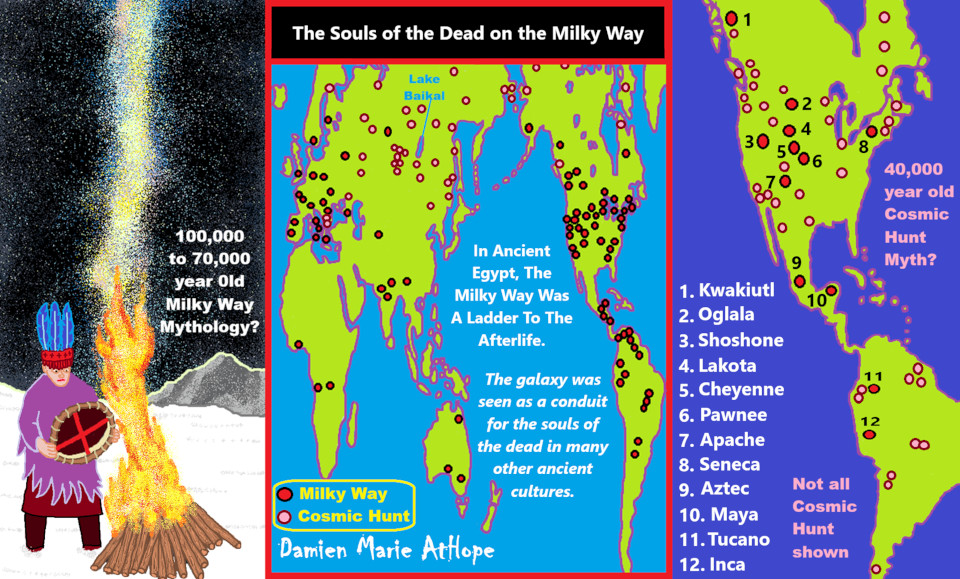
(The above illustration Is of a shaman involved in soul travel using smoke from a fire to reach the Milky Way thus the afterlife or upper world of ancestors and supernatural beings. The maps to the shamans right have both a plotted reference to Milky Way Mythology: often a path to the afterlife, path of dead souls on the Milky Way as well as that of the Cosmic Hunt mythology: also, often with relatedness to Milky Way Mythology as soul path thinking. Where a wounded/killed animal “bear or horned animal: like a dear/elk/moose and occasionally cattle” in the Cosmic Hunt mythology is transformed into a constellation, creating a mythologically charged relationship with the nighttime sky.)
The world map was adapted from two Milky Way maps and one Cosmic Hunt map by mythology expert John White, of the Crecganford YouTube Channel, as seen in the three videos in order:
- Misunderstanding Myth: Peterson, Hancock, Dawkins et al (video)
- The Milky Way: Source of some of our Oldest Myths (video)
- The OLDEST story in the World – The Cosmic Hunt (video)
The Americas map was adapted from one Milky Way map by archaeologist Edwin Lawrence Barnhart and one Cosmic Hunt map by mythology expert John White, of the Crecganford YouTube Channel, as seen in the three videos in order:
- THE MILKY WAY AS THE PATH TO THE OTHERWORLD: A COMPARISON OF PRE-COLUMBIAN NEW WORLD CULTURES (article)
- The OLDEST story in the World – The Cosmic Hunt (video)
Some groups of North and South America with Milky Way beliefs listed in the art above:
Kwakwa̱ka̱ʼwakw, 2. Oglala, 3. Shoshone, 4. Lakota, 5. Cheyenne, 6. Pawnee, 7. Apache, 8. Seneca, 9. Aztec, 10. Maya, 11. Tucano, and 12. Inca. (16) (Barnhart, 2003)
Milky Way Mythology
Milky Way myths are wide-ranging not simply by place and time but even can be varied in the same place such as seen in Egypt (Graur, 2024). In one Ancient Egyptian conception, the Milky Way was a ladder to the afterlife (Taub, 2024). Yet in another, the Milky Way was conceptualized as an ancient fertility cow-goddess called Bat, sometimes pictured as a celestial bovine creature surrounded by stars, or as a woman and was worshiped from the earliest religious records. Later syncretized with the sky goddess Hathor (Hill, 2010). Still another Ancient Egyptian conception, the Milky Way was a celestial depiction of Nut the sky goddess relating to stars, all heavenly bodies, and the cosmos as well as the barrier separating the forces of chaos from the ordered cosmos in the world (Graur, 2024). Nut was sometimes pictured as a celestial bovine creature or as a woman made of stars. Nut also was a symbol of protecting the dead when they enter the afterlife (Graur, 2024).
The Milky Way in a Babylonian mythology conception was formed from the severed tail of the slain goddess Tiamat, a later equivalent of the oldest generation of Mesopotamian deities the goddess Nammu (dating from 4,600 to possibly 6,000 years old) (Webster, 2005) and (Brisch, 2019). Tiamat was envisioned as the “shining” personification of primeval waters, the sea that filled the cosmic abyss in the chaos of original creation. Tiamat may have begun as part of the cult of Nammu, who was an older Sumerian female representation of a primeval sea/ocean/watery creative force, with equally strong connections to the underworld (Brisch, 2019), and (TVTropes, n.d.).
In Hindu mythology, the Milky Way was conceived as all the visible stars and planets moving through space, likened to the abdomen of the dolphin that swims through the water, and the heavens, “The Ganges River of the Sky.” In another Hindu conception, the Milky Way is a representation of the Kshira Sagara (Sea of Milk: cosmic ocean), in which God Vishnu lies meditating with his consort Lakshmi on the primordial being of creation Shesha, viewed as a serpentine demigod and king of the serpents (Bhagavata purana, n.d., Ch. 23).
The Milky Way, in Eastern Asian and Chinese mythology, was the “River of Heaven” or the “Silvery River.” The Silvery River of Heaven (Milky Way) motif is part of a romantic Chinese folk tale, where once a year, on the seventh day of the seventh lunar month (typically after the New Moon in a Waxing Crescent Moon phase), a flock of crows and magpies would form a bridge over the heavenly river to reunite the lovers for a single day (Brown & Brown, 2006, p. 72) and (Green, 2025).
In Hungarian mythology, Csaba, the mythical son of Attila the Hun and ancestor of the Hungarians, is supposed to ride down the Milky Way when the Székelys (ethnic Hungarians living in Transylvania) are threatened. Thus, the Milky Way is called “The Road of the Warriors” (lit. “Road of Armies”) Hungarian: Hadak Útja. The stars are sparks from their horseshoes (László, 2021).
The Milky Way was and is called “The Pathway of the Birds” among the Finns, Estonians, and related peoples (Andres, 2002).
One Greek legend explains how the Milky Way was created by Heracles (Roman Hercules) by spurting milk out when being pushed away as a baby suckling on the goddess Hera while she was startled awake and was not willing. In another version Hera was awake and knowingly agreed to suckle Heracles but then he bit down and Hera pushed him away in pain, allowing milk to squirt out to form the Milky Way (Miles, & Peters, 2002).
Welsh mythology and cosmology derive from the ancient oral traditions of the Celtic Britons, which were maintained by druids and bards until the time of their recording in medieval Welsh literature. Many features of the night sky are named for the “children of Dôn” the ancient mother goddess and sky goddess, with the Milky Way being associated with Gwydion ab Dôn (the son of Dôn) and named Caer Gwydion (“The fortress/city of Gwydion”) or Llwybr Caer Gwydion (“the path to the Castle of Gwydion”) (Squire, 2003, p. 252–253).
In Irish mythology, the main name of the Milky Way was Bealach na Bó Finne — Way of the White Cow. It was regarded as a heavenly reflection of the sacred River Boyne, which is described as “the Great Silver Yoke” and the “White Marrow of Fedlimid,” names that could equally apply to the Milky Way. (Mór-Chuing Argait, Smir Find Fedlimthi) (Archive, 2013).
The Milky Way as the Path to the Otherworld: Pre-Columbian New World Cultures
Similar to Eurasia, people in the New World had many myths about the planets, the stars, Milky Way, and the universe. Indigenous-built structures from Chile to Alaska were observatories and recreated models of the universe by applying archaeoastronomy, thus illuminating past hidden customs of those groups. Cross-cultural comparison of the cosmologies of four New World cultures, the Inca, Maya, Aztec, and Navajo demonstrate that each believes in a three-planned universe: the earth plus an upper and underworld. Moreover, there can be shown that there is a prominent role of the largest of all-sky phenomena, the Milky Way, from the perspectives of eleven New World cultures: Inca, Tukano, Maya, Aztec, Apache, Pawnee, Cheyenne, Sioux, Shoshone, Seneca, and Kwakiutl (Barnhart, 2003).
While information on the Milky Way cannot be found for every New World culture. This should not be construed as a lack of beliefs regarding the Milky Way. Each of eleven New World cultures has their own myths regarding the creation and character of the Milky Way involving local animals and geography. The Milky Way is spoken of in terms of metaphors that have special meaning to each of eleven New World cultures as well. However, if one looks beyond the localized metaphors, to the meaning and function of the Milky Way in those same cultures, continuity emerges. Each of eleven New World cultures regards the Milky Way as the Path to the otherworld, traveled by spirits, deities, and shamans in trance (Barnhart, 2003).
Milky Way as Tracks of the Cosmic Hunt
Many cultures see the Milky Way as related to the Cosmic Hunt, such as relating to the tracks of a celestial hunt, like an animal trail, and constellations (like Ursa Major “the Great Bear”, Taurus “the Bull of Heaven”, and Orion “the Heavenly Hunter or Shepherd” all seen near the Milky Way) (Berezkin, 2005), (Chandra, n.d.), (Garfinkle, 1997, p. 66–67), (Rogers, 1998). The Cosmic Hunt is likely very ancient-originating over 15,000 to possibly 28,000 years ago in a widely distributed family of cognate myths involving a large animal(s) pursued by a hunter(s); the animal is wounded/killed and transformed into a constellation near the Milky Way (Berezkin, 2005) and (Grokipedia, 2025). Variants of the Cosmic Hunt are common in cultures of Northern Eurasia and the Americas. The prey animal is either a bear or a large mammal with hooves and often horns as well (Berezkin, 2005) and (Grokipedia, 2025).
Siberian/East Asian and North American Milky Way Mythic/Belief Elements
Six Milky Way mythic/belief elements in Siberian/East Asian and North American Afterlife beliefs provide an ethnographic context for interpreting hypothesized figurative portable art in the Clovis cache at the Anzick Clovis infant burial site, Montana, USA, 13,000 years ago (Harrod, 2022).
6 Milky Way mythic/belief elements:
- Milky Way (if Milky Way is also a path of souls; birds; dog; or wolf, fox, or coyote.
- The Path of Souls (if that path is the Milky Way)
- Birds, as guard of, psychopomp to, or ruler of a path to land of the dead
- Dog, as sacrifice, guard of, psychopomp to, or condition to reach the land of the dead
- Wolf, Fox or Coyote, as guard of, psychopomp to, or ruler of the land of the dead
- Reincarnation (Harrod, 2022)
Among thirteen Siberian/East Asian tribal groups, all thirteen have reincarnation beliefs. Nine have Bird element and Nine have Dog element. These are the most prominent elements. With respect to nineteen North American tribal groups, all nineteen (if Wintu-Maidu and Yok-Utian ‘ashes’ evoke trail of cremated deceased) have the Milky Way as Path of the Souls of the Deceased. Fifteen tribal groups have reincarnation beliefs (for the other four lacked no information); eight had the Bird element; eleven had the Dog element; seven had the Wolf element; and three had a Coyote element. With respect to North America, the belief that the Milky Way is a Path of the Souls of the Deceased extends across major language groups: Wakashan, Salishan, Penutian, Uto-Aztecan, Algonquian, Iroquoian, Siouan, and Muskogean. It is also found in some Hokan tribes (possibly influence by the Ghost Dance) and Caddoan Pawnee (influence of Ghost Dance) (Harrod, 2022).
The Mythology & Folklore Database:
“Found 344 results in total for Milky Way. Database matches were found in the sections for Books (2), Folktales (3), Berezkins Database (339).”
The Milky Way was conceived in the mythology of the indigenous Māori of New Zealand as the canoe once used by the legendary voyager Tama-rereti. The original sky had no stars, Tama-rereti sailed his canoe along the river that emptied into the heavens (to cause rain) and scattered shiny pebbles from the lakeshore into the sky. The sky god, Ranginui, was pleased by this action and placed the canoe into the sky as a reminder of how the stars were made (Archive, 2006).
Like the night starting starless in Māori beliefs, the San people in southern Africa whose mythology holds that long ago the night was pitch black without stars. A lonely girl of an ancient race who wanted to visit other people threw the embers from a fire into the sky which created the Milky Way, so she had a path to go and be with them (Wessels, 2007).
Limitations
Authur of this article explicitly acknowledges that when trying to mix and compile interpretations of varied artifacts as well as differing mythologies there is also a large burden of limitations. Any paper such as this with Hypothesis-driven exploratory research and bold “almost manifesto-like” ambitions in examining Paleolithic art in conjunction with Comparative World mythology faces significant limitations, primarily stemming from the vast depth of time involved, the absence of direct textual evidence, and the limitations subjectivity of interpretation. Interpreting images created tens of thousands of years ago is inherently subjective, risking the imposition of modern, or unrelated cultural assumptions onto prehistoric creators. Moreover, linking Paleolithic art with often features ambiguous figures to varied mythological possibilities cannot be definitively established to even specific known myths.
References
Aboriginal Art Online (2001). Rainbow Serpent and the Dreamtime – Aboriginal Art Online. Retrieved 2025 https://web.archive.org/web/20101112040032/http://www.aboriginalartonline.com/culture/rainbow.php
Andres, K. (2002). Names in Estonian folk astronomy – from ‘Bird’s Way’ to ‘Milky Way’. Electronic Journal of Folklore. 22. Folk Belief and Media Group of Estonian Literary Museum: 49–61. doi:10.7592/fejf2002.22.milkyway
Archive (2013). Irish River-Goddesses: Drowning and Wisdom. Retrieved 2024 https://web.archive.org/web/20130921101524/http://theses.univ-lyon2.fr/documents/getpart.php?id=lyon2.2009.beck_n&part=159207
Archive (2006). Tama Rereti and how the Stars. Retrieved 2024 from https://web.archive.org/web/20060928083643/http://www.carterobservatory.org/index.php?option=content&task=view&id=505&Itemid=103
Barnhart, E. L. (2003). The Milky Way as the Path to the Otherworld: A Comparison of Pre-Columbian New World Cultures. Retrieved 2025 from https://www.mayaexploration.org/pdf/milkyway.pdf
Bernabé C. (1653). Historia del Nuevo Mundo. Retrieved 2025 from https://intiyana.org/bibliodig/files/original/912504ef35763464781026dad5d0a23fa6b3d57c.pdf
Bender, H. (2022). A Serpent’s Tale: the Milky Way. Retrieved 2025 from https://www.researchgate.net/publication/346084712_A_Serpent’s_Tale_the_Milky_Way
Berezkin, Y. Y. (2005). Cosmic Hunt. Retrieved 2025 from https://www.researchgate.net/publication/26484663_Cosmic_Hunt_Variants_of_Siberian-North_American_Myth
Bhagavata purana (n.d.). Chapter 23. Translated by Prabhupâda. Canto 5.
Brisch, N. (2019). Namma (goddess). Retrieved 2025 from https://oracc.museum.upenn.edu/amgg/listofdeities/namma/index.html
Brown, Ju; Brown, John (2006). China, Japan, Korea: Culture and customs. North Charleston: Book Surge. p. 72. ISBN 978-1-4196-4893-9.
Chandra (n.d.). Ursa Major (big bear). Chandra X-ray Observatory. Retrieved 2025 from https://chandra.harvard.edu/photo/constellations/ursamajor.html
Garfinkle, R. A. (1997). Star-hopping: your Visa to Viewing the Universe. Cambridge University Press. p. 66–67, 77. ISBN 978-0-521-59889-7.
Graur, O. (2024). The Ancient Egyptian Cosmological Vignette: First Visual Evidence of the Milky Way and Trends in Coffin Depictions of the Sky Goddess Nut. Retrieved 2025 from https://www.researchgate.net/publication/384075004_The_Ancient_Egyptian_Cosmological_Vignette_First_Visual_Evidence_of_the_Milky_Way_and_Trends_in_Coffin_Depictions_of_the_Sky_Goddess_Nut
Graur, O. (2024). The Ancient Egyptian Personification of the Milky Way as the Sky-Goddess Nut: An Astronomical and Cross-Cultural Analysis. Retrieved 2025 from https://www.researchgate.net/publication/386333806_The_Ancient_Egyptian_Personification_of_the_Milky_Way_as_the_Sky-Goddess_Nut_An_Astronomical_and_Cross-Cultural_Analysis
Graur, O. (2024). The Myths and Lore of the Milky Way. Retrieved 2024 from https://thereader.mitpress.mit.edu/the-myths-and-lore-of-the-milky-way/
Greenberg, J. (2018). Drawing Discovered in South America May be Oldest Sketch Made by Humans: The red ocher markings are 73,000 years old. Retrieved 2025 from https://www.insidehook.com/culture/oldest-drawing-humans-discovered-south-africa
Green J. (2025). Phases of the Moon explained. BBC Sky at Night Magazine. January 21, 2025. Retrieved 2025 from https://www.skyatnightmagazine.com/space-science/why-does-the-moons-appearance-change
Grokipedia (2025). Cosmic Hunt. Retrieved 2025 from https://grokipedia.com/page/Cosmic_Hunt
Harrod, J. B. (2022). Siberian/East Asian and North American Afterlife Beliefs, Mortuary Rituals and Psychopomp Motifs, especially involving Milky Way, Path of Souls of Deceased, Bird, Dog, Coyote or Wolf, and Reincarnation. Retrieved 2025 from https://www.researchgate.net/publication/357718151_SiberianEast_Asian_and_North_American_Afterlife_Beliefs_Mortuary_Rituals_and_Psychopomp_Motifs_especially_involving_Milky_Way_Path_of_Souls_of_Deceased_Bird_Dog_Coyote_or_Wolf_and_Reincarnation_Versio
Hill, J. (2010). Bat. Retrieved 2025 from https://ancientegyptonline.co.uk/bat/
Koumoundouros, T. (2025). Crucial Feature of Human Language Emerged More Than 135,000 Years Ago. Retrieved 2025 from https://www.sciencealert.com/crucial-feature-of-human-language-emerged-more-than-135000-years-ago
László, R. (2021). “Hungarian Mythology”. The Oxford Handbook of Hungarian Studies. Oxford University Press. ISBN 9780198802037.
Miles, M. A; Peters, C. F. (2002). Along the Milky Way. Retrieved 2024 https://web.archive.org/web/20070926225230/http://starryskies.com/Artshtml/dln/10-02/along-the-milky-way.html
National Aeronautics and Space Administration. (2025). Moon Phases. Retrieved 2025 from https://science.nasa.gov/moon/moon-phases/
National Aeronautics and Space Administration (2011). The Oldest Lunar Calendars: The Aurignacian Lunar Calendar dates back to 32,000 B.C. Retrieved 2025 from https://sservi.nasa.gov/articles/oldest-lunar-calendars/
Republic of Peru (2018). Learn about the animals that were considered sacred in the Inca Empire. Retrieved 2025 from https://www.peru.travel/en/masperu/learn-about-the-animals-that-were-considered-sacred-in-the-inca-empire#:~:text=Each%20represented%20a%20different%20plane,puma%20represented%20the%20earthly%20realm.&text=This%20majestic%20bird%20of%20prey,sacred%20animal%20for%20the%20Inkas
Robyn Williams (presenter); Ray Norris (guest) (3 January 2010). “Aboriginal Astronomy”. Ockham’s Razor. Australian Broadcasting Corporation. RadioNational http://www.abc.net.au/radionational/programs/ockhamsrazor/aboriginal-astronomy/3076818
Rogers, J. H. (1998). Origins of the Ancient Constellations: I. The Mesopotamian traditions. Journal of the British Astronomical Association. 108: 9–28. Retrieved 2025 from https://ui.adsabs.harvard.edu/abs/1998JBAA..108….9R/abstract
Shipton, C., Roberts, P., Archer, W. et al. (2018). 78,000-year-old record of Middle and Later Stone Age innovation in an East African tropical forest. Retrieved 2025 from https://www.nature.com/articles/s41467-018-04057-3
Steele, P. R. (2004). Encyclopedia of Mythic Narratives, Themes, and Concepts. Handbook of Inca Mythology. Santa Barbara, CA: ABC-CLIO. p. 95–98. ISBN 1576073548.
Squire, C. (2003). Celtic Myths and Legends. United Kingdom: Parragon. p. 252–253. ISBN 9781842040157.
Taub, B. (2024). In Ancient Egypt, the Milky Way was a Ladder to the Afterlife. Retrieved 2025 from https://www.iflscience.com/in-ancient-egypt-the-milky-way-was-a-ladder-to-the-afterlife-73778
Taylor, B (2023). Lunar Timekeeping in Upper Paleolithic Cave Art. Retrieved 2025 from https://www.researchgate.net/publication/377396371_Lunar_Timekeeping_in_Upper_Paleolithic_Cave_Art
The Brighter Side of News (2025). MIT researchers discovered when human language first emerged. Retrieved 2025 from https://www.thebrighterside.news/post/mit-researchers-discovered-when-human-language-first-emerged/
The Research Council of Norway (2006). World’s oldest ritual discovered: Worshipped the python 70,000 years ago. Retrieved 2025 from https://www.eurekalert.org/news-releases/801556#:~:text=The%20ritual%20took%20place%20in%20a%20small,*%20**Red%20spearheads%20that%20had%20been%20burned**
Tian, L. (2024). How Did the Vikings Understand the Sky. Retrieved 2025 from https://medium.com/from-alpha-to-omega/how-did-the-vikings-understand-the-sky-589f245226ee
TVTropes (n.d.). Mesopotamian Mythology Primordials. Retrieved 2025 from https://tvtropes.org/pmwiki/pmwiki.php/Characters/MesopotamianMythologyPrimordials
Viajes Puma (2025). The Symbolism Behind the Inca Empire Flag. Retrieved 2025 from https://viajespuma.com/inca-empire-history/
Webster, M. (2005). The Babylonian Creation Story (Enuma Elish). Retrieved 2025 from https://faculty.gvsu.edu/websterm/Enuma_Elish.html
Wessels, M. (2007). The Discursive Character of the /Xam Texts: A Consideration of the /Xam “Story of the Girl of the Early Race, Who Made Stars”: RESEARCH ARTICLE. Folklore. 118 (3): 307–324. doi:10.1080/00155870701621806. ISSN 0015-587X. S2CID 142855837
White, J. (2024). The Milky Way: Source of some of our Oldest Myths. Crecganford. Retrieved 2025 from https://www.youtube.com/watch?v=9Rk17t-XMQg
Appendix
References for Figure #1
Boissoneault, L. (2017). Prehistoric Pointillism? Long Before Seurat, Ancient Artists Chiseled Mammoths Out of Dots. Retrieved from https://www.smithsonianmag.com/science-nature/prehistoric-pointillism-long-seurat-ancient-artists-chiseled-mammoths-out-dots-180962306/
Coulson, S., Staurset, S., Walker, N. (2011). Ritualized Behavior in the Middle Stone Age: Evidence from Rhino Cave, Tsodilo Hills, Botswana. Retrieved from https://www.hf.uio.no/iakh/personer/emeriti/coulson/Coulson%20et%20al%202011%20Ritualized%20Behavior%20in%20the%20MSA%20without%20photos.pdf
Синицын А. А. Ранний верхний палеолит Восточной Европы:украшения и вопросы эстетики () ed. Г. А. Хлопачев, St. Petersburg 2016. Archived 26 June 2018 at the Wayback Machine. Retrieved 2025 from https://web.archive.org/web/20180626013231/http://www.archeo.ru/struktura-1/otdel-arheologii-paleolita/pdf/Sinitsyn2016_Iskusstvo_paleolithic_Katalog.pdf/
National Aeronautics and Space Administration (2011). The Oldest Lunar Calendars: The Aurignacian Lunar Calendar dates back to 32,000 B.C. Retrieved from https://sservi.nasa.gov/articles/oldest-lunar-calendars/
Peabody Museum of Archaeology & Ethnology (2018). Modern Humans’ Earliest Artwork and Music: New European Discoveries. Retrieved from https://www.youtube.com/watch?v=Wp7WqPiCmPM&t=887s
Pitulko VV, Pavlova EY, Nikolskiy PA, Ivanova VV. (2012). The oldest art of the Eurasian Arctic: personal ornaments and symbolic objects from Yana RHS, Arctic Siberia. Retrieved from https://www.researchgate.net/publication/257650637_The_oldest_art_of_the_Eurasian_Arctic_personal_ornaments_and_symbolic_objects_from_Yana_RHS_Arctic_Siberia
Ruggles, Clive L. N.; ICOMOS; International Astronomical Union, eds. (2011). Heritage sites of astronomy and archaeoastronomy in the context of the UNESCO World Heritage Convention: a thematic study. Paris: International Council of Monuments and Sites. p. 27–29. ISBN 978-2-918086-01-7.
Shipton, C., Roberts, P., Archer, W. et al. (2018). 78,000-year-old record of Middle and Later Stone Age innovation in an East African tropical forest. Retrieved from https://www.nature.com/articles/s41467-018-04057-3
Tedesco, L. A. (2000). Mal’ta (ca. 20,000 B.C.). The Met’s Heilbrunn Timeline of Art History. Metropolitan Museum of Art.
Tribolo, C., et al. (2006) TL dating of Burnt Lithics from Blombos Cave (South Africa): further evidence for the antiquity of modern human behaviour. Archaeometry, 48, 341–357.
UNESCO (2017) Caves and Ice Age Art in the Swabian Jura. UNESCO World Heritage Centre. Retrieved 2025 https://whc.unesco.org/en/list/1527/
References for Figure #4
Barnhart, E. L. (2003). The Milky Way as the Path to the Otherworld: A Comparison of Pre-Columbian New World Cultures. Retrieved 2025 from https://www.mayaexploration.org/pdf/milkyway.pdf
Berezkin, Y. Y. (2010). The Pleiades as Openings, The Milky Way as the Path of Birds, and The Girl on the Moon: Cultural Links Across Northern Eurasia. Retrieved 2024 from https://www.researchgate.net/publication/43337047_The_Pleiades_as_Openings_The_Milky_Way_as_the_Path_of_Birds_and_The_Girl_on_the_Moon_Cultural_Links_Across_Northern_Eurasia
Excellence Reporter (2019). Siberian Shaman: The Country of Red Shamans. Retrieved 2024 from https://excellencereporter.com/2019/01/02/the-country-of-red-shamans/
Graur, O. (2024). The Myths and Lore of the Milky Way. Retrieved 2024 from https://thereader.mitpress.mit.edu/the-myths-and-lore-of-the-milky-way/
Lebeuf, A. (2020). 1996.The milky way, path of the souls. Retrieved 2024 from https://www.researchgate.net/publication/346547402_1996The_milky_way_path_of_the_souls
Taub, B. (2024). In Ancient Egypt, The Milky Way was a Ladder to the Afterlife. Retrieved 2024 from https://www.iflscience.com/in-ancient-egypt-the-milky-way-was-a-ladder-to-the-afterlife-73778
White, J. (2025) The Milky Way: Source of some of our Oldest Myths. Crecganford. Retrieved 2026 from https://www.youtube.com/watch?v=9Rk17t-XMQg
White, J. F. (2025). The Mythology and Folklore Database. Retrieved 2024 from https://www.mythologydatabase.com/loginmythdb.php
White, J. (2024). Misunderstanding Myth: Peterson, Hancock, Dawkins et al. Crecganford. Retrieved 2024 from https://www.youtube.com/watch?v=ovbpxgcnGW0
White, J. (2022) The Oldest Story in the World – The Cosmic Hunt – An Incredible discovery. Crecganford. Retrieved 2026 from https://www.youtube.com/watch?v=ANRw-3C_MYA