
Book Review
Immediate Keepsake Asks Readers to Soak up the Magic Around Them
By Tabitha Dial
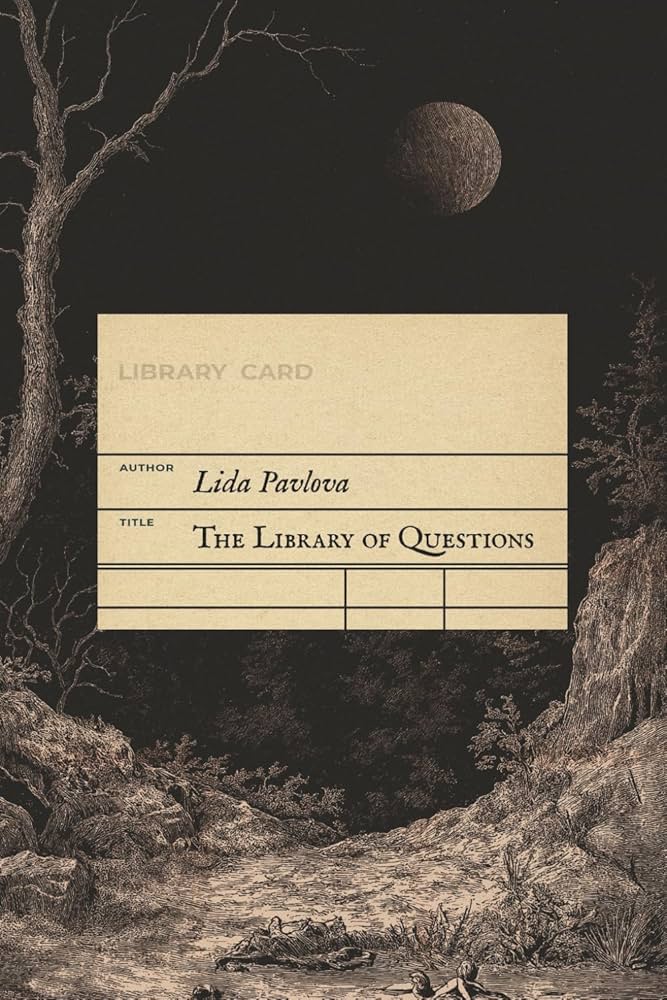
The Library of Questions
By Lida Pavlova
Illustrated by Khvost Sennikov
“The Library of Questions” is the kind of book that entices you to peek inside– a beautifully crafted and organized hardcover, it has the look and feel of an immediate keepsake. But readers must open carefully– It innately knows what each individual needs.
Its author Lida Pavlova wrote that we look for answers from our intuition and divination tools such as Tarot cards because we desire a connection to magic. And we want “the quiet chat with the miracle” (27).
One example of a chat with the miracle was early on Halloween morning 2025, when I turned to “The Library of Questions”. Prepared to finish reading Lida Pavlova’s straightforward intention-setting introductions, I opened the book instead to the first of her many unique spreads.
To those unfamiliar, a spread is also known as a layout for a card reading. Divided into four sections, Pavlova’s book features Magical Spreads, Practical Spreads, Self-Care Spreads, and Seasonal Spreads.
“My mind doesn’t seem to start looking for answers, solutions, and ideas until I ask the right questions” (13), Pavlova writes that she wants us to fill our lives with quality questions that help our brains find possibilities (14). Solutions, answers, and ways out are only some of the creative opportunities our minds can map out after we teach our intuition what it can ask.
She wants readers to remember that intuitive prompts like hers work because we do not expect the perfect, right answer right away. The answers that immediately come to us, she writes, offer insight and help, but they also scratch the surface of our own wisdom:
The answers will keep coming after you do the reading or journaling. Be open to them. Expect them, but without pressure. Ask your questions — do the answering yourself — and then stay open to the answers you would’ve never thought of in the first place (15)
Pavlova believes this practice builds value. “You can train yourself to see more information in the cards, and to find more information inside your mind” (16). It is a type of mind magic worth pursuing as a discipline (16).
If we interact with the questions in the order they appear in the book, we begin with Pavlova’s exercise in seeing ourselves as adventurers with maps and banners that we carry for success. We end with a spread designed to read for our birthday, with our personal new year in mind. Both the first and final spread usher in empowering self-talk. Both spreads dare us to make good on promises we may wish to keep with our innermost selves.
Let’s look at how some of the spreads can influence the way we think and behave.
A Personal Interaction:
The Sheer Madness Spread (137) appeared when I randomly opened “The Library of Questions” on the third day of November 2025. November, significant, in this case, to creatives as a month many commit to writing a novel, either with or without a community.
This was my first year pursuing the writing challenge, though I knew about it for 20 years. I chose a nonfiction project that involved tracking interactions with others. It was a last-minute decision. I hadn’t spent the previous month preparing, which is common to people who join the challenge.
“The Library of Questions” knew I made a sudden, large commitment. The endeavor of writing regularly wasn’t “sheer madness” in itself, but adding the homework of tracking my interactions with others may be “something grand and probably stupid” (137), as Pavlova describes the intended application of her spread.
Here are the questions that the “Sheer Madness Spread” asks:
- Why do I want to do this?
- Why, deep down, do I want to do this?
- What will happen if I completely abandon this?
- What will the result be if I implement it more gently and cautiously?
- What will happen if I fully commit to this crazy idea?
The process of completing the questions as a journal prompt showed me just one of many applications a spread like this can have for readers. It holds great value as a means to finding the purpose behind the more challenging projects we want to finish.
The survey of motivation she published as the “Sheer Madness Spread” is one of multiple examples of Pavlova allowing us to see ourselves fully and give ourselves a chance to let go of things we may want to do one day but not the next.
If you’re wondering, I exceeded my original goal of 20,000 words for the November writing challenge by almost 10,000 words. The “Sheer Madness Spread” refreshed my ambition while allowing my ego to stay in check at a stage where I started to doubt myself or possibly, eventually, burn out.
Deeper Adventures within “The Library of Questions”:
Pavlova’s first two spreads focus on adventure: one giving us a psychological landscape of our resources and values, the other a simple four-question layout with two characters that can be used to provide ideas for a short story:
“Adventure” (29) (Pavlova’s second spread):
- Choose your weapon (what will help you?)
- Choose your ally (who will help you?)
- Choose your enemy (what or whom are you fighting?)
- Let’s see what happens (possible outcomes)
Finishing this spread can leave one feeling like they have a benevolent narrator. They can feel like they understand a situation from a more objective lens. It’s perfect to shed light and can be used as a creative writing prompt.
Magical Spreads section inspires plenty of imagination. It plays with archetypes like the beekeeper, cat goddess, a paranormal pigeon, the unicorn, the wanderer, and more. It contains 50 separate spreads. Very much influenced by folk lore and fairy tales, it ends with spreads called “There are Three Paths”(84), “Witch’s Familiars”(85), and “The Ultimate Guide Through Scary Things” (86).
The Magical Spreads are not pure flights of fancy. The final three sets of questions do not shy away from difficult matters. “There are Three Paths” asks readers to look at what they are willing to make sacrifices for, what stories direct their lives as they repeat those stories to themselves, and what one thing we are protecting that shapes the meaning of our lives. The “Witch’s Familiars” give readers a chance to look for four helpful tools to face a difficult situation: the confidence to be in the right mindset, how to find helpful information, what will assist with material resources and funds, and what warning sign will help keep you from making a false step. Finally, “The Ultimate Guide Through Scary Things” guides readers through the “big why/goal” behind an important or potentially terrifying action they must take– and asks how you can transform anxiety into an ally, how to comfort yourself, and lastly, “how to reward myself for my bravery when it’s all over” (86).
For those inclined to practical thoughts and actions, particularly in the realm of work, relationships, money concerns and more, Pavlova includes a Practical Spreads section that is worth discussing on its own. See the conclusion of this review.
Early entries in the Magical Spreads section, including “Ancient Amulet” (30) and “Benevolent Spirits” (31) can ease the heart. Ending with the questions “How to protect your loved ones?” and “Why do [benevolent spirits] love me?”, respectively, compassion for one’s wellbeing and a desire for support set the tone for how to use this book, as well as the purposes of the spreads found under Self-Care.
Applications for Self-Care and Tarot Professionals:
The Self-Care section, with 26 spreads, welcomes you to hold its hand and covers a broad scope of personal needs. This includes the type of concerns approached in the “Sheer Madness” questions shared at the beginning of this review.
“Care” (131), “Faith” (132), and “Rage” (133) are explored fearlessly and inquisitively — making the Self-Care section particularly eye-opening to those interested in receiving or giving counselling and therapy.
Pavlova includes what many writers of books like hers forget to do. She recognizes there are many ways to look at and handle anger. “I Don’t Have to Be Good” (135), a spread about accepting anger, asks six questions, ending with:
“What way of thinking about my anger can be helpful? What can my rage embody?”
And
“Inner strength. Why am I valuable or right regardless of any emotions I may have?” (135).
Tarot professionals may immediately recognize the possibility to serve others with a combination of the “Daily Frog” (32) and the “Dark Forest” (33) which follows. The first is a one card pull for the day that stands out from the usual — it asks how we can be “the most extraordinary, amazing and gladdest frog today?” (32).
As a professional Tarot reader of many years myself, it is refreshing to see such language from Pavlova. Adopting different personas is a useful strategy practiced by Jung and other psychologists. It can help navigate trying times or allow one to step outside of their comfort zone to set new boundaries, accomplish a task, or go after a job. Why not give your deck a chance to have fun and read it to learn how be an extraordinary, amazing, and gladdest frog?
The “Dark Forest” spread may be used for Tarot readings when a client doesn’t know what they want to ask — or if they wish to keep the purpose for their reading to themselves. One may or may not wish to include the fourth question in the spread. Or they may alter it to suit their own reading style:
“Dark Forest”
- What should I fear here?
- What should I trust here?
- What am I searching for here?
- What might I lose here?
To wow both Tarot readers and for Tarot clients who seek magic and marvelous insight, the “Summer Night in a Fairy Forest” (46), is a great fit. One of its questions asks what a quarter or more of the book wishes readers to explore: “What do you do to soak up the magic of this world?” This particular spread stretches our impressions and beliefs about ourselves. It challenges us to explore where we need magic — and what can awaken “our minds and our interest” (46) again.
Conclusion:
“The Library of Questions” is a book that anyone can use, regardless of their familiarity with journaling, self-help, or divination books and tools. It’s an invaluable resource, adaptable to psychological or spiritual inspiration, creative writing, entertainment, or more reflective problem solving.
Pavlova briefly gives a heartfelt and grounded explanation of what Tarot is and answers the question “Is this Witchcraft?” early in her book. She argues that “metaphysically …(w)e are all pure magic. Handling and understanding magic is witchcraft” (23).
She puts readers at ease when it comes to using and learning Tarot:
“As with everything else, the more you read cards, the better you get at it. Each card tells its own story. If you look at those stories closely, you’ll find ways to apply their wisdom to your own life and problems” (18).
Pavlova goes further, addressing the importance of reflection and uncovering solutions as she introduces her Practical Spreads section (91):
“Card readings change lives. Journaling helps us find ways that have been hidden from our anxious minds” (p 91). She describes the practical section as one full of questions that involve common confrontations within our work, relationships, money worries, and more.
A bit like a sponsor in a twelve step program, where “One day at a time, sometimes one hour at a time” is commonly advised, Pavlova’s Practical Spreads include “The Dawn” (101), “Good Morning” (102), “Good Day” (103) and “Not-So-Good Day” (104)
The Practical Spread section is full of clean ways to handle relationships, deal with “When Things are Really Bad” (107) and not lose your “gladdest frog” persona to more everyday issues. Some favorite spreads here include “Creativity” (111) and “Objectivity and Productivity” (112).
The spreads in the Practical Spreads section include one in the spirit of not controlling others called “You Can Only Inspire Them” (100). Another reminds me of my own psychologist who changed me into a much more autonomous person when she kept telling me “It’s your life, Tabitha!” That spread is “The Decision is Yours” (122).
The “The Decision is Yours” spread is one for any skeptics and fearmongers who may feel people who use divination have a belief that their cards hold knowledge that they must follow, and that they think they spell out a future that they cannot have any say in.
The premise of “The Library of Questions” is to find and maintain your own magic and extraordinary value. Many spreads help us engage in the world around us and uncover unconventional sources and inspiration as we support and handle our best selves. Even the twenty sets of questions in the “Seasonal Spreads” are designed to usher in wonder and a deeper knowing of oneself in the rhythm of nature: itself a grand miracle.
If you want an innovative way to solve problems with a fun but wise approach to human nature, folklore, and self-awareness, “The Library of Questions” is an ideal book. If you believe in magic– and the good questions that it often takes to recognize magic– grab this book. Get it for anyone who wants to better grasp the ability to read cards, whatever system they have: Lenormand and Oracle as well as Tarot. Refresh a seasoned reader’s ability to make the most of their deck. Put new life into a journal near you through “The Library of Questions.” Or just use it to delight friends and loved ones, those who can show us the strongest personal magic of all.
Tabitha Dial, Poetry Editing Team. A Winner of the Penned Literary Contest (2021) and member of Jersey City Writers. She completed a Poetry Gauntlet of 100 poems written in one year, and an MFA in Poetry from Colorado State MANY years prior. I once performed a Opera in Kentucky while dreaming of chickens.
@TabithaDial – Instagram and Bluesky

Like what we do? Buy us a Cup of Coffee!