
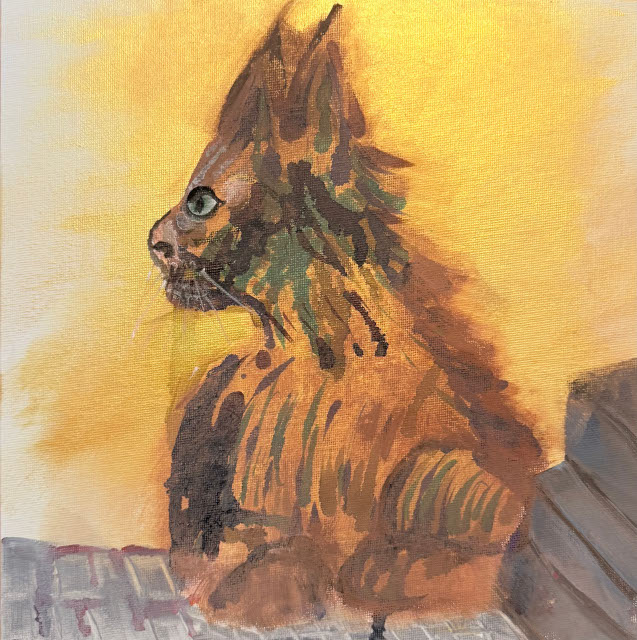
I Know Not
By Kimberly Y. Choi
Illustrated by Shelly Kay
The afternoon is cold for one who has been pacing about the agora this long. Socrates thinks of a warm meal with his wife and homeward angles his steps.
“No,” I say.
His gait breaks rhythm but a bit. He returns towards the plaza. It never takes him much willpower to resist sensory pleasures, and he always heeds my command.
“I thought you had left for the day.” Whether the textile seller is just making conversation or being derisive I cannot tell.
“My daimonion says not yet,” Socrates replies.
The agora at this hour is lightly traveled, a passer-by here and there, some of the merchants starting to wrap up. Still, Socrates must not fall into laziness. To bring the people to virtue and open their minds is his work under the gods. The Oracle of Apollo told him so long ago. He is faring very well at his life’s task partly because he listens to me. Among humans, he has a rare penchant to perceive and heed his daemon, even if he has never been able to see me, and the only word I can say to him is “no.”
I walk alongside Socrates, I about the same height as he, out of the shade of a building and stand to the side of one of the busier roads. A little calico cat licks her paws near a cheese vendor. On the next street two men who look like father and son cheerfully meet and walk south together. People pass by, each with their own daemon, ghostly human figures beside them.
Almost all my fellow daemons have a less active career, their human charges never realizing they exist. We are nearly always invisible to humans although we can see each other. Many have bewailed to me that their charges go their entire lives without ever hearing a thing they say. Probably most humans hear their daemons’ advice in the form of insights or convictions as though their own.
Once, the daemon of a street musician told me his charge somehow always attributed those insights and convictions to herself rather than an external spirit, even though they were so much more moral and wise than her own urges. She really thought it was herself desiring to publicly praise her rival or going home to cook for her husband instead of staying to flirt with the audience member she fancied more.
Socrates brushes a rough crumb of stone from under his bare foot and looks up. A gruff man is coming up the road with long strides.
“Good afternoon,” Socrates calls out.
“Good afternoon,” the man grumbles without looking.
“An opinionated fellow, perhaps? What’s something you believe?”
The man is already down the road. His beliefs will go unquestioned today.
Socrates is not embarrassed; he is used to being disliked. He only worries his questionings will not reach the people who need it the most and that the people in power might do him harm. As we wait for someone else to come near, I call to the cat across the street. She approaches us and sits down in front of me in that proper, elegant feline way, with all four feet together.
I am fond of cats. I wish they were more common pets in Athens. They are spiritually-minded creatures who can hear and see daemons even though they have no daemons of their own. While their minds are simpler than humans’, I speak to them with ease without Socrates hearing me.
“It’s a fine day, is it not?” I say.
The cat stretches, expressing her contentment. Socrates reaches over and gives her just a quick pat on the head, from which she recoils. It occurs to him the cat might be here for his daemon, not for him. He sure is wise; I suspect most humans would fail to consider the possibility.
“He is good, too,” I tell the cat.
She trusts me; perhaps she perceives my holiness. She steps over to Socrates, though shyly, and nudges his leg with her face. Then she looks back up at me.
Socrates glances down at the cat and follows her gaze to me. I would say if daemons bridge man and God, cats bridge man and daemons. For a moment, Socrates looks me in the face though I remain unseen. When he looks back down to the cat, she lifts her paw at me.
Socrates for a brief and truthful moment fully sees what the cat is pointing out. He and I make eye contact. This moment may be the peak of his spiritual clarity in all his life. He then isn’t sure whether he saw me or, because he is so accustomed to remembering I am with him, only imagined me.
Then approaches a man, middle-aged, serious in appearance, whom Socrates recognizes. This man has stopped before to listen to Socrates’s ravings of wisdom on the streets and was a familiar character at the Assembly. His daemon and I greet each other.
When the man notices Socrates, he immediately tenses up and stands up straighter. The thoughts of people other than Socrates are invisible to me, but I can discern, no better than a human can, that he fears getting intellectually humiliated but doesn’t want to back down.
“‘Eubiotos,’ it was?” Socrates addresses him.
Eubiotos scowls and stops walking. “Yes, Socrates.”
“Do you have much knowledge?”
“Very much?” Eubiotos glares. He sets down the bag of meat he is carrying from the marketplace.
“Of what?”
“I’m an orator by profession.”
Socrates is satisfied because he already knows how to induce new thinking in this man. “So you can explain things very well.”
Eubiotos winces. “That is only the beginning of it. The more advanced task is to change people’s minds.”
“Why would you need to do that, rather than merely explain things?”
Eubiotos fidgets with the handle of his bag. “You know what an orator does. I am adept at swaying the populace on issues that matter, public spaces, our leaders, war. I have altered the opinions of many.”
“Is that distinct from merely explaining those issues?”
“Yes, because–” The orator hesitates and glances about, though his trained voice keeps cool. “Because anyone can just explain! I must strategically use my words and delivery. I must speak about those issues in a way that makes people think differently of them.”
“You say your specialized knowledge concerns how to think about issues such that one forms a specific opinion on them, and this is distinct from simply having accurate knowledge of those issues. If these are different, does that mean your knowledge of the issues is not entirely accurate?”
Eubiotos struggles to conceal his agitation professionally. When Socrates provokes someone so, I feel that harmony with heaven that is the sweetest part of my existence. I seek his accordance with his divine work like humans seek pleasure. Even so, I can understand why people are annoyed.
But Socrates does not argue to win or to claim superiority, only to open minds. Eubiotos’s daemon and I glance at each other but stay silent and watch the interaction, as is common among us.
“Please! Socrates, you are trying to entrap me. You think this is clever. I’ve not met one other wise person who thinks ill of rhetoric.”
The cat, who has been watching all the while but not understanding the argument, meows softly to the distressed man. Eubiotos looks at the cat and relaxes a bit, but then he returns to recapturing his pride.
“I know about politics and law in depth. And when I speak, I am not a liar,” he says. “I persuade people of what I really believe.”
“Would it not be better to educate the people than to sway them?”
“No!” He practically stomps on the graveled ground.
“Could it be, if you search yourself, that you don’t know these issues that well and have merely used a kind of rhetoric on yourself?”
“I have no need for you, Socrates. You are disrespecting a noble profession.” His voice bulges with the disdain that would have escaped its vessel if not for his practiced stateliness that kept him in place longer than most mortals would endure. He walks away.
On his way down the street, Eubiotos turns and glances at us again, looking by Socrates’s feet. The cat watches. Eubiotos turns away, and then looks again.
“Go for it if you want,” I hear his daemon say.
I soon realize what the daemon is talking about when Eubiotos walks over and sets his bag of meat on the ground. “This cat, though, I will not leave,” he mutters in explanation. “Her voice is too sweet.” The cat hops into the bag.
Eubiotos’s daemon assures the cat: “Eubiotos may have a temper, but he will never strike you. He is a good human in the end. You will be well with us.”
The cat pokes her little head out of the bag and lowers her face in acknowledgement, and away she goes with Eubiotos.
#
This morning, the sun is out, and gusts of wind rumble among the great stone buildings. The cat chases a broken broom handle and then takes shelter from the wind behind a column. Socrates wonders if Eubiotos might be nearby, letting his cat run while he mingles and shops.
Socrates heads for the craftsmen’s district, hoping to jar some craftsmen from their usual sureness of themselves. I am eager for it too. But from the left comes a shouting voice, riled, not joyous, echoing along the stone. I notice the cat leap, startled, and dash away, her tail drawing a loop in the air. Socrates goes to see what the commotion is about.
A loose crowd of men is moving wildly. Socrates skirts around the throng, trying to get a better view without getting mixed into the action.
One man is yelling at another: “Barbaric! You ask for the common people, you ask for me to be oppressed! This is good to you! This is good to your uncivilized mind!” He kicks him to the ground and moves closer, neck arched, hands in fists. The fallen man struggles to scoot away.
“Stop!” Men rush in. In the frenzy, it is hard to discern whether they are siding with the attacker or the attacked, but it becomes clear that it is both. The voices become painful to Socrates’s ears. The daemons, too, are shouting at their charges. One of the bystanders backs off suddenly, whether because he heard his daemon consciously or unconsciously. At least one daemon urges a man to attack while another calls for mercy.
Eubiotos is among the disorderly crowd, moving in to pull an attacker off the victim. The attacker stands up suddenly, knocking Eubiotos sideways to the ground. Eubiotos exclaims in pain, standing up, and gets away from the tussle.
Eubiotos waddles up to Socrates, frowning, his shoulders back, as though reluctantly conceding something. He rubs his side that he fell on.
“What have you come to me for?” Socrates has a playful note in his voice. “I don’t know much at all, let alone about bruise healing.”
He looks around. “After all, I want to ask your opinion on something: democracy.”
Socrates cocks his head. This encounter is going to energize Socrates and fulfill me.
“I speak in support of democracy. That man, the attacker, is a supporter of the cause, and he just attacked someone for supporting the oligarchs.” He looks about him. “Now, I know you have said some things that people have interpreted as anti-democratic— Was I right, Socrates? Is my conviction about democracy enough for all this?” He motions to the space behind him.
The men are beginning to disperse.
Socrates smiles. “We can work this out. What is the goal of government?”
“To rule the people,” Eubiotos answers tiredly. It seems he is unhappy with having to go through this procedure, yet he does.
“And what should it compel the people to do?”
“Be virtuous.” Eubiotos shifts his weight to the other leg. “Treat their fellows fairly.”
“Would the people be virtuous without a government?”
Socrates is performing his beautiful work. As they speak, I look to the clear sky and revel in the approval of the divine. I do not understand the divine plan for Athens as a whole, if there is one, but I know there is rejoicing when Socrates acts with virtue. Over the next quarter of an hour, Socrates has the orator question democracy and oligarchy and government itself and human goodness and human evil and the court and the military and the farmers and the gods, and all the while, Eubiotos gets more agitated.
“Enough! I don’t need this.” He smacks the air by Socrates’s face. “For a moment, you’ve made me think I believe nothing at all. Of course I believe. I believe in the evil of tyranny and that people should rule. You want us to question everything. I think the right ideas simply don’t need to be questioned.” Socrates is about to say something, but Eubiotos raises his voice to stanch him. “No one is obligated to consider ideas that are worse than the ones they already have. That would mean entertaining thoughts that are foolish or immoral. You are dangerous. You will destroy the city.” He leaves.
Disappointed in this man who had started to show promise, Socrates seeks to put this conversation out of his mind. He goes to eat one of his modest meals of bread and beans and question the craftsmen after all.
#
A few months have passed. Socrates had gotten over the Eubiotos incident in a day; plenty of people are not receptive to him.
Today he is not on his questioning duty; he is attending a debate at the university, another exercise of wisdom. But I’m worried. It is that difficult-to-describe worry that is distinct from the ordinary and comes, I believe, from above. The gods are warning me.
As the debate ends and Socrates stands up from his seat, Meletus, the poet, looks at him with a severe eye. Socrates does not catch it. While Socrates leaves, multiple sets of footsteps follow us, echoing in the space of the great theater. Once Socrates is out, he sees the small group of men together striding towards us.
At the sight of Meletus, Socrates frowns and casts his eyes down. He gets annoyed with poets. A verse or tale must not be mistaken for wisdom, he believes. I like poetry myself, I admit. It is often like a friendship between men and gods. But it is always good how Socrates commits to his values.
In fact, Socrates feels like breaking the gravity of the situation with some anti-poetry derision. He tries to compose the right quip.
“No,” I say.
The men stand before us, firmness in their poise. Their daemons regard me with solemn expressions.
“Socrates,” says the poet, “you are charged with heresy and turning the youth against Athens. The proposed punishment is death.”
Even a man who is sure of the value of his accomplishments so far and who has suspected such a fate feels a chill at such news. Though trembling, Socrates takes a deep breath and says, “Oh, I must’ve done a good job at it then.”
Another of the men scowls. “You question too much, Socrates. You are attacking the foundations of society.”
Meletus, with his long hair and ungroomed, lopsided beard, stands imposing. “You are to appear next week before the magistrate.”
#
Socrates’s wife sat up in bed last night, weeping.
He, lying down, held her arm. “I will defend myself. I know I am right. If I fail to defend myself, Athens is wrong, and I will not want its support.”
Now he sets out into a too-bright morning, weary from his restless sleep. A wren sings its frantic song. Socrates had never spoken directly to Meletus, even though he knew of him. Who could have encouraged him to bring the charge?
Quite a few people have called Socrates dangerous; more were simply offended. There was one student who aspired to research astronomy, who told him, “Stop taking me for one of those thoughtless common people who never analyze anything.” Orators and poets like Meletus did not like what he said about their professions. I wonder as much as Socrates who it was.
We are not going to the agora, but tramping up a hill. Socrates is truly heroic. As troubled as he is, he is still carrying out his usual mission until his hearing. He’s ascending the Pnyx to catch the great speakers and learned people who come to see them at the speaker’s platform. He’s thinking what I think: if these may be the last days of his work, he might as well do the most good before the most powerful and educated people of Athens.
No one is delivering a speech right now, but a small group is gathered on the stone beside it to talk politics, making those little movements of casual conversation. They glance towards Socrates, who stops to read a posted note: the list of who is to speak in the coming weeks. Eubiotos is speaking in two days.
Socrates is reminded of him oftener than he would like when he recognizes his cat prowling about the agora. It’s mostly not Eubiotos’s unpleasantness that bothers him, but the fact he came so close. Socrates wonders for how much more of the schedule of speakers he will live. And then he joins in the political discussion around him.
For humans, the preservation of one’s life is usually the greatest thing. For daemons, it is fulfillment of their divine work first and preservation second. If it ends up coming to it, I would hope Socrates dies for his belief in his work rather than save himself. And I figure Socrates, among humans, will be unusually in accordance with the daemon view of things.
Still, it is painful for me to think of his death. I feel it all the more keenly as I watch him continue to say, “And why does your friend believe he is right?” or “What does God really want from you?” to a passer-by at such a time. In his distress, his questions still thrive.
But could I save Socrates? I expect Socrates to construct a better defense in court that I can. And the will of the jury is not in my control. But the jury is drawn from the people. And who does have control over the people is the orators.
I need to speak with Eubiotos’s daemon. It is my only hope. We must try to find him in the agora; it is not unlikely he would be there on a sunny day like this. I can’t tell him to search the agora or even to leave this place. I can only tell him “no.”
“No.”
Socrates stops mid-speech. “My daimonion is telling me not to debate with you.” He is puzzled what I’m saying no to: his questioning of their opinions on some of the noted scholars of the day, or standing here and debating at all. He is not afraid of abruptly leaving and proceeding downhill. He believes my voice is more important than social acceptability.
On the way down, he checks for dangerous storms in the sky, but it is clear. He reviews his arguments, asking himself if he said anything dangerous or immoral. He hardly even gave an opinion, really, only had the others clarify theirs. He makes for home.
“No.”
Socrates obeys and goes to the agora instead. There, he strolls slowly, but I need him to move rapidly and search for Eubiotos.
“No.”
He turns and strolls slowly in the other direction.
“No.”
He picks up the pace. He’s getting the idea. He keeps pausing at intersections, wondering which direction I mean for him to proceed. I don’t know how to convey to him that he is not supposed to go to a particular place but to move around until we find Eubiotos.
“No,” I say the next time he pauses.
I can’t even pause? he thinks. He feels an urgency. This is the most I’ve ever spoken to him within a single hour. He wonders if he is in immediate danger from something he cannot see, and he proceeds into the market area.
When he passes the cheese merchant, he slackens, tired, and jokes with me in a whisper, “You’re telling me this is really good cheese?”
“No!”
We are near the theater where plays are performed. Socrates’s aging legs are weary. I do not know where in the agora Eubiotos is likeliest to be, if he is even out today. But we have little time.
I do not spot Eubiotos, but I spot his cat, down the street to the right. It would have to do. “No!” I say quickly as Socrates is about to continue straight ahead. “No,” as Socrates starts to turn left. Then he goes right. When the little calico appears in a pocket of sunlight between buildings, I say “no” to stop Socrates from going any further.
“Eubiotos’s cat? Really?” Socrates whispers to me.
The cat looks at us and recognizes me. “Kitty,” I call her in affection. She trots up to us on little, light paws, and sits.
Socrates pets her, catching his breath, overwhelmed by the strangeness of this all. He considers I may be altering my usual behavior because his life is about to end. Instead of saving my interventions for serious circumstances, I may be urging him to enjoy the charms of a cat one last time. Unsure, he strokes the cat’s head a little. “Would it not be more appropriate to serve society?”
But I cannot answer.
I tell the cat, “You have to stay with Socrates. Stay until your human comes looking for you.”
The cat seemed to want to stay a moment ago, but now that I gave a command, the cat gets up on her feet and arches her neck to look around.
“No, this is very important.” I convey to her a sense of divine importance, not merely mundane importance. When it comes to the spiritual, cats understand far more than their due. I love how they watch me and other spirits with their curious, knowing eyes.
Socrates paces around in the general area for about an hour. He does continue with his questioning of passers-by, the cat accompanying him throughout it all. I hope Socrates will buy him some food, but one of the questioned people does.
Finally, Eubiotos rounds the corner. He narrows his eyes. “What are you doing with my cat?” Then to the cat: “Come along.”
Eubiotos’s daemon and I lock eyes. I need to speak with that daemon. But Eubiotos is not going to stay with Socrates for long.
“Stay a little longer,” I tell the cat.
She sits in place. Eubiotos approaches, wincing at Socrates or perhaps Socrates’s smell, and reaches out for his cat.
“Dodge,” I tell the cat.
She eludes him.
“So, while you’re here,” Socrates begins, “what’s your opinion on, say, the criminal prosecution system?”
“If you think I was behind the accusations, I’m not.”
The cat slinks over behind Socrates’s legs.
Eubiotos sighs. “Why are you over there?”
“I believe you,” Socrates says. “I have many haters; I did not suspect you in particular. There was probably a large combination of people involved. Now, what would you say is the nature of transgression?”
“I’m not here to do this; I’m here to get my cat.”
For my part, I address the daemon. “Was it him?”
“It wasn’t.”
“I am glad of it.”
“Eubiotos doesn’t like Socrates,” the daemon goes on, “but he never wants him dead or considered legal action.”
I might have a chance after all. I am confident. “Good. Has he spoken against him?”
“Publicly? Not much. I suppose he has briefly said things like, ‘That would be the thinking of that fool, Socrates,’” — the daemon lightens up a little bit too — “but probably with more epizeuxis and synecdoche and all those things rhetors do.”
“Do you think he might speak for him?”
“No. He doesn’t want him dead, but he hasn’t considered defending him.”
“You must tell him to do it.” The cat tries to rub against my immaterial legs. “Socrates is a very uncommon human. He can do much good for the world. And his acquittal will set a precedent for the mortals in making it legal to question things.”
“I would help if I could. But Eubiotos never hears me and thinks I’m his own mind. He has never once obeyed me unless he was already going to do whatever it was.”
“Some humans are definitely better at hearing than others. But what I did was choose one very simple concept and devote all my energy to communicating it as materially as possible. I chose a rebuke, the concept of ‘do not do this.’ I just say ‘no.’ It is useful in many cases, and Socrates is wise enough that most of the time, it is best to let him do what he feels is best and only rebuke him.”
The daemon ponders. “I will have to think on it.”
The cat could help too, I realize. “Good cat, please show Eubiotos his daemon, like you showed me to Socrates.”
The cat remains behind Socrates’s legs, looking up at me with her gold eyes.
I stoop and give her the spiritual pets she enjoys. “This is not one of those orders that come from humans. This is of a divine nature.”
She obeys. She conspicuously turns and looks up at the daemon’s face with her wide eyes.
“What are you staring at?” Eubiotos says. To him, it must look like she is standing idly, looking far above her where a human’s face might be if a human was there. “We’re going home now.”
“Point,” I order the cat.
Eubiotos looks at his daemon and reels back.
“He saw me for a second,” the daemon tells me. “This may make it easier to communicate. But I still must think of a simple thing or a word that can tell him to defend Socrates.”
“Hurry, though. Socrates is to see the magistrate in a few days, and then his trial.” To the cat, I say, “You can go to your human now.”
She quickly leaps by Eubiotos’s side and leaves with him. Watching the cat trot along with him, I find myself wishing Socrates had a cat too.
#
Eubiotos’s speech is scheduled for today. I would have tried to steer Socrates to the Pnyx, but I don’t have to. He lurks near the platform, figuring the same as I that Eubiotos may be convinced to rally support. He feels Eubiotos is a soul on the verge of swinging over to reason.
The gathering attendees look to Socrates, expecting him to engage them, but he says nothing until Eubiotos himself arrives.
Eubiotos sighs. “What are you doing here, Socrates?”
Everyone quiets down, eager to hear the exchange between these two.
“I’m sure that as a sharp speaker, you can answer this one: what is the mark of a good orator?”
Eubiotos seems to be assessing the size of the audience. “I already know you will twist my words; you do not like orators. But my answer is to use skillful words and speak confidently.”
“‘Confidently,’” Socrates repeats. “So you must pretend to be sure of what you say.”
“Not pretend, but transfer the strength of my belief to the audience.”
“And are you always so sure of your stance in a debate?”
“Y–”
“Maybe,” his daemon interrupts him.
This is delightful. An “ooh” rises from the other daemons on the street. Of course, most humans cannot hear Eubiotos’s daemon, but it seems Eubiotos himself has heard.
“I have strong convictions much of the time. However, it is commoner than it looks that I see merit in the other sides.”
The onlookers move around, surprised, even uncomfortable, so strange an admission it is. Socrates feels hopeful.
“And, might an audience member who does not speak decisively for violence or unrest, but merely asks questions, be rendering a service to society?”
“Maybe,” Eubiotos’s daemon says.
“Maybe.” Eubiotos looks away from Socrates, resigned, and glances around at his audience.
Murmurs go around.
“It is my hour to speak.” Eubiotos ascends the speaker’s platform.
“I hope you will defend the pursuit of wisdom and Athens’ wisest,” Socrates calls out.
“Maybe,” urges the daemon.
#
It is the fateful day. A prosecutor speaks his hideous words from above the crowd: “This is a man who is hateful to the divine.” Where do they get such notions? It’s just the sort of oration Socrates despises, calculated for domination by leading the listeners into ignorance. Socrates and I both like to think the jurors and spectators are above believing it, especially those who heard Eubiotos speak, but we can’t be sure.
Then it is Socrates’s turn. Eubiotos is watching from the spectators’ area, standing very upright, finger in his mouth. Among the large attendance I also see Socrates’s student Plato and so many people Socrates had debated or listened to or seen among intellectual company. Socrates puts up an impressive defense.
Finally, a time comes when all the cases have been spoken. The courtroom is silent but for the ballot disks lain on the floor one by one and the judge counting to himself. He has reached the 100s in counting the “guilty” votes out of the jury of 500. All wait like the verdict would fall on them as a drop of liquid fate and dye the whole room.
Ballot disks clang, the sound of bronze against stone. The prospect of death comes to Socrates as a growing dread. While he reasons death itself is not fearsome, he thinks of the grief of his wife, great pain from poison, what his execution would mean for freedom of thought. Did his debate with Eubiotos and Eubiotos’s speech really have any sway? He readies himself to die.
The judge draws himself up for the announcement. “227 jurors have voted to convict. By vote, Socrates is innocent.”
A streak of brightness runs through Socrates. I smile at Eubiotos’s daemon. The great, majestic room becomes loud with chatter.
Socrates and the jurors and spectators scatter from the courthouse. What a frivolous ordeal that all was, he thinks. He figures he merely became a scapegoat for some people’s political discontent, and destabilized some people’s beliefs, but after all, the majority believe a man has the right to reveal to people what they don’t know. That’s how he conceives of it, and it’s over.
And from across the street comes a little cat running, delayed by the footfall of many merry people, yet negotiating them deftly. Perhaps it’s upon seeing my glad expression that she wants to greet Socrates and share his joy.
Kimberly Y. Choi writes fanciful and introspective stories. She lives in the Washington, D.C., area. You actually can’t find her posting on social media.