
A note from this issue’s Guest Editor
Diana L. Paxson
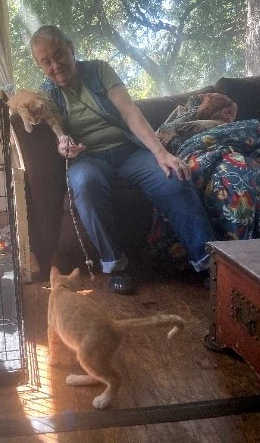
Diana and the Greyhaven Kittens

FELINES AND FANTASY
“What was that?”
“It was the cat.”
(H.M.S. Pinafore)
What is it about cats that makes them so fascinating?
A dog makes his feelings clear, but the cat is a master of ambiguity. When a feline shows affection, we feel honored. When she wraps her tail around her feet and fixes you with an inscrutable gaze, you wonder what she knows. In European witch-lore, the cat is the traditional familiar. Writers also work magic, and since a ninth-century Irish monk compared his own literary efforts to the stalking hunt of his white cat, Pangur Bán, felines have been favored companions. When I first started seriously writing, my ginger queen cat, Brunhilda, used to curl up to absorb the energy of the pile of typed manuscript. When I shifted to composing on a computer, she napped atop the printer.
It is no surprise to find cats making themselves at home in literature. Some literary cats, like Puss in Boots, are themselves magical. Others, like the ephemeral Cheshire Cat in Alice in Wonderland, or Dr. Seuss’s Cat in the Hat, challenge our concept of reality. Literary cats can be tough, like Mikhail Bulgakov’s Behemoth (The Master and Margarita), or Terry Pratchett’s Maurice (The Amazing Maurice and His Educated Rodents), and Pratchett’s terrifying Greebo. Other fictional cats, like the Siamese who reveal clues to their owner in The Cat Who… mystery series by Lilian Jackson Braun, appear to be ordinary animals, although, as in the case of Carol Danvers’s cat in the Captain Marvel movie, they may be revealed as something else entirely. Robert Heinlein’s novels include the time-traveling Pixel (The Cat Who Walks Through Walls and To Sail Beyond the Sunset) and Petronius the Arbiter (Pete) in The Door into Summer.
Although cats often appear mysteriously solitary, folklore includes figures like the King of the Cats, all of whom are subjects of his kingdom. In Diane Duane’s Young Wizard books, cat wizards manage interdimensional travel. The series by Tad Williams that began with Tailchaser’s Song presents a community of felines with its own politics and customs, as does David Weber with the Treecats in the Honor Harrington books. Old Possum’s Book of Practical Cats by T.S. Eliot, which reveals the hidden lives of cats in our own civilization, transcended genres to become the enduring musical, Cats.
With such a wealth of examples from the worlds of the imagination, it is not a stretch to suspect cats of playing a role in history, hence, the theme of this issue. In “Susu the Palmyrene” by Mary Salome, a cat of Egyptian descent serves Queen Zenobia. ´Louise Michel’s “Moggie or: Jig-a-Leg the Lollygagger and the Communard Cats” by Angelisa Fontaine-Woo resonates with 19th-century French patriotism. In Kimberly Choi’s “Yes I Know Not”, we meet a Daimon, a cat, and Socrates. A Parisian bistro called Le Chat Noir is a nexus that transcends time in “The Cat of the Mosque” by Adam Porkolab, in which a gray cat passes through the bistro to the Hungarian city of Pécs in three different centuries. The cat of Andrea Tillmanns’s “Ardurian Scouts,” on the other hand, is from a possible near future. In “Housecats,” by Torger Vedeler, the cat is the guide back and forth through time and memory. In this issue cats also move through the poetry, with references from Dr. Moreau to T.S. Eliot, transcending time and space.
Today, after ten years without a cat at our house, three ginger kittens rescued from a laundromat are sleeping in the cat carrier in which they arrived. Will one of them become my new familiar? As you will see in the pages that follow, there are few limits on what a cat can do.