
Featured Author
We created a challenge: Tell the story of this painting by Inna Vjuzhanina

The Witch of the Crocus Valley
By Josh Dobbin
She yawned and opened her eyes for the first time.
If you were there to see them, you would be hard pressed to name the color of those eyes, because there was no name spoken by men for such a color. They were at once dark and brown but then also green like the deep forest and yet still they flashed and shone with a violet iridescence. Or were they a cold blue? It would be impossible to tell, because the fact of the matter is that they were all those things. Who could say, really, because there was no one there to see them.
She was alone.
She stretched and examined her fine, pale hands, balling them at first into purposeful fists, then flexing them out to full extension with fingers splayed. Her sharp nails were painted crimson red, and she weaved them in little figure eights, feeling the warmth of the new spring’s air.
It had been a punishing winter, but on the breeze, she caught the scent of the trees waking and beginning their own slow stretches. She observed a soft oval shadow that ended at the midpoint of her arm. It was cast by the oversized brim of her hat, which sat perfectly atop her head, no matter how her neck arched in the yawn.
There was work to be done, and soon; this she knew. Work that would not do itself. But for now, she yawned and stretched. Everything in its time.
She found that she had awoken on a wide sill by the casement window in a large stone room. The window was open; it was made of wrought iron and impossibly old stained glass in geometrical designs. A series of diamond shaped panes of purple glass danced a pattern of light onto the floor of the room.
It was safe, here in this stone house. Outside, nothing was safe. It had not been so for some time. But here, in these walls, with these windows, nothing could come to harm. Soon she would venture into the world again. But for now, she could look out on the world, from this house in the space between worlds.
She considered the wordless beauty of the scene outside the window: the skeleton-bone branches of shrubs and trees that lined the meadow were dotted here and there with fresh green shoots and buds that had tentatively begun to open.
A flurry of motion erupted behind her, from within the stone house. She kept her gaze and focus out the window, though. There was a dim memory of something at the edge of her mind. A name she could not remember. A flash of light. A feeling of pressure and a terrible ringing sound.
“She’s new!”
“She’s awake!”
This was spoken behind her, but not in words. It was the chittering vocalizations of two cats. If anyone else was there to hear it, it would sound like the intent and syncopated mewlings of a cat looking at a bird that flits too far off beyond a window. But no one else was there to hear it, only she, on the sill, by the window. And she understood it perfectly.
She turned to consider them: a plump black and grey tabby, and a wiry ginger cat. They looked quite silly indeed, and it made her smile, although she still held onto some lingering sense of sadness, from whatever she had been dreaming. Despite herself, she could not help but laugh, for both were wearing tiny hats, just like hers, and both hats remained perfectly in place, resting just so on the top of their heads, no matter how they ran or moved. She answered in spoken words, which the cats understood perfectly as well. This was the way of things in the stone house, between the worlds.
“I am awake, kishka, yes. But I am not new. I have always been.”
“Still and all the same, new girl,” the tabby yowled, “We are here to greet you. Do you remember anything before you woke?”
“She’s a pretty one,” the ginger added before sticking up a hind leg up between her lap and in front of her face and beginning to lick herself clean in a manner that seemed less than dignified. Somehow, her wide brimmed black hat managed never to get in the way.
“What do you mean, do I remember?”
“Well,” meowed the tabby, “We have been here, in this house for a hundred years now. And this is our first conversation, is it not?”
The young woman by the window thought for a moment then frowned.
“Little koshenyatko, I know the call of the turtledove and the corn crake; the whistles of the sandpiper and the shrike. I can tell you the shape of every crawling thing outside this window in the grass and dirt. I can remember the names of all the plants and flowers in the meadow.
But… I cannot recall what I was doing yesterday. It is passing strange.”
The tabby stepped up clawlessly onto her leg and plopped its full weight into her lap.
“Not strange at all, if you listened to us. We’re cats. We know what we’re talking about. We’re the welcoming committee. This is your first day.”
“How can I be welcomed, and how can this be my first day? I have never not been here. Isn’t that true?”
“Sure. Very true. But both things are.”
She shook her head, and again, the large black hat never was at risk of moving from its place. “You are being mischievous, because you are cats and it is your nature. Now, tell me your names.”
The ginger cat craned her tail into a question mark and leisurely stretched her body before her.
“You are new; if you were not, you’d know never to ask such a question. True Names are things of power and not given out so casually. What you choose will become what we are called, but you ask for names? True names? Those are dear. I am sad for you that you lost yours, but happy to have you here.”
The young woman’s fierce eyes flashed with anger. Again, the dreamy wisp of memory of a buzzing and too much light and a terrible rumbling troubled some far part of her mind.
“I did not lose anything, and don’t appreciate your tricks. When the mighty Maksym Zalizniak oak of Cherasky was but a newly dropped nut, even then was I old beyond measure. I know my name. I am Mavka, and there was never a time when I was not here, in the forest!”
“Oh, she’s a good one,” the ginger purred, and rubbed the side of her mouth against the girl’s pointing finger.
It was very cute, this cat, with its silly hat and its fearless affection. This is a truth about cats, talking or otherwise: it is hard to stay mad at them. Mavka smiled and said, “Hmm. Never mind all that. Fine. You shall be Saffron. And you,” she said, petting the tabby in her lap, “Shall be Loaf. Now, I have waited long enough. Come with me, there are terrible men in my forest and I don’t like them. Not one bit.”
Mavka swung her legs out of the window and leaped down into the grass. Saffron and Loaf followed behind her. The stone house was no longer there; it never was.
——
“Suka blyat! Pishov na hooey! That was the last one in the goddamn pack! I lit the goddamn thing by the goddamn filter,” Corporal Serhiy spat.
He shook his head in resignation. He considered the blackened end of the bent, half crushed cigarette with a withering look and flicked it into the small wood stove they had set up in the corner for warmth. He gave a bitter shrug to the young soldier to his right.
That young soldier was a private named Oleksandr and he now had a problem.
The problem was that no one in the squad would believe him. He found it hard to believe, himself. It sounded ridiculous in his head, as he considered the words he was about to speak out loud. But in his heart and in his gut, he believed. The cigarette being lit on the wrong end meant that the call was coming in moments. He would have to say it.
“Count to five,” she had told him. Then speak and tell them.”
They sat huddled in a darkened room in what was once an office that handled logistics for ship-building equipment. The structure was largely ruined and looked uninhabitable from the outside. This was why they were holed up there; enemy drones would have no reason to target it. The building and those around it had been bombed out and abandoned, as had so much in this area of Kherson, close to the frontline of Russian held territory across the Dnipro River. Spring had just begun, but the grasp of winter’s brutal chill still held, especially in the early hours of the morning, right after sunrise.
The past few hours were uneventful, but full of stress for Oleksandr. The normal stress, he was used to, so much so that it became little more than background noise of the mind. The everyday reality of being a part of a small detail of mobile drone operators close to the warfront was now a baseline, a hum of white noise. But the eerie anticipation of waiting for the words the old woman had said would come was a new kind of fear.
A separate scouting unit full of soldiers they never met was flying surveillance, looking for targets: enemy troops or high value equipment. His crew was here, waiting for the call and the description of the location, so their drones could be armed, loaded, and sent out to eliminate them. The waiting could be hours. It could be tomorrow. It could be in the next minute. Life during wartime created a new kind of emotion that he did not know what to call; a simultaneous feeling of boredom and tension.
During those downtimes, in these improvised workrooms fashioned from dead spaces full of dusty artifacts of a bygone time of promise, the three men would talk, joke, and prepare. When the call arrived with instructions, Oleksandr would carefully jerry-rig the two components- bomb and drone-together with zip ties, soldering iron, and fishing wire; the drones and material would be delivered by separate resupply groups. The old saying, “Necessity is the mother of invention” is never more true than when it becomes necessary to kill invaders sent to destroy and occupy your land, and to do it as cheaply and as often as possible. Mother Necessity had given painful and bloody birth to a host of terrible flying children.
He was now a craftsman of makeshift bombs and a short order chef of explosive powders and putties. Serhiy & Oleh were the pilot and navigator. Together, this three-man team had made the invading Russians pay a heavy price in blood and equipment.
After Serhiy had tossed his ruined cigarette, Oleskandr drew in a deep breath. He thought of the old woman, her breath like onions and old earth as she leaned in to give him a kiss on his cheek… And of that strange moment where she had changed. He silently counted to five.
An involuntary shiver ran the length of his spine, and he had to work hard to stop his jaw from chattering. He had no nerves or apprehension anymore when formulating deadly homebrew explosives in scavenged plastic bowls, but the thought of what he was about to speak to the open air found him with gooseflesh on the back of his neck.
On five, he found his voice. He stood up with a start. He spoke confidently and with purpose.
“The phone will ring now. And they will be wrong.”
Olekdsandr pointed at the phone with a flourish, like a stage magician signaling a “tah-DAH.”
One dreadful second ticked by.
And another. They seemed the slowest two seconds ever stacked on top of one another that he had ever experienced. He lived a lifetime of regret and humiliation in them. And yet, the relief of it all being just a silly bit of superstition was a comfort, he realized. Being wrong meant only that he had been duped by his own gullibility and that he had not met something beyond this world. Still, he felt absurd; the feeling closest to it that he could recall was a dream he once had as a child, of arriving at school only to realize that he had somehow forgotten the task of putting on his pants or shoes and managed to not notice until he was in a crowded hallway.
Sergeant Oleh, a taciturn and sharp-faced man, looked up from the monitor he was hunched over. His quizzical expression was painted in tones of blue from the reflected LED light of its glow.
Then the phone rang.
“I must have counted too fast,” Oleksandr thought. The flood of relief at not looking like a fool was short-lived. Now he must live in a world where it was all true.
The phone sounded again.
Sergeant Oleh answered it. “I’m listening,” he said curtly.
He took a pad from his uniform’s shirt pocket and reached for the pencil stub he kept behind his ear. It was a one-sided conversation, with the command operator dictating intel and Oleh scratching his pencil rapidly but neatly, to transcribe it.
“Received,” he said.
He replaced the phone into the charging and scrambling console.
“Gentlemen, we have a target and little time. There’s a detachment of twelve fucking orcs on the move toward a fortified bunker across the river but Private Oleskandr, do you have something you want to tell us?”
“Seargent, the target information they gave you, it’s not correct. I.. I know where they are. At least, I know now,” Olksandr said, but he could hear his voice faltering.
The sergeant’s face was stony. He stared wearily at Oleksandr. He did not blink.
“I was given a location and description of a bunker eight kilometers out, maybe a few hundred yards from our forward forces, “Sergeant Oleh said. “Surveillance confirmed twelve orcs in the area, headed toward it. By the time we get in the air, assuming it gets through unjammed, they’ll be in there, and God willing, we will deliver a package they won’t enjoy. But you, private? You know different? Pardon me, but I don’t remember you being anywhere other than here with the two of us for the last twelve hours. Who handed you a secret note? Is there a domovoy in this ruin whispering in your ear?”
Serhiy chuckled behind him. While they all referred to the Russian invaders as “orcs,” the enemies from the Lord of the Rings movies, because they acted as inhuman brutes, they knew they were not magical monsters. But a domovoy was a creature from folklore; a little house-elf that remained mostly invisible and would, in stories, sometimes be helpful if he favored the family that lived in the home. A thing to tell children, a fairy story.
Oleksandr got the dismissive joke. He had no secret house elf feeding him information. The problem was, the answer was just as hard to believe. Harder, perhaps.
“No. It… it…”
”It was what, soldier? We need to be moving. We’ve got a target. “
“It was foretold to me… by a woman.”
“What woman?”
“Sergeant, I believe——”
“What, Oleksandr?”
“I am sure she was a witch,” he said miserably. “I didn’t believe it, either, I didn’t tell anyone about her, but the cigarette—” he said, hearing how mad the words sounded in the air.
“Oleksandr, since the child, I have worried about your mental state,” Oleh said plainly. It was without rancor or anger, but it was also without pity.
At the mention of the child, the private winced. It had been three days ago. They had been too late. Because they were close by, Command had their mobile unit rush to clear “butterfly” mines dropped by enemy heavy lift drones in the nearby fields and forest of a village, some fifteen kilometers from their current location. PMF-1 was their official designation, but they were called butterflies or petals. They were scatterable land mines; dozens of little two-ounce explosive charges that fell softly to the ground by way of the thin plastic “wings” on their side. In nature, a maple or ash tree will produce seeds on fixed wing leaves that drop and spin like a helicopter blade, to be carried on the wind and sent off to land in the soil and grow. The Russians copied Nature’s simple design, but to destroy and maim.
The team had arrived just in time to see a little girl, picking new flowers by the edge of the field. Private Oleksandr had called out to her, “Come back, sweetheart, it’s not safe.” She had made it three steps back toward him. The blast didn’t kill her outright. She had died in his arms as he scooped her bloody body and ran back with it, screaming for help.
“This isn’t about her,” he said. “It’s— You must listen. By the woods, there,” he pointed off to the eastern wall of the building, “When we first set up here, I was gathering sticks for the stove, remember?”
Sergeant Oleh’s expression seemed to be carved from granite as Oleksandr spoke.
“And I damn near shot her; she was just suddenly there,” Oleksandr continued. “A staren’ka, an old lady. Ugly. And standing so close. With two cats by her legs, can you imagine? An orange and a marble one. They had made no sound before I saw them… I told her the area’s not safe, she should go, but she just,” and here he gathered his breath.
“She just chuckled and said, ‘Here, boy, this is for you. It’s a crocus flower. It means resilience and rebirth,’ she says. ‘But it’s poison, too.’ I just think, this is a crazy old lady, who knows? Maybe her home was destroyed, she’s wandering, lost. And she puts this flower into my chest pocket and leans in. Smells like onions and old earth. And she says..” Oleksandr stopped for a moment. He squeezed his eyes shut, tight.
“She says, ‘let an old woman give the young hero a kiss on the cheek for luck,’ and when she leaned in, I was frozen. Like in a nightmare, where you want to run, but cannot move. She whispered with Serhiy’s voice! She said ‘Suka blyat! Pishov na hooey! That was the last one in the goddamn pack.‘ Then she said, ‘When you hear that, you count to five. And the call will come. And it will be wrong. They will not be there; they will be a half a mile past. Down the path, by the pines you’ll fly it—north to a small cottage, you’ll see them rushing to get inside. YOU TELL THEM. Count to five and tell them, before it rings.’”
A moment of silence passed.
“Private. You are not well. This is some kind of… episode. Oleksandr, you’re arming the drone, Serhiy is flying it, and I am navigating him to the bunker from the intel. And then we will see about getting you some rest. You’ve been pushed to the brink.”
“No. You must listen. You saw, how I knew the call was coming, a moment before it came.”
“A lucky coincidence. No domovoy, no witches. Now, Serhiy,” Oleh said, turning and addressing the older, grizzled corporal who would pilot the drone. “Come, let’s set up.”
Corporal Serhiy stood with his arms crossed. His expression was unreadable. “Tell me, Oleksandr,” Serhiy said, “what became of this old crone? Why did you say nothing of her?”
“After she said all that, the old woman gave me that kiss, on my cheek. But when she did she… changed. I know how crazy this sounds. For a moment, she was young and she was beautiful. But terrible in her beauty. When she touched me as this woman, and I saw her eyes, I knew in my bones that she was the oldest thing I’d ever meet. I closed my eyes and when I opened them… She was gone. The cats, too. So, of course, I said nothing. I thought, as you, this was some waking dream, from lack of sleep and stress. By the time I got back, I had convinced myself it was just a delusion, from exhaustion, you know? I had not slept for so long. And… and the little girl, you know? But then with the cigarette. The words. The call. It was real. And I had to say something. Do you believe me?”
“No,” Oleh said flatly.
From the dark corner, Serhiy stood impassive. Although he was a corporal and Oleh the sergeant, his words carried weight; he was the oldest of the three by a decade. He asked a single question.
“You say you saw her eyes. Tell me this: what color were they?”
Oleksandr frowned, for his answer would sound just as mad as the rest of it.
“They were every color, all at once.”
Serhiy nodded, thinking. He ran a hand over his close cropped, greying hair.
“Private, go arm the drone and ready it for flight. Oleh. We listen to the boy.”
—-
“Akmat, you fucking dim-witted, idiot grinning churka, I have good news for you,” Dima laughed. It was an ugly laugh, which was fitting, as Dima Lebedev was an ugly man. He stood six feet tall and was thick all around with flab that covered a brutishly strong frame, in a way that suggested a man who was both familiar with hard drinking and even harder brawling. His face had incurious, close-set eyes that were a pale grey-blue, red rimmed, and bloodshot. He flashed a smile that went nowhere near his eyes.
“They’re sending your sister to the front to entertain the soldiers with her mouth, and she says of course she must start with you, for old time’s sake,” Dima said, nodding.
“Brother, I tell you this, in truth: Go sit on a dick,” muttered Akmat Cherotetin. He spoke a kind of primitive, broken Russian in the squad as it was the most universal language among the motley gang, but his thoughts always began in Kyrgyz. He was twenty-three years old and could barely grow a beard.
He, Dima, and the rest of their thirteen-man squad, all in mismatched gear and helmets, were on the march through a wooded area, en route to a fortified bunker, on orders from God knows who. On his back, he carried a durable electronic box with a radio-frequency jammer, to disable Ukrainian FPV drones. Across his shoulder, he had a 12 gauge, modified MR-155 shotgun—this, too, an anti-drone measure of last resort. And more reliable, as the electronic jammers had batteries that drained quickly and didn’t always work.
“How much further?” yelled a Belarusian in standard camouflage uniform, but festooned with custom med kits, hanging gear, and armor plates.
“A kilometer, not even, Kravchenko. Maybe if you were not decorated like my grandmother’s New Year’s tree, it would not be so much a hardship,” Dima barked, then laughed at his own joke, causing the rest of the crew to join in. Only the two hard-faced Dhagastani boys in the squad, with their chin-strap Sunni Muslim beards, didn’t crack a grin. They never did.
Dima was the leader of the squad, but leading was more a matter of herding than strict discipline. It was a collection of rough criminals and low men from all over, with minimal training, lured or pressed into combat by promises of bonus money and the chance to take whatever they wanted in spoils; you had to treat them a certain way to keep them all in line as a group.
Dima understood this well enough; he too was a low man and a rough criminal.
He was at the front of the march, so he saw the girl first.
He could not believe his own eyes, or his good fortune. She was up ahead, a little off the path, crouched down, trying and failing to stay still enough not to be noticed. She was young, with tangled, long brown hair, pieces of dried twigs caught in it, like she had been running panicked through brambles. But the best fact of all for Dima Lebedev was that this little lost waif was naked from head to toe.
Who knows what horror she had run to escape from? But now, with a smile that did go all the way to his eyes, Dima thought, “Well, whatever it was, the sad little rabbit has run into something worse. Wolves.”
Taking a woman by force together would bond them for a time and he could ride the spotting of her in the brush into a story he would tell for years.
“Look alive, you sons of suki, we’re taking a detour before the bunker! Fate has given us a toy to play with!” he announced. He gestured with his battered AK-74M rifle to where the girl was crouching.
Then the chase was on.
The boys hooted and cheered as it began and the terrified waif—she looked no older than 19—turned and sprinted. After her initial burst of speed, she flagged and slowed. Dima had almost caught up to her, he could see the thin red lines of bramble cuts all criss crossing her arms and down at her ankles and was reaching out a hand to grab at that hair, when the bitch found some hidden reserve of speed and pulled away from him, increasing the distance with each stride.
He cursed under his breath and regretted the vodka and cigarettes he had drank and smoked over the last year. He was winded. He slowed and that pridurok Akmat Chorotengin barreled past him. Dima sucked in a great volume of air; he felt he must be lightheaded; didn’t it look, as he had reached out to grab the sprinting naked girl’s hair, that it had suddenly gone bright green?
Dima gathered his breath and took off after her. The pursuit had become frustrating; at first, it seemed as if they would be upon her quickly, but she kept them at bay, always in forward motion. There was now a silent, angry determination to the pack of men. No yelling, no bravado, no wasted breath. They could not turn back or stop now, or else feel foolish & defeated. When they caught her, they’d make her pay.
The little shlyukha had brought them a good half mile north of the bunker they were headed for, by Dima’s estimation.
Then the girl’s luck ran out. Although she outpaced the pack by at least 200 feet, she had run blindly into what was a dead end. She had led them through a path past some pines; but the path narrowed to a small, abandoned cottage, with blown out windows and a door hanging by a flap. All around it was impassible brush and a treacherous ditch ravine.
They watched as she fled into it, trying to slam the door behind her, only to have it list even further off the frame. She let out a pitiable sound like a trapped and exhausted animal and disappeared into the cottage. This was it.
She had given up.
Dima found his voice, “Come on! Last one in there is the last one in her!”
The men all ran in single file, now all jangled and out of sorts. Their helmets, never fitting perfectly, were at odd angles and their faces and bodies were sweaty. They cartoonishly piled into the small cottage, like a circus car overpacked with clowns, to find her lying on the dirt floor, heaving with exhausted gasps.
Dima waved to the stragglers in back of the pack, a fat Uzbek named Shavkat Abdullayev and that damned Uladzimir Kravchenko, with his tricked out, jangling straps and bags, to hurry up. Then he ran in, not wanting to be last in line for the takings.
—
“Well, I’ll be fucked,” Oleh breathed.
On the monitor of the chaser surveillance drone that he had ordered against his every judgement to a position one klick to the north of the bunker’s location, up the path past the pines, he saw the impossible. The cottage that Olkesandr had said would be there. It was there. Little more than a two-room shack. But what was more: there they were.
He watched as thirteen Russian army troops, orcs, just ran like children into this tiny house. One after another, in an almost polite single file line. All of them laden with gear; a thin soldier had a backpack signal jammer and buckshot shotgun. Outside the door, a stout soldier paused before entering, waving to the last two. Why were they rushing to fit in there? A glassless window hole on the side was a wide portal in; it was more than big enough for Serhiy to guide the drone into.
“And all clear! Now,” Oleh said.
He glanced down at Serhiy, sitting on a folding stool, holding what looked like a high-end video game controller and wearing a set of plastic goggle-blinders over his eyes. It was a Virtual Reality headset, with its real-time visual data being piped in from the kamikaze drone’s fisheye camera.
Oleh looked at his monitor from a separate feed from the chaser drone, which provided a floating perspective of the cottage. He saw Serhiy’s drone beeline straight into the wide-open window, not one second after the last of the enemy soldiers had piled in.
The next moment, a mushrooming explosion of orange fire and black smoke blew the roof off the place and shook the walls. The whole structure was on fire.
Thirteen men had entered. No one came out.
Serhiy removed his headset. He stared ahead for a few moments, in silence. He had a haunted, faraway look.
Sgt. Oleh looked over to Oleksandr, who was sitting on the floor, knees propped up, back against the corner.
“Is it done?” Oleksandr asked.
“It is,” Serhiy answered.
There was no cheering or celebration.
The three men, alone in the quiet of the rubble of the bombed-out office room did not speak for a while. It was Oleh who broke the silence.
“I don’t understand what happened here. I… I just…” He trailed off.
The other two men did not respond.
“Let’s say the private’s ‘visitation,’ real or imagined, proved to be accurate. Let’s chalk that up to mystery. But Serhiy—what I don’t know is why did you believe it? How did you know?”
Serhiy stood from the folding stool. He rummaged through a backpack and withdrew a crumpled packet of cigarettes; his emergency backup supply.
Taking care that the filter was where it should be, he lit and deeply inhaled.
“This I tell you now? I never spoke of it. Not to anyone. I was a boy, seven years old. Summer. I was playing in the woods, by my grandmother’s house. I built a little house from sticks. Two older boys from the village, fifteen, sixteen, come upon me. Cruel boys. They smash the little house. I am small, so of course, I cry. One of the boys, he was—” here Serhiy made a gesture at his forehead— “off.”
Serhiy took a deep drag from his cigarette and exhaled before continuing.
“Cruel boys can egg one another on, but this one, he was… He was off. The boy pokes at me with a sharp stick. The other joins in. I run away, into the woods and they chase me. It is almost a game, at first. But the older one, he becomes different. He throws a rock at me, the size of your fist. Smashes on a tree, right by my head,” Serhiy said. He did not look at either of the two men as he spoke.
“Suddenly, I know, this is a different danger. There are no adults around and these two will hurt me, for sport, because it has begun, you know? A line that is crossed. I run for my life.”
Oleksandr blinked. These were the most words the gruff colonel had ever said in a row.
“And I am small and fast; I run enough ahead that I am out of their sight, but I hear them, yelling in the woods. ‘Come out and take your medicine,’ the leader, he yells. ‘If you make me find you, we’re going to make it hurt so much more.‘ If I run, they will hear and go in my direction, chase me down. If I stay, they will find me anyway.”
Serhiy stopped and considered the stub of his cigarette, before dropping it and crushing it out with his boot.
“Then I saw her. She was so pretty. Stepped right from behind a sapling tree, casually. Long hair and the biggest, widest hat; how was it hidden behind that thin tree? She lifts her finger to her lips, ‘shhh…’ Beckons me over. There is a dip and a hidden hollowed out trunk of a fallen tree. She points. I cram myself into the space, and she bends down and gives me a kiss on the cheek. I see her eyes, then. They are not kind. They are not of this world. They are old and the color fills me with… like a dread, when you try to count the stars, on a clear night? So vast, yes? She speaks. Tells me ‘You close your eyes, little boy. Count to five thousand, but in your mind. When you are done, walk back home.‘
Then she is gone. I shut my eyes tight, and I count. Over an hour, I am inside this tree and when I get to five thousand, I open my eyes and leave… I do as she said. My grandmother spanks me for coming home so dirty. I tell no one.”
“What happened to the two boys?” Oleksandr asked. Oleh was silent, shaking his head.
“The next day, there is a big cry in the village,” Serhiy said. “Two older boys had gone missing. They found them drowned in the lake by the forest. Tragic accident. I could only think of her eyes. Timeless, without pity, and a color that has no name.”
Serhiy began to gather his gear.
“Sergeant Oleh, I am like you. I live in the real world. I know about radio frequencies, electronics. Science. Psychology. Over the years, I convince myself this memory was just the product of a young boy’s mental panic. Out of terror, in a time of great stress, my mind created an imaginary helper. A friend. What happened in the real world? Boys chase me. I hide in a tree. They lose interest, go fuck off in the woods like assholes, accidentally drown. No mystery, yes?”
Serhiy smiled and nodded.
“But here is the thing, Oleh. I never forgot those eyes. And I saw them again, today. When I flew the drone in, she was there. Floating over the ground, arms outstretched, holding them rapt in some spell. Same hat, same brown tunic. Same eyes. And those pieces of shit, they didn’t even turn as the drone flew in. Like she had done to lead the two boys to drown, that day, so long ago.”
“No, this cannot be real,” Oleh insisted. “We can look on your drone’s video footage.”
“It will be static, I am sure. Scrambled signal. And we will have to choose what to believe. I know what I believe.”
The men worked the rest of the day in silence, filing their after action report, arranging for transport out of their location. No mention was made of a girl with an impossibly wide hat and wild eyes.
—
That night, before the transport was to arrive, Olkesandr went outside, alone. He held the crocus bloom that the old woman had given him. It was still fresh.
Of course, she was there, waiting for him. Oleksandr saw her by a tree. A plump, unremarkable old lady, wearing a headscarf and a simple blue frock overcoat. Two old farm cats walked in figure eights through her feet and rubbed at her ankles with the sides of their mouths, as if in competition for who could give affection the most earnestly.
“бабуся,” he greeted her. “I think I know your name. I think I know who you are.”
“Darling boy! You did well. Know that we are proud of you. Do you still have the crocus flower?” Her mostly toothless smile was plain and warm.
“I do,” he said, patting his pocket.
“Keep it, for luck. The purple crocus is the first to bloom in spring. New beginnings, from the dead soil. I come from a place where there is a whole valley full of them.”
Oleksandr walked toward her, tentatively, as one would approach a shrine.
“Come, yes, give an old woman a hug,” she said, and waved him forward.
When she embraced him, it was quite ordinary. No choir of angels singing, no shining warm light. The squeak of the cheap polyester of her coat, slight musty smell of it, the way her kerchief came a little off kilter in the squeeze, the casual action of her weathered hands readjusting it, they were all quite normal.
But Oleksandr knew.
“My great grandmother told me a story once about the Mavka,” he said. ”A spirit that leads boys to their doom in the forest.”
“Did she, now? And in her telling, was it any boy she found, or just the bad ones?” the old woman asked.
“She said it depends on who tells the story. Some say that the Mavka are the spirits of girls who died in the forest before they could be baptized but… but my great grandmother said that some believe otherwise.”
The old crone laughed, “Baptized, no. That’s not it.” She shook her head.” Mavka is older than the churches. Of this, I am very sure.”
She winked and grinned and took his arm to put in the crook of hers.
The old woman said, “It is true. Many tales of Mavka. The way I tell her story, it’s just the bad ones she kills. The good boys she meets in the forest, she will just kiss on the cheek and send them on their way.”
Then she pulled him toward her, with the rude strength that the elderly so often possess, kissed him on the cheek in a businesslike fashion, nodded, and turned abruptly away. She ambled off towards the woods at a respectable speed for a woman her age. She has already gone quite a distance when Oleksandr spoke.
“Wait!” he said. “Before you go, can I see you? One more time? But— as you truly are?”
The old lady in the road stopped.
She stood for many seconds.
Was it this cold when he first stepped outside, or had the temperature dropped? Oleksandr was not certain.
The old woman turned, slowly. She faced him.
“Be careful what you ask for,” she said. Her tone was flat.
Oleksandr caught the scent of wet earth somewhere on the night’s breeze.
“What face of Mavka would you ask to see?”
She stood up at full height.
In the shadow of the night, by only the half-moon’s light, who could tell if her face was old or young? Enough to see that she now floated a foot above the ground.
“This is a man’s question. It angers me. You ask to see me as I truly am as if there is but one way to be true,” she said and Oleksandr could not tell you when her kerchief had become a large, black, very wide brimmed hat, only that it had.
He could not know what her face looked like, or if her jacket had vanished and now long hair spread and waved in the air as an underwater plant may wave because he was caught in the colors of her eyes. They were all of them, all at once.
She spoke softly, but he heard it deep inside his chest, all the same.
“A babe is born and swaddled in her mother’s arms,” she said. “But wait! Now she grows to be a girl with freckles who climbs trees and is scared of thunder, yes? Shh! Look! She is a young lady, standing under the stars with a boy, worrying that she does not know how to kiss. Don’t blink; she is a mother who has learned to carry one baby on a hip while tending to the skinned knee of her oldest. She once wakes early in the morning, just before the sun, and steps into her garden— she sees a deer in the mist. See? It turns, frozen still; they gaze into each other’s eyes for some time in silence. Now the doe startles and bolts off. She will think of this moment in her sixtieth year as she watches her husband’s casket lowered into the ground. See how she weeps. She is older: look, she places her weight upon her cane and bends down with weary knees to see her granddaughter’s son, in the cradle, just born. Now she is older still and she dreams of climbing trees and a first kiss and a deer in the mist and she has lived very long until she no longer can, so she dies. A full life. This is the life of a woman… tell me, what moment will you ask her ‘let me see you as you truly are?‘ When is she untrue?”
Oleksandr could not say. In his mind’s eye, he had lived a lifetime of joys and woes, sorrows and laughter, watching this girl summoned into his imaginings.
Now her hair was green and her tunic simple and she floated close to him, and he could smell lilacs and wildflowers.
“Sweet boy. Now I will tell you of Mavka. That freckled girl in the tree, she never stands under the moon awaiting that first kiss, because a man has choked her in the forest, and pushed her lifeless body into the loam. Her last moments are pain and terror. She is not alone. Other girls, different times, other places, all the same girl: the one whose time was stolen. Another girl, in a field, by her home; she bends to pick up what seems to be a toy and there is a terrible flash, and she never dances at her wedding, she never holds a grandchild, she never mourns a true love. All of that is robbed from her, by bad men.”
“The girl, in the village. I could not save her,” Olkesandr said. A tear pooled by the side of his eye, swelled and then ran the length of his cheek, to the edge of his mouth. “I found out her name. You are her, are you not? Her name was—”
She put her finger to his mouth. “Shhh…” said the floating woman with impossible eyes. “Do not speak it. She closed her eyes in that field, killed by bad men in my forest. Her name is buried with her, as are all the others taken each time by cruelty and the will of brutes. They are too many to count. They close their eyes. I open mine as Mavka. There are a thousand, thousand dead names buried in the cold earth before their time: we are all of them. And I am the vengeance for those women they were never able to become. As long as men are cruel, there shall be Mavka,” she said.
Her eyes, although he could not tell you their shade, were sad. This he will remember for the rest of his life: “So I have always been and shall forever be.”
Oleksandr looked away from her, down to the ground, and then back again.
She was already gone. He was quite alone.
——–
This story was inspired by the art of Inna Vjuzhanina, a fantasy artist from Ukraine. Her evocative work tells a story of the power and wonder of the divine and mystical feminine.
It also draws inspiration from “The Forest Song” by Lesya Ukrainka in 1912, particularly this passage:
“Like a girl… no, more like a lady, because your hands are white, and you’re so slender, and you’re dressed in a way that’s not quite like ours… But why aren’t your eyes green? No, now they are green… but they were blue, like the sky… Oh! Now they’re gray, like that cloud… no, it seems they’re black, or maybe brown… you are truly strange!”
And from this video of a single Ukrainian drone taking out a squadron of russian invaders:
https://www.instagram.com/reel/DX5NiZqMTtB/?igsh=MW41Z3E2Ym4zeHI5OQ==

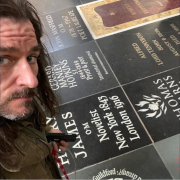
Josh Dobbin is a human, currently being. He travels ninety miles per second around the sun, one hundred and thirty six miles per second around the galaxy, and one hundred and eighty five miles per second within the local cluster of known galaxies.
He accomplishes these spectacular feats all while standing still.
Josh is fond of reading and writing stories about (but not limited to) knights, witches, wizards, robots, spacemen, monsters, thieves and cowboys.
He is pictured here among a field of dead poets, who he will one day join. But hopefully not too soon.