
The Cat of the Mosque
By Adam Porkolab
Illustrated by Joel Bisaillon
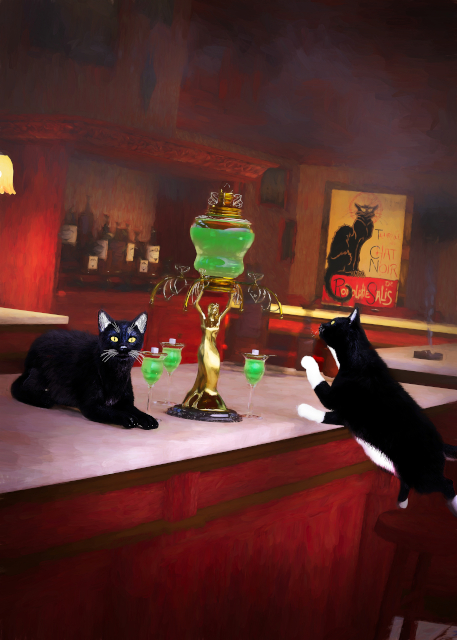
A gray cat came in through a gap that was too small for it, behind the bar, where one line of grout had opened a little wider than grout should. It came and went as it pleased, and it was always somewhere no one had put it. What the gray cat saw, it kept. What it kept, it carried in its nose and behind its eyes, and it would have told anyone who asked. In Le Chat Noir no one asked. That was the room’s single discipline, held more faithfully than any other: not to ask, and so never to have to know.
Smoke did not rise inside Le Chat Noir. It drifted sideways, a slow river, and caught along the ceiling where Parisian soot had long since merged with tobacco haze, with the fumes of absinthe, with a sweet undertone no one named, because to name it was to admit you smelled it, and to admit was to come back.
Madame La Chatte lay along the corner of the bar the way cats exist on top of furniture: as though the furniture had been built for her. Her coat was darker than the darkest corner of the room. Her eyes were two yellow coins narrowed to slits, seeing everything, holding nothing important.
Rodolphe Salis stood on stage reciting an anarchist poem of his own composition, and it was bad, but the audience would applaud, because the audience always applauds. Salis knew this. The poem was bad to exactly the degree the audience could still applaud masterfully.
The chanteuse they all called La Petite sat on a tall stool at the edge of the stage, one leg crossed over the other, one shoe fallen, the other swinging from her foot. Between the numbers she introduced the numbers, and between the introductions she talked, so low that the front row had to lean in and the back row had to come stand behind the front row, so that the whole room gradually contracted, an accordion drawing a wheezing breath. La Petite knew that whispering was a greater force than shouting. For a whisper, a person comes closer.
Les Dames Folles des Chats sat at the back table. Three glasses of absinthe stood on the table, each at a different stage: in one the sugar was still melting, in the next it had already melted, in the third the sugar had never been there, because the owner of the third glass did not believe in sugar as a concept. They spoke of conspiracy, low, not in earnest, as conspirators should: so that whoever overheard could not decide if it was a joke.
Les Hydropathes sat at the middle tables drinking wine and speaking against water—specifically against it—because water is the drink a cow drinks, and if a cow were clever enough to understand, she would order wine for herself. One of the Hydropathes was reading out an essay on the phenomenology of wine which no one was listening to, though everyone pretended they were, and this was the essence of Le Chat Noir: a place where feigned attention was a higher art than honest attention.
The room itself was built for it. On the walls, Théophile-Alexandre Steinlen’s cats looked down at the crowd, black cats with arched backs and eyes a little too wide, and above the pictures the posters had been pasted in strata, so that red letters of the lowest layer bled through the black letters of the top, and the whole wall was a palimpsest rewritten every week and never erased. A chandelier hung from the ceiling, once holding six candles; three had broken off, and the three remaining sockets now held dried flowers that had been the same dried flowers for months. The dried flowers, the burning candles, the smoke: together they gave Le Chat Noir its smell, which existed nowhere else and would never exist again, because smell is not reproducible, smell is the one record time does not keep.
The cat was not Madame La Chatte.
This cat was smaller. Its gray was exactly the shade the French called gris de Payne and painters called grime. Half an ear was missing. The loss was old, healed, worn smooth at the edges, as natural as if the cat had been designed this way from the start: asymmetrical, unfinished, exact.
The cat sat beneath the bar, motionless, its body folded in, its eyes fixed on the floor. Waiting.
Madame La Chatte looked down. Two yellow eyes met two green. What passed between them was not communication and was not a message. Two cats were looking at each other. One turned her left ear back by one degree, and the other stood up.
The gray cat set off along the back of the bar, hugging the wall, to where the grouting between the tiles was a little wider than it should have been. A draft came up from the wider grout. In the draft was a smell Paris did not know: warm stone, crumbling plaster, a resin that grows only where the sun falls differently.
Behind the tile, a door.
A gap. The size that a cat’s head will fit through, and cats will fit through any opening their head will pass, and their head will pass through any opening they mean to pass through. The gap had always been there. A novel would have placed a trapdoor here, a keyhole, a password, but the gap was simpler, older, truer.
The cat went through.
#The stone was warm.
Not the damp, acidic warmth of Paris stone. A different warmth: dry, dense, slow gathered, the whole day’s work of a different sun burned into limestone the way a sentence is burned into stone that no one has read for centuries but the stone remembers.
The cat’s pads knew this stone.
Under the dome, the chamber was what a human would call vast. The cat did not see a dome: it saw columns of air rising from floor to height, dispersing up there, thinning out, vanishing. In the octagonal room eight windows let in moonlight—eight milk-white pools on the stone, eight steps from dark to bright—and crossing one of them the cat felt the temperature of the moonlight on its fur: colder than the surrounding air, not by any measurable degree, and the fur lifted above the moonlit stone and settled back as the cat stepped into shadow. The carpets lay thick on the floor, dark red, hand-knotted, and the cat’s pads sank into them, the wool packing between its claws, and the smell of the rugs was different from the smell of stone: lanolin, dye-plant, a spice the cat had no name for but knew by touch, because it slept on this rug when the mosque was empty, and the rug was the only surface in the hall that shaped itself to the cat’s body.
The air was dense and unmoving. It held everything that had ever happened here. Incense and prayer and human skin, candlewax and stone-dust, and time itself, which is not odorless as people believe, but sweet, faintly rotten, like lavender left too long in a drawer.
The cat sat down before the mihrab.
The cat did not know such words: prayer-niche, mihrab, qibla wall. Where the wall hollowed, there it sat, because in the hollow the air was a degree warmer. Carved stone adorned the niche above: geometric patterns that to human eyes formed stars, and to the cat’s eyes formed shadow and light in alternation, the way sunlight alternates through leaves. In the warmth a light wavered. Not any modern light: an oil lamp whose flame threw the silhouette of a man onto the wall.
The man sat on the floor, legs crossed, and was writing. A brass lamp stood beside him, droplets of wax spattered on the rug around its foot, and beside the lamp was a wooden bowl of dates, from which the man did not eat, because for the calligrapher the dates were not food but a signal: as long as dates remained in the bowl, he was still writing; when he ate the last, he was finished. The dates had been in the bowl for two days. The skins had shrunk.
The smell of ink was stronger than anything else in the room. Soot-black ink, dense, tacky, with plum in it, gum arabic, bone glue. The man’s hand moved slowly across the parchment. The letters ran right to left, their lines rising and falling the way the surface of water rises and falls beneath a wind.
There was more in the room that the cat’s nose registered. Scents rising off the man’s body: the sweat gathered along his ribs, the oil of his hair, the dry skin of his cracked heels. And a fourth scent, which did not come from the body but hovered around it: the thin, copper smell of fear, filling the whole chamber, layered beneath the incense and the ink, the deepest smell in the room. The calligrapher was afraid.
The cat moved closer.
The man did not look up. People usually looked up when the cat came near, because the cat’s presence in this space was a draft with no source: people sensed that something had changed and they looked up. But this man was writing, and a person who is writing is not in the room—he is in the word. The word does not know cats.
The cat sat down beside the ink pot. The pot was warm, not from the ink but from the closeness of the man’s hand, which had worked above it all night, dipping and lifting the way a heron works at a pond.
The calligrapher’s name did not matter. The cat did not know it, and the name would not change the story. The man was young, thirty-five or so, his beard trimmed, ink under his nails always, because ink does not come out from under nails—the calligrapher’s shame and his pride at once, the sign that he works and the sign that the work is soaking into him. He had come to Pécs from Istanbul five years earlier on the sultan’s personal commission, because the paperwork of the Pécs sanjak was ugly, and ugly paperwork veils ugly thought, and the sultan believed beauty was an instrument of order.
What mattered now was the word the man was writing. A single word, placed at the center of the page, inside a gilded frame. One word that tomorrow would come to the sultan’s hand. The sultan would read it, and from the reading he would decide, and on the decision Pécs would stay or be lost.
The word: merhamet.
Mercy. Or clemency. The word had no exact translation, the cat no exact name, the door no exact place. The word floated there between the ink and the parchment, not yet dry, still changeable. The calligrapher’s hand trembled, because he knew the thickness of the stroke mattered, the depth of the curve mattered, the distribution of the ink mattered. The sultan was a calligrapher too, and he would read the sincerity of intention from the beauty of the letter. From a beautiful letter, he would read an honest intent. From an ugly letter, a lie. And a man who lies to the sultan does not lie for long.
This was why the calligrapher was afraid. He was not afraid of the word. The word was true, mercy was true, the city’s merit was true. He was afraid of his hand. His hand trembled because he had not slept for three days, because the weight of the word had not let him sleep, because every soul in the city hung on this one word, and if the hand trembled, the stroke trembled, and if the stroke trembled, the sultan would see the fear, and fear is not mercy; fear is weakness, and the sultan did not pardon the weak.
The calligrapher laid the reed down along the edge of the parchment. His hand came to rest on his knee. The nail of his right thumb was scraping the skin of his left thumb, slowly, rhythmically, at the edge of awareness.
The cat touched the ink pot with its nose.
The pot did not tip. It did not move. The cat’s nose was cold, damp. The dampness left a small mark on the side of the pot, and the mark caught the light of the oil lamp. In the light the calligrapher’s hand stopped. The scraping stopped.
He looked up.
The cat sat beside the inkpot. The calligrapher looked at the cat, the cat looked back at him. The moment was ink-scented, oil-lit. The calligrapher’s hand stilled. The trembling stopped. The cat was there.
The calligrapher leaned back to the parchment. He drew the last stroke of merhamet. The stroke was precise because the hand was steady. Not beautiful: precise, in the way a stone is precise. The stone that falls where gravity pulls it.
The ink began to dry on the parchment. The oil lamp’s flame jumped higher, then settled back. The cat lay beside the ink pot, its head on its forepaws, its eyes narrowed, watching the light, or nothing.
The calligrapher set the parchment aside, stoppered the inkpot, wiped the reed on a rag, and let the rag fall to the rug, where the tip of the cat’s tail just touched it. He reached for the bowl and took the last date, wrinkled and half-candied, and ate it slowly. The rag was warm and damp, the smell of ink on it denser, more concentrated, and the cat’s nose twitched, and the cat did not pull away. The calligrapher stood; his knees cracked, his joints protested three days of stillness, and the cat heard the cracking the way frozen twigs crack when stepped on. The calligrapher went to the window. Outside, the city slept. From the minarets, a muezzin was calling the night prayer, and the sound entered the hall through the dome, muffled and filtered, and the cat listened from the rug, one ear turned toward the sound, the other—the whole one—turned back, toward the silence, because the cat always listened also in the direction of silence, in case something that mattered came from there.
The cat closed its eyes.
#The cat opened its eyes, and the stone was cold.
The same stone. The same hollow in the wall where the warmer air gathered. But the carpets were gone. The stone was bare and the cat’s pads stood directly on limestone, and the limestone was cold—not the cold of February: the cold of being left alone, which is another thing, deeper, because the temperature of stone is kept by the feet walking on it, and on this stone only dust had walked for some time. The warmth now came from above, through the roof, where there was a hole. There should not have been a hole. Through it the February night was sliding in, wet and sharp.
Dust filled the hall. Not the fine gold dust that gathers near oil lamps: coarse gray stone-dust, the kind that gets between the teeth, that squeaks on the tongue. In its smell there was lime, rubble, violence.
The dome was still standing. The dome could not be hurt, the way a hill cannot be hurt. It could only be reshaped. Now it had been reshaped. The walls were bare, the carpets gone, and where the oil lamps had stood, ropes hung from the ceiling, thick hemp ropes that would carry bells when the bells arrived—but the bells had not yet arrived, because the bellfounder was in Vienna, and Vienna is far, and at the edges of the empire things happen slowly.
The cat heard the chisel.
The sound came from above, from the minaret, which still stood, though not for much longer. A man was up there working a chisel against the crescent that sat on the spire—bronze. The bronze would not yield easily. The man was cursing, not in Hungarian, not in Turkish: in German. He was a man of the Hofkammer. The Hofkammer had given the order that the crescent come down and the cross go up. That was now happening.
Languages meant nothing to the cat. Frequencies did. The sharp, angular vibrations of German command-speech were different from the soft, rounded waves of Turkish prayer, which still trembled in the stone decades later, the way the rings of water remain visible long after the pebble has sunk. The cat heard both. To the cat there was no difference: one vibrated, the other vibrated, the stone took them both in.
The cat went to the minaret.
Not quickly. Cats do not hurry. They shift to another speed that looks unchanged from the outside and is different inside. The strides grow shorter. The paw sets itself down more precisely. The balance moves forward. With this outwardly invisible quickness the cat made its way to the staircase that spiraled inside the minaret, tight, snail-shell tight.
The spiral staircase was dark. The cat saw the dark that was not dark: shapes the human eye does not see. The cracks in the wall. The wear of the treads, cut into stone by a hundred and fifty years of Ottoman leather, now further cut by the Habsburg boot at a different angle, a different weight, because the Ottoman shoe was pliant and the boot rigid, and the stone held the mark of both, and the cat’s pads felt both.
On the twentieth step there was a scent, fresh and warm: human urine—the stonecutter’s. The cat stepped over the patch.
On the roof, wind.
The city lay below. For the cat the city was not a city: points of light and darker patches, movement and stillness, smells rising upward. The scent of fire from the north side where the military lodgings were, and in the smoke tallow too, the leavings of soldiers’ suppers, the fat burned into the bottom of field kettles, and the wind carried it up, mixing with the resin of pine, because the lodgings were built of pine boards, temporary, the way the empire in this country was temporary. From the east the smell of stables, from the former bazaar, where horses were now tethered under the arches, and the smell of the horses was stronger than the spice, and the cat’s nose separated the individual scents of horses the way a person separates faces: this horse is ill, a ferment beneath the hide; this horse is young, his sweat is sweet; this horse is afraid, his fear is coppery, the way the calligrapher’s had been once, in another layer. From the forested flank of the Mecsek, wet earth and rotting leaves, even in February, because the southern slope of the Mecsek never freezes all the way through, and from beyond the hill a deer-smell sometimes arrived, rarely, depending on the wind, and then the cat would lift its head and its pupils would widen, because the deer was for the cat an old memory, a thing the body knows and the brain does not.
The man hung from the crescent. His hand was bloody. The edge of the bronze had cut into his palm, the skin split at the root of the fingers where the skin is thinnest, and the blood was running slowly down his wrist, dripping onto the cuff of his coat, and from there onto the stone. The man was looking down at the stone of the square, which was far. At that distance the cobbles were small and indifferent. The man had a family near Graz, a wife who wrote every month, and the letters always said the boys were growing and the vines had borne, and the letters smelled of wax and ink, a different ink from the calligrapher’s—thin, blue, European—and the man carried the letters in the inside pocket of his coat, nearest his heart, and the smell of them was there now too, beneath the blood and the bronze, faint. He was a stonecutter, and his hands knew stone as the calligrapher’s hands had known ink: by its weight, by what it would and would not allow.
The cat went to the foot of the crescent, to where the bronze met the stone. It sat down.
The man saw the cat. He hung in the February night at the top of the minaret, the blood from his hand flowing onto the bronze, from the bronze onto the stone. He saw a cat that had sat down at the foot of the crescent and was watching him. Cats look at a struggling thing the way cats look at anything: eyes open, pupils wide, body still. Clean attention, free of judgment, because judgment is a human invention.
The man pulled himself up.
There was still strength in his hand, and strength decides; strength counts—at least that is what the man would have said, if asked. But the cat was there. The cat’s being there did not change anything and did not need to. The presence was what mattered. A hand that is about to let go lets go differently when no one is watching than when someone is, even if the someone is only a one-eared gray cat at the foot of a bronze crescent.
The man hauled himself up. He sat on the parapet of the minaret, legs hanging over. He wiped his palm on his thigh, and the blood left a dark patch on his trousers. He looked down at the cat.
The cat looked up at the man.
The man took a crust of bread from his pocket, because he always had a crust of bread, because the men of the Hofkammer were given hard bread for breakfast, and the crust of hard bread stayed in the pocket, wedged into the lining of the coat. He broke off the corner of the crust and dropped it down to the cat.
The cat sniffed the crust. It did not eat it. Bread is not food for a cat, but the nose registered the smell: rye, sourdough, the aroma of Viennese ovens, different from Ottoman bread, which was flat and made of wheat and baked on a hot stone. And one further trace, faint: iron. The man’s hand had touched the crust.
The man looked back at the crescent. The crescent stood crooked on the spire, the chisel’s mark visible at the base, two deep gashes where he had tried to pry the anchoring band free. The man was thinking. Tomorrow he would come back. Or the day after. The Hofkammer’s order was not urgent. The empire is patient when it destroys: destruction sets no deadline.
The man stood, brushed off his trousers, and started down the spiral. His steps grew heavier on the treads; the boot struck the stone. The cat listened to the striking as it grew fainter and reached the bottom, a door opened, a door closed. Silence.
The crescent remained.
The cat stayed at the foot of the crescent. The metal was cold under it, but the cat did not leave, because the cat weighs things its own way: cold metal is not pleasant, but the wind comes from up here and the wind carries scents, and the scents were interesting. The city lay below in the February night. The wind brought the scents up: fire, horse, rotting leaves. But the wind did not bring the old scents—the incense, the rose water, the coffee. Those had soaked into the stones, and stone does not give back what it takes in.
The cat sat there, above the city, on top of the minaret, at the foot of the crescent, looking down, and its green eyes were two small lamps in the dark that no one saw, because no one was looking up, because people never look up when a city is changing masters between empires, because the master always comes from below, never from above, and the cat was above, where the masters did not reach.
The cat closed its eyes.
#The cat opened its eyes, and the stone was shaking.
The stone itself trembled, from below, deep, from where the roots of stones reach into the earth. In the tremor there was diesel, steel, a weight that did not belong on this stone. The bronze crescent had at least been silent. This was roaring.
Tanks.
The cat did not know the word. The cat knew the vibration: deep, monotone, metal-smelling pulse that came up through the stones of the square, through the floor into its pads, from its pads into its bone. The dome amplified it, like a drum-skin. The mosque was no longer a mosque again: it was a church because the crescent had come down in the end and the cross had gone up, and now it was beneath the cross that the air shook. The cat’s ears flattened back.
Outside: Széchenyi Square.
The cat did not go out.
In the square were sounds the cat did not understand, but whose frequencies it knew: a shout, the metal-scream of tank-treads, engine, engine, engine. Every so often a dry pop, not loud, not dramatic, but after it the stones trembled differently, as if the pop had altered the temperature of the square. The cat did not know the pop was a shot. The cat knew that after the pop the shout fell quiet, and the quiet was worse than the noise.
The cat went down.
Cellar. Low-vaulted, damp—the basement where the stone is wetter, colder. The smell older, much older than anything above. Roman stone in the lowest course, and Roman stone smells different from Ottoman, different from Habsburg: more sour, deeper, denser, the way older wine is denser. In the cellar the tremor was muffled. The roar of the tanks reached here the way rain reaches underground: filtered, spread thin, its edge lost.
A person was sitting in the corner.
A young woman. In the dark, the cat did not see her face; it saw the heat-image of her body. She was hot, the blood ran fast in her, the adrenaline painted her neck and her temples yellow-white. She wore trousers, a checked fabric, the cloth wet at the knees, because water stood on the basement stones and the woman had knelt before she sat back against the wall. One shoe was missing; the stocking was torn at the sole. On her other foot the shoe was there, brown, laced, the sole worn, the lacing loose, and the shoe smelled of leather, street-dust, and more—blood, not much, already dry, on the toe, where she had stepped on a thing she did not want to remember, and the cat’s nose would have told anyone who asked, but no one asked.
Beside her on the stone lay a leather bag, flat, scuffed. Papers stuck out of the bag, papers with printed text the cat did not read, because the cat does not read, but it knew the smell of the paper: printer’s ink, fresh, this morning’s, and beneath the printer’s ink the smell of human fingers—many fingers, not only the woman’s—many hands had touched this paper before she stuffed it into her bag and ran down into the cellar where the stone was silent and the roar of tanks was only tremor.
The woman was not hiding. The woman was waiting.
The cat did not know what she was waiting for. The cat did not care. What interested the cat was that the woman’s lap was warm, and the cellar was cold, and between the two there was a place for a cat’s body.
The cat climbed into her lap.
The woman stiffened. Her hand, which had been feeling the surface of the stone, stopped in the air. The cat felt the pulse through her thigh: a hundred and twenty, maybe a hundred and thirty, bird-fast. The cat did nothing. It sat in her lap, four kilos of warmth, four kilos of weight that did not threaten, did not help, only was. The weight was real. Real weight in the shaking space, where above the tanks roared and the stones trembled and the dry pops came closer together on the street: real weight was worth more than any of it.
The woman’s hand found the cat’s back.
Her palm lay on the cat’s back, still, no pressure. The cat felt the warmth of the palm through its fur. The palm trembled. Beneath the cat’s skin the muscle contracted, eased, contracted, eased. It did not purr. The rhythm was not a heartbeat: breath, or slower still, the hidden kneading of a body at rest. Her heart, pounding at one-thirty, began to follow that rhythm, because the body imitates, the body always imitates; the human body is coded to fall into the calmest rhythm near it. The cat was the calmest thing in the cellar. The cat was the calmest thing in the whole building, in the whole city, perhaps in the whole country that night.
The woman’s pulse slowed. A hundred and ten. A hundred. Ninety.
The wall of the cellar glimmered with damp. The pipes along the ceiling were rusted, and one dripped water, evenly, into a hollow of stone where a small pool had gathered, and in the pool the cat saw its own eyes reflected back, two green points in the dark. The rhythm of the drip was slower than the woman’s heartbeat, faster than the pull of the cat’s muscle, and the three rhythms lived together in the cellar, interwoven—drip, heart, muscle—none aware of the others, but the cat’s ear heard all three, and the cat’s ear did not rank one above the rest.
The woman’s smell changed. Beneath the coppery smell of fear, a warmer, sweeter, more familiar layer came through—the layer that breaks through human skin only when the body steps from the present into the past. The cat’s nose registered it. A memory-bearing smell: butter, warm pastry, a paper bag gone soft with grease. The girl had been eight or nine, and on Friday evenings her mother would bring pogácsa home from the bakery on Király Street on her way back from the university, and the paper bag was always half-wet, because the butter came through, and her mother would be laughing at whatever the tram conductor had said. This was not the cat’s smell. It was the woman’s own memory, rising off her skin onto the fur, and the cat took it in the way the cat took in anything that fell onto the floor. She did not understand how the smell had come into the fur. But it was there. Her mother’s face was there. The creak of the tram was there. The cat did not move.
The woman pressed her face into the cat’s fur. The fur was not clean. In the fur was the dust of the mosque, the dust of every age—stone-dust and incense and lime and soot—and through the fur into the woman’s nose went the whole building, the whole history, the plum-smell of the ink pot and the metal-tang of the bronze crescent and the sourdough of the rye loaf, and the woman did not know what she was smelling, but in the cat’s fur was what is constant: that the stone stands, that the dome stands, that the mosque-church-mosque stood under the Ottomans and stood under the Habsburgs and will stand under the tanks, because the stone does not care about the crescent and does not care about the cross and does not care about the red star; the stone stands, and the cat carries the smell of the stone, and the cat sits, and that is enough.
Above, the tanks rolled on.
The cellar was dark. The woman sat in the dark, the cat in her lap. Outside, the world chose the way the world always chooses: blindly, loudly, with heavy metal objects. Below, under the stone, the cat chose nothing. The cat’s being there changed nothing, saved no one, did not rewrite history.
But the woman lived. The woman’s pulse was eighty. The woman slept.
The cat sat in the lap of the sleeping woman, and in the cellar there was quiet—not true quiet; the tanks were still rolling somewhere, farther off now, pulling east—but the cellar swallowed the sounds, the thick stone filtered them, narrowed the roaring to a deep, barely audible rumble a human ear could not have distinguished from silence, though the cat’s ear did, and the cat’s ear did not worry, because the cat does not worry.
Hours passed. The cat did not count them. Above, the city’s sounds shifted: the roaring came nearer at times, then drew away, and in the lulls between, small sounds filled the space—a door slamming somewhere, glass breaking—and once, a human throat, rising and cut off, and after that the quiet had a different quality, thicker, heavier. The cat heard all of it, the ear registered, the body stayed still, because the cat was in the woman’s lap, and in the woman’s lap the six kilos of warmth counted for more than anything above.
The cat sat in the warmth of the woman’s body, and the woman’s body slowly cooled—not the cooling of death, the cooling of sleep, when the body in its creaturely wisdom turns the heating down, because sleep does not need as much warmth as waking, and the cat felt the cooling, and in answer the cat’s muscle pulled tighter, producing more heat, because the cat is also an animal, and an animal body responds to the temperature of a body near it.
Toward morning the pops died out above. The roaring drew away. The woman shifted in her sleep, her hand slid along the cat’s back, down the length of the cat’s spine, and the cat let it, because now it was a real stroke, the half-sleeping, unconscious stroke a human hand gives to warm fur before the brain wakes and remembers where it is, and why.
The woman opened her eyes. The cellar was dark, but gray light seeped in through the crack toward the staircase—the light of dawn—and in the gray light the woman looked down into her lap and saw the cat. The cat looked up at the woman. The woman said nothing. Her face was what the cat had seen at the beginning of the night: young, warm, quick. But it was calm now. In her eyes, nothing was afraid.
The woman stood. The cat jumped from her lap. The woman picked up the leather bag, crumpled the papers back into it, tied the shoelace on the foot that still had a shoe, pulled the torn stocking off the other foot, crumpled it, put it in her pocket. She started toward the stairs. She did not look back.
The cat did not follow.
The cat stayed in the cellar. The drip kept its rhythm in the pipe. The pool had grown larger through the night; its edge had reached the cat’s left forepaw, and the cat drew the paw back, slowly, with the motion cats use to pull away from water: dignity and revulsion at once. The smell of the cellar had changed since the woman had left. Her scent still lingered—sweat, printer’s ink, the peculiar smell fear leaves on skin—but it was fading by the minute, and under it the cellar’s own smell returned, the dense, sour breath of the Roman stone, and the cat’s nose took this in, and the cat’s nose was content, because this smell was constant, and the cat loved what was constant.
The cat rose. It stretched its hind legs, one after the other, with the slowness that is ritual for cats and necessity for their bodies. Its spine rippled from end to end. Its tail came up. The cat set off toward the staircase—up, out of the basement into the nave, from the nave toward the entrance—and at the entrance it stopped, because the entrance was different now: boarded up with planks, light coming through the seams, morning light, and in the light dust hung, much dust, because outside the tanks had torn up the stones of the square.
The cat found the gap.
The gap had always been there. Between the stone and the plank, where the wall meets the floor, where the cat’s head would fit. The cat passed through the gap, and behind the gap the draft blew toward Paris, and the smell of Paris came back: soot, tobacco, absinthe, the sweet thing.
#In Le Chat Noir the smoke was still drifting sideways.
Salis had finished the poem. The audience applauded to exactly the degree required. La Petite was announcing the next number—a thing without a name, only a long introductory monologue about Napoleon’s cat, who had allegedly boarded the ship in Egypt and whom Napoleon had loved more than Joséphine, and whose descendants now inhabited every cellar of the Boulevard de Rochechouart, and La Petite told it with such seriousness that no one dared ask whether it was true, because at Le Chat Noir truth was not the criterion, only the performance.
Les Dames Folles des Chats ordered another round of absinthe. The owner of the third glass, who did not believe in sugar, left the sugar out again. The glass was green, bitter, clear.
The gray cat came back.
Through the gap behind the tile, out of the grout that had been a little wider than it should have been. Its fur was not dusty. Its pads were not damp. Its eyes were the same green as when it had gone. Half of one ear was still missing.
Madame La Chatte lay on the bar. The gray cat went up beside her. The two cats looked at each other.
Madame La Chatte raised a paw. The motion was slow, heavy, ceremonial—not a cat-motion but a Madame-motion. In it was the Boulevard de Rochechouart and the Seine and every dark corner of the Parisian night, and in it was the question that was not posed as a question, because cats do not pose questions, but the paw, as it rose, waited.
The gray cat blinked.
Slowly. Once.
It was the kind of blink cats give one another. What cats know and humans do not: that the blink is not agreement, not denial, not choice. The blink is acknowledgment. The cat had seen the Ottoman calligrapher, the ink pot, the word that meant mercy. The cat had seen the stonecutter, the crescent, the blood on the bronze. The cat had seen the woman in the cellar, the tanks on the stones, the six kilos of warmth in the trembling lap.
The cat had seen all of it. The cat blinked. The blink said: this.
Madame La Chatte set her head back on the bar. Her yellow eyes closed. Le Chat Noir went on living the way it always lived: in smoke, wine, verse, lies, absinthe, music. In its dark corners, where empires rose in whispers, a silence held for one moment—as long as a cat’s blink lasts.
La Petite finished the monologue about Napoleon’s cat. No one applauded, but no one spoke either. La Petite had expected this. She leaned down from the high stool, her foot searching for the shoe somewhere beneath it, and at that moment she saw the gray cat on the bar. Her hand paused in the air. She was not watching the cat: she was watching the cat’s eye, green and narrowed to a line, and in it was the kind of distance unusual at Le Chat Noir, because here everyone was close, everyone was in. But this cat had come from outside and had stayed outside. La Petite sensed it without understanding. She found the shoe, pulled it on, and turned away.
Then one of Les Hydropathes broke a glass, and Salis went over, and the smoke drifted sideways, and Paris slept.
Adam Porkolab is a Hungarian writer and poet, working in both English and Hungarian. He holds a PhD in linguistics from the University of Pécs and works by day as a software engineer. He lives in Pécs with his wife and son. Learn more at his website, https://adamporkolab.com.