
Back to Journals
Home
Next Wonderous
Story
Fiction

The Fathoming
By Christi Krug
Illustrated by Kevin Kihn
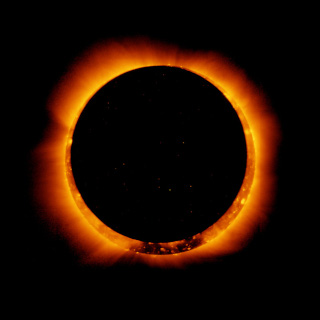
Grandma Lou came over way too early for a school holiday. She knocked quick and sharp on the door and called in her quavery voice, “Eclipse, everyone!” We went outside and froze in our pajamas by the potted plant with the dead geranium and looked up at the big dark bite being taken out of the golden cookie.
“It’s Friday the Thirteenth for crying out loud,” said Benny, Ma’s boyfriend. “Bad luck.” He shook his head and went back in for coffee.
Something had happened. I could feel it.
We went to Hotcake House, and Grandma Lou helped me pour purple syrup onto pancakes. “I just knew 1974 would be a magical year,” said Grandma Lou. Ma was quiet. Benny scowled under caterpillar eyebrows and picked his teeth with a toothpick. Next Grandma Lou took us to Uptown Theatre for Cinderella. When the red velvet curtain slinked open, she patted my hand like I was her real grandkid and she wasn’t just a volunteer.
When Ma and Benny got up to leave, Grandma Lou sat bunching her gloves in clasped hands like they were a bouquet of flowers. “What did you think?”
“It’s a fairy tale.” My imagination was always running away with me, and even though all day I’d felt a quiver in my hands and also, a crinkly feeling in my ears, nothing was lucky or unlucky or magic. I had to remember this. “It isn’t real life.”
“A fairy tale,” said Grandma Lou, “can get mixed up. Magic hides, showing up best in bad things. A fairy tale is real life.”
I was still wondering what she meant when she said goodbye, and the rest of us got in Benny’s hatchback for a stopover at the grocery store. There was something about the lumpy way Ma and Benny breathed in the car. They didn’t look at each other.
In the school aisle, there was a pack of rainbow felt pens. “Hey Ma?” I tried. Ma kept pushing the cart.
At the checkout, Ma counted welfare tokens and Benny huffed, pulling out his black leather wallet and sliding out dollars. In the car, Ma sank into her raincoat. Both looked straight ahead and barked, “You never—” “You always—” “Do I have to pay for everything?”
Then I saw it. Their ears, tipped with white. They couldn’t hear each other.
I had always suspected an evil force was after me and Ma. It was the Earfrost.
I buckled my seatbelt. If I’d gotten those felt pens, I could draw a red-orange-yellow-blue-green fire, brighter than the gold torc of sun next to a dark eclipsing moon. It would melt the Earfrost. My fingers tingled.
My imagination.
The next time the Earfrost happened, it was Benny and Ma’s date night. Benny put on his stocking cap and Ma unhooked her raincoat. Something was falling through the trailer, an invisible snowdrift piling onto the olive carpet. Ma turned to the mirror to put on her earrings, her earlobes white as the tops of ocean waves.
“Annabelle’s always late,” I said, my breath sharp. “Last time I had to wait an hour.” I wasn’t ready to be alone like that again.
Benny grabbed his keys as Ma unchained the door. “The sitter will be right over.”
I drew pictures in the dark and thought about the Earfrost. When the very cold moon had gotten in the way of the sun, that cold had drifted down to the ears of people on earth. Somehow.
Two dogs started barking and fighting, the park lights went on, and an engine coughed and chugged. “Sorry squirt,” Annabelle said when finally she ducked into the doorway. “Car problems again.” She sighed and raked ragged fingernails around her skinny shoulders.
In the morning, Ma didn’t wake at the alarm so I ate my cereal dry and walked alone to school.
The Earfrost crept on. Ma’s mouse-brown waves hung loose over her cheeks, and Benny’s dark hair shagged past his chin to cover big saggy lobes, so you barely noticed the sheen of white growing brighter, more brittle. Others in Dee-Luxe Estates were getting the Earfrost too.
But of course I’d made the whole thing up. A fairy tale.
The frogs chirroaked when I walked to the end of the trailer park. I squeezed through the broken chain-link fence and jumped the creek; the frogs went silent. If I waited just long enough, they would chirroak again. I heard everything. I didn’t see the frogs.
Seeing wasn’t all it was cracked up to be. I’d seen the eclipse, but who knows when I’d see one again. And people saw me. Walking to school with my too-big tennis shoes because they were a Caribou Lodge donation. They were navy with fat, round, rubber toes good for slapping mud if jumping didn’t get you all the way across.
People saw me walking into school wearing my red checkered pants. My pockets were empty because when I asked for lunch money, there’d been the Earfrost again.
Mrs. Volt had thick brown hair falling from temples to chin. At the blackboard she stood watching me, rolling a stick of chalk in her palm. She said, “Good…” and it took forever to get to my desk, and when I sat down, she finished, “. . . morning, Hatti.”
It wasn’t good to be seen in any kind of way. I made my desk tag gorgeous—all loops and curls, with my one purple felt pen from last year.
Lessa, one row ahead, read slowly, “H E T T I. What kind of name is that?” I felt small and dumb in a room the size of an ocean, trying to explain my name, but Lessa was already talking to another girl. Lessa’s ears were frosted on the sides, like half-eaten cupcakes.
I tried telling the teacher I didn’t have lunch money. “Put your hand down, Henni,” she said, “I’ll help you later.” Then she never did. I had to stand last in line with my green lunch tray and not get food: Best Beef Gravy and Mashed Potatoes, Dilly Carrots, French Roll, and Strawberry Jello Delight. It took a long time for the staff to figure out what to do. They finally gave me pancakes, but yum—purple syrup.
I went to my cousin Seymour’s that weekend, where green hills and a blue mountain shone in his second story window. He told me how to play things and work things: foosball in the basement, the tricky bathroom faucet. When I wriggled my fingers over the game table or sink, that tingle came. Nobody could ever have quite the same magic.
Of course it was only a feeling.
On Monday, Ma was talking to herself. Last winter I got donated earmuffs that made my voice wobbly and deep in my head when I wore them. Ma’s hearing was like that, muffled by the powdery Earfrost so she couldn’t hear her own voice.
As for Benny, his earlobes were shifting from white to ice-blue. “Your mother has a nervous condition,” he said as he tromped out the door. “She should try harder.”
“I can’t do it!” shouted Ma at dinnertime. “Why can’t I think straight? Hetti, why don’t you have breakfast for dinner. That’s fun. Frozen waffles. Remember how to toast them? What a mess. You washing your hands? New viruses going around. My feet hurt.”
Ma put her feet up against the wall and I put Yogo Waffles in the toaster and made tunnels in the piles of clean clothes and dirty clothes in my bedroom. I wore the red checkered pants on Tuesday.
Lessa said, “Your pants are too short.”
Principal Laura sent for me. She wore big globs of yellow jewel earrings with white-splotched skin underneath. I needed to be on time for school, Principal Laura said.
A social worker visited the trailer and sat on the end of the couch like I was a dog needing a wash. Her curly red hair covered her ears and she had a raspy voice, and I only answered her questions with “Yes” or “No” because why waste words?
It was a gray, wet winter. Whatever Grandma Lou said, fairy tales weren’t real life.
The Earfrost sealed off happy songs—the kind that used to slide down into my heart like warm honey, then rise in a golden bubble. It made me not want to sing.
At the drugstore, I stretched on tiptoes while Ma stood at the counter. “She’s taking too many pills,” I told the pharmacist.
Ma crinkled her face. The pharmacist blinked and smiled and stuck out a white stapled bag. “Here’s your prescription, Mrs. Paley.” Tiny branches of frost laced his brown earlobe.
“Thank you, Mr. Wu.” Ma pushed hair from her ears, which were cold and shiny like small hard snowballs after you stick them in the freezer.
At Friday recess, Casey and Brigham were calling each other names. They threw punches, not hearing Principal Laura until she grabbed them by the shoulders.
The Earfrost kept on.
A girl with black braids played outside at the end of our row. “She’s deaf,” Benny told me. “Besides, she’s not your race. Not a good friend for you.”
I went to the girl’s concrete step. She sat with hands spread, string running in long lines from one hand to the other, fingers popped up like soldiers. She had black eyes, snappy and smart, and her ears were smooth and cinnamon brown.
The girl scooped her right middle finger into the string woven on the left hand, and then with her left finger did the same on the right. When she pulled the string between her hands, it shaped two diamonds.
Grandma Lou came in the late afternoon with a grocery bag of donations. I fished a shoelace out of the bag and looped it around my fingers. “Cat’s cradle,” said Grandma Lou, and transferred the string to her hands, her cherry-red fingernails shining. She had to point with her chin where I should put my fingers. I shifted the shape into a hammock. As Grandma Lou took it back, it became two witches’ brooms.
“A fence,” I said, at the final lattice shape.
“A ladder to the stars,” said Grandma Lou, handing me the shoelace.
I walked Dee-Luxe Estates. A small black cat with a cream-filling ruff cried for a cradle; no one heard. The air was a net of iced fog you caught from the corner of one eye. No matter how fast you turned your head, the net disappeared.
The library downtown used to have puppets on Saturday, but today it sat empty, and it wasn’t even sunny. I waited at the kids’ table while Ma went down the street to the pharmacy. I found a book called, What Is an Eclipse?
The moon, getting in between the earth and sun. Nothing about Earfrost.
Outside the library, a line of people held signs: “End the War” and “Not Our Sons.” They shouted as people walked past.
“So much trouble in the world,” said a round, brown, blonde-haired lady to her fringe-dress friend. “We need the Fathoming.”
Fringe shook her head. “Marjorie, that’s a fairy tale. There’s no Fathoming, and anyone who says otherwise is a hypocrite.”
That night the President looked out over TV land with ginormous ears. He said, “fight,” and “our boys,” and “the war must go on.” He wasn’t hearing those people on the sidewalk. Scooting up to the screen, I could make out a powdered sugar sheen on his earlobes.
I wished for a movie, or pancakes, or patting hands, but all that came was a phone call. A lady at the Golden Grandparents Agency, telling us Grandma Lou couldn’t come over; she had pneumonia.
The sky was darker than ever, and there weren’t any stars.
…I met the girl with the string and we played on the cold step. No sounds collected at our outer ears, no words moved past our eardrums. But we understood each other.
Maybe that’s what outsmarted the Earfrost.
The girl shaped triangles, then laid the frayed, stained string across my hands which were greasy from toast. The girl’s fingers were short and thin, warm and dry. She showed me arrows and swings and stars. My fingers tingled.
On Wednesday, it rained and I didn’t have a coat, so the girl led me to wicker chairs, reedy and damp with moss in the cracks. Almost a forest, green moss below with rusty pine needles above. The rain fell but we stayed dry under a tarp.
On Friday, the girl gave me a note.
Dear Hetti,
I’m inviting you to the Collecting.
Sunday at 10. Please come.
—LaChelle
LaChelle’s handwriting looked like spiderweb thread.
“What’s it for?” I asked.
LaChelle reached under the wicker chair for a capless Bic pen in a cement crack. She scrawled: The Fathoming.
My breath stuck. This had to do with hypocrites. And fairy tales. I could not go to this place.
LaChelle’s snappy eyes were watching me. My fingers felt zips and tingles.
Sunday, I followed LaChelle to the Collecting. The building shone with rainbow glass spires and wreathes and arches shot with sun. A lady in a denim dress said hello at the door.
LaChelle grabbed me and headed for the front row next to a stage with steps. I let go of LaChelle’s hand, shaking my head. No, I wasn’t going up there.
I found a seat in back next to a man with a beard. His ears were hidden under a peach wool cap, while on the other side, a girl-maybe-boy or just person had spiky hair and two thick, tan ears like pancakes. A man and lady ahead of me had ears warm and brown as coffee.
Denim Dress had black hair that scooped smooth ears. As she led the singing, there was a smell like the sweet white magnolia tree at Grandma Lou’s, where I went once. My fingers were tingling.
“It’s the Fathoming,” said the man with the beard in the peach wool cap, in between smiling and singing.
In the first row, LaChelle was clapping fiercely and singing in a voice that was blurts and “ba-a-as.” Denim Dress said, “And now, the Transduction.” She nodded at LaChelle, who held her head high and climbed the steps.
LaChelle wriggled her fingers and golden sparks fluttered like confetti. She held out her arms and fixed her eyes—on me.
I gulped. There from the back row where I thought I was hidden. I was being called.
The people murmured and looked around.
There was a hush as I walked up. On the stage, or altar maybe it was, LaChelle clasped my hands. We stepped apart and the string quivered in LaChelle’s palms in a square like a gilt picture frame. My fingers tingled and zinged as I reached in to touch the string. I did and also didn’t know how I was lifting the string from LaChelle, holding a shimmery crescent.
The string winked with golden light, rising off my hands and dancing into the air, expanding for all to see, a huge half-circle with seashell whorls, an ear.
Denim Dress—her name was Dakota—stepped up. The people bowed their heads. “You circled this world long ago. You heard the first roil of magma and whisper of wind.” Dakota was talking to someone—who?
“You fathomed the ocean,” said Dakota. The Fathoming.
Dakota spoke names then. “Annabelle Fadel. Her brakes went out in a car accident.”
I thought of my tall teenage babysitter as all the people said, “Hear us, Fathoming.”
“Lou Fennewick, in the hospital.”
A pang. Grandma Lou.
“Hear us, Fathoming.” I said it with everybody.
…The next day, I spoke into the air by the creek. About the Earfrost. And Ma. And Grandma Lou. “Hear us, Fathoming.”
After dinner, we got a phone call from the Golden Grandparents. “We are very sorry to tell you this,” said the lady. Grandma Lou had died.
If real life was a fairy tale, this was the kind that made you cry.
…On Monday, the social worker asked me questions. Her eyes were on me, looking for something—food on my face, maybe. I didn’t like how it felt. I looked at my fingers. Had I imagined them tingling with the Fathoming when I’d drawn with string, the ear shimmering in the air, ready to listen?
The social worker leaned in. A dog barked. I put my hand in my pocket: the shoelace. I took a deep breath that tasted like the Yogo Waffles I burned that morning. “Ma doesn’t wake up ‘til noon,” I said.
The social worker nodded. “Tell me more.”
At the next Collecting, Annabelle Fadel glided in front of me, a white collar wrapping her neck like a giant peppermint. “Hey squirt,” she said, smiling.
I looked left and right; nobody else was seeing Annabelle. “Are you…?”
“I’m a fairy tale,” said Annabelle. Her nose crinkled and she laughed. I had never heard her laugh. Dakota came by, cupping a hand over Annabelle’s bony shoulder, and they hugged, and it was for sure Annabelle was real.
I looked around at coats and hats and arms and heads, bright in the rainbow glass window light. The ears were pink and beige and brown and wrinkly; smooth or nubbly. Hearing ears. There were people from Dee-Luxe Estates and some from other places, people in new clothes and old: sequined jeans and patched corduroy and knit vests and holey shoes. Some were good at school, some had problems. Maybe they didn’t have money. Maybe they had troubles like Ma.
I remembered where I’d heard the Fathoming before. At the sea with Seymour. My cousin had handed me a shell and said, “Hold it to your ear. And listen.” And everything went still, and the shell breathed back: I’m here. The whole ocean, and more than the ocean.
You had to wait and trust before it came, I’m here.
My fingers and ears tingled, connected by a string.
Then something happened that I never expected. I was singing and singing, and my head crackled like Styrofoam, like a puddle on a deep winter morning when you crunch-step thin white ice. There came a spring feeling, a tingling everywhere, streaming from the top of my head down my neck and across my shoulders. The music belled. I’d never heard the notes so bright, so clear.
Ah. I’d had the Earfrost too.
“Benny’s not coming back,” said Ma after I got home. “He met someone at the Caribou Lodge.” I heard sadness after sadness in Ma’s voice. In myself, I heard a brass chime of sad, missing Grandma Lou.
The social worker came back. Her name was Ginny, and she’d noticed me wearing the red checkered pants. Ginny brought pants my size in yellow, green, denim, and purple. She signed me up for school lunch tickets—free.
On my way to school Monday, the small black cat with cream-filling ruff was crying. I knocked on a door, fingers tingling, and an old lady in curlers answered. “Your cat wants to come in,” I told her, and the lady smiled and said, “Thank you dear.” The cat slipped inside between the cradles of the lady’s pink slippers.
Mrs. Volt called on me for social studies. I put down my hand and answered the question. “Thank you, Heidi,” said Mrs. Volt. I thought of the shell and the Fathoming. A honey warmth soaked my neck, rising to my ears—sweet magnolia blossoms blowing in ocean spray. I stood up.
Like a chirroaking frog, I said, “I was named after my grandmother Henrietta. My name is Hetti.”
It went quiet in the classroom. Mrs. Volt nodded. “I mean Hetti.”
Later that afternoon, in science, Mrs. Volt turned so the light of the window caught her ears—their mushroom color was coming back.
I asked when the next eclipse would be.
“That’s a very good question, Hetti. It won’t be for five years, and it will be a total eclipse of the sun.”
If the Earfrost came back, I knew how to be heard.
Over the weekend, I went to Seymour’s, and the sun came out, and I helped wash a car. It rained and ruined our shiny work. “I am thinking of selling that car,” said Seymour. “Cheap.”
I was someone with tingle, my own way with strings and knowings. “I know someone who needs it,” I said.
We colored at the kitchen table. There were felt pens in every color, and I made diamonds and shells and arrows and wings. A fairy tale wasn’t real life. It was life, spoken or sung with words or string or pictures. The Fathoming would hear. Ears could come open, starting with your own.
Christi Krug’s fiction has appeared in Giganotosaurus, The Saturday Evening Post, Dappled Things, Luna Station Quarterly, and elsewhere. Her poetry and essays have been published around the globe and in Alchemy and Miracles: A modern nature poetry anthology, The Dewdrop literary magazine, GRIFFEL, and Kerning. A Pushcart nominee, she has been awarded residencies for poetry, creative nonfiction, and nature writing. She has coached writers at Yosemite National Park, on the French border, and at the Oregon Coast. As a retreat and workshop facilitator, she explores the integration of yoga, writing, nature, and art. As an instructor for both Clark College and Lane College, Christi is grateful for her community of creative students, and she strives to inspire wonder and flow in all the creators and story-lovers in her path.
Eclipse photograph Courtesy of NASA

Like what we do? Buy us a Cup of Coffee!


